Samuel Lee (1785–1871) was a prominent farmer and mill owner in Henry County, Georgia, whose legacy is inextricably linked to the “militantly Unionist” undercurrents that persisted in the Georgia Piedmont during the secession crisis. A man of Scotch descent, Lee operated Lee’s Mill—which included both a flour and lumber mill—and held significant land holdings near Stockbridge. His status as a dedicated Unionist is formally preserved through his post-war Civil War Claim (Case File #5766), a record typically filed by Southern loyalists who maintained their allegiance to the United States throughout the conflict.
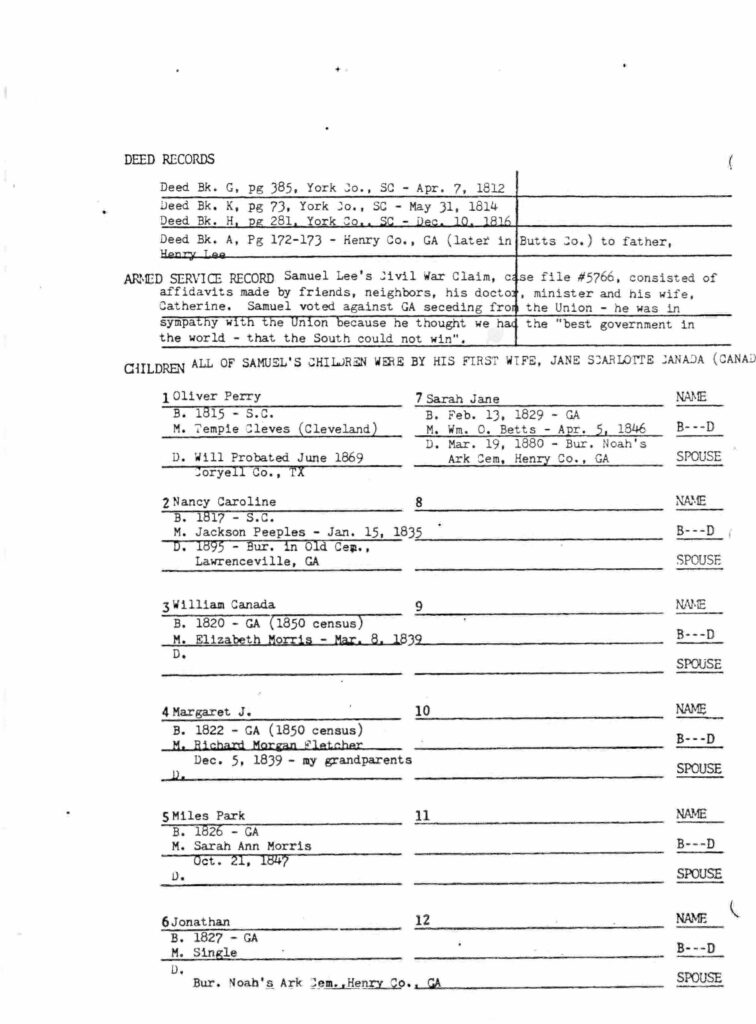
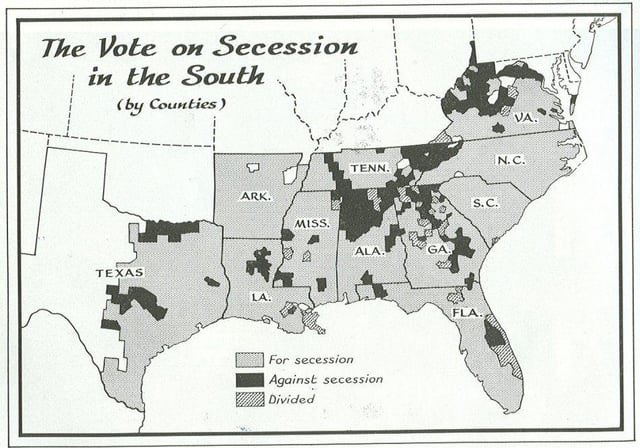
While Lee was not a delegate to the state’s Secession Convention, he was a member of a community that was deeply fractured over the decision to leave the Union. In the popular election of January 2, 1861, which selected delegates to decide the state’s fate, Henry County voters largely favored a cooperationist philosophy, which sought to avoid immediate, unilateral secession in favor of continued deliberation within the Union. This sentiment was so strong in the county that its delegation to Milledgeville was initially two-thirds opposed to immediate secession, comprised of Francis Epps Manson, E. B. Arnold, and James H. Low.
Samuel Lee’s public stance of openly preaching against secession to his neighbors aligned him with the regional dissent common among the “Plain Folk” of Middle Georgia. These residents often resisted the radical fervor of the coastal planter elite, viewing the revolutionary movement as a threat to the stability of their family households and local economies. Lee’s personal convictions reflected the broader Piedmont Dissent, where Unionism was not a “binary choice” but a sophisticated debate over the timing and legal nature of the American compact.
The political representation of Lee’s home county in the Georgia Secession Convention of 1861 ultimately validated his dissenting views:
- In the critical final vote on January 19, 1861, two of the three Henry County delegates—Francis E. Manson and E. B. Arnold—remained steadfast in their opposition, casting their votes against the Ordinance of Secession.
- They were part of a minority of 89 delegates who refused to endorse the immediate dissolution of the Union, representing a significant portion of the Georgia electorate whose “No” votes were courageous acts of dissent under extreme social and psychological pressure.
Samuel Lee’s grave at Noah’s Ark Methodist Church Cemetery in Henry County serves as a final testament to a man who, like his neighbors Manson and Arnold, prioritized regional stability and constitutional loyalty over the radical tide of Confederate revolution.
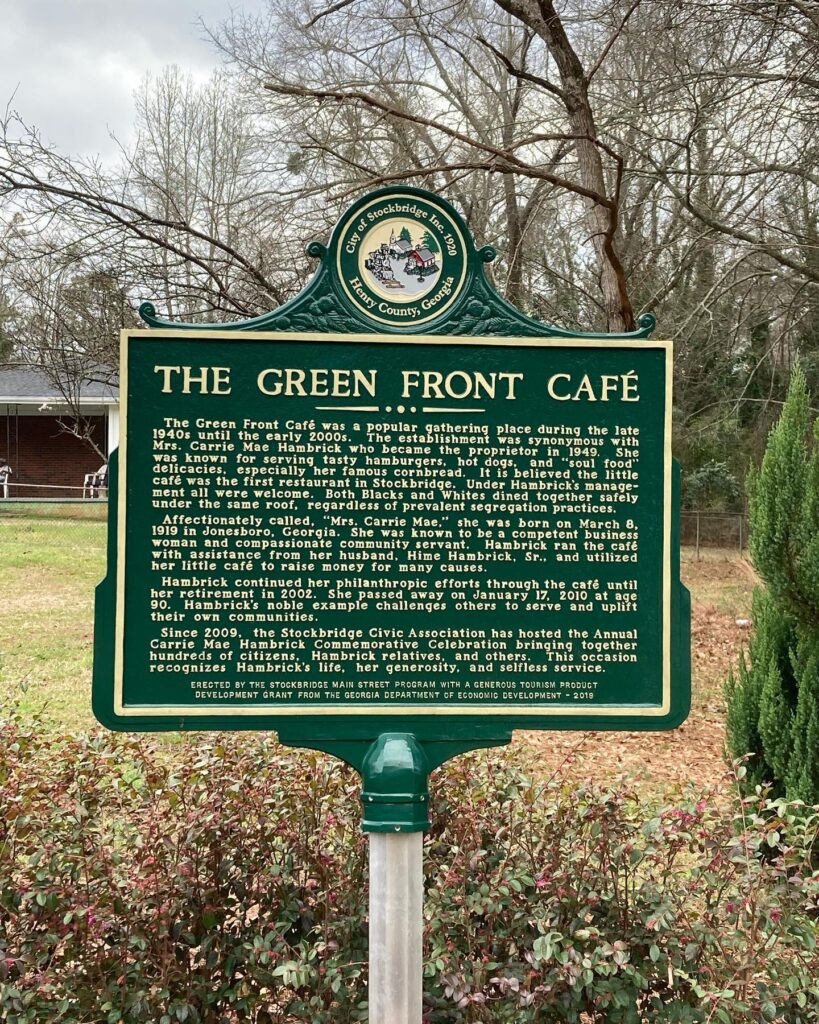
As to his son, Stockbridge Mayor Robert E. Lee 1927-1952. We’ve covered in previous stories (and now the city’s new report) how he electrified, gasified, irrigated and paved Stockbridge. Who the man was is evident in his family and the deep religious nature of this place. Mayor “Uncle Bob” Lee lived in unity next to Floyd Chapel Baptist Church. That’s the one the Honorable Mr. Thomas commemorated for Martin King Sr. in downtown. Not only that, but he enshrined on the Green Front Cafe memorial sign that during Carrie Mae’s ownership & operation. While under the Mayorship of Mayor RE Lee. People ate there together under the same roof.
Stockbridge as I was raised was a place of fellowship. That sentiment has seemed to wane in the recent years. It’s my fervent belief that to change the name of Lee St. will damage the legacy of what makes Georgia and Stockbridge a great place to be. By renaming the name of Lee St. to any other name we damage the legacy that made this grow to begin with.
- Footnotes:
- Georgia Secession Convention of 1861, https://www.georgiaencyclopedia.org/articles/government-politics/georgia-secession-convention-of-1861/
- The Civil War and Reconstruction in Georgia, Part 1 – Brambleman, https://brambleman.com/the-civil-war-and-reconstruction-in-georgia-part-1/
- Republic of Georgia. Ordinance of secession, passed Jan’ry 19, 1861. with the names – Loc, https://tile.loc.gov/storage-services/service/rbc/rbpe/rbpe01/rbpe014/01402600/01402600.pdf
- Journal of the Public and Secret Proceedings of the Convention of the People of Georgia, Held in Milledgeville and Savannah in 1861, Together with the Ordinances Adopted – DocSouth, https://docsouth.unc.edu/imls/georgia/georgia.html
- Our Good and Faithful Servant: James Moore Wayne and Georgia Unionism – SciSpace, https://scispace.com/pdf/our-good-and-faithful-servant-james-moore-wayne-and-georgia-4gi0nmxikq.pdf
- Secession – New Georgia Encyclopedia, https://www.georgiaencyclopedia.org/articles/history-archaeology/secession/Causes of the War – GPB GA Studies, https://georgiastudies.gpb.org/units/unit-5/chapter-13/section-1
- The 11th Day of January, 1861 – LOUIS, https://louis.uah.edu/cgi/viewcontent.cgi?article=1323&context=huntsville-historical-review
- Baptists and the American Civil War: January 19, 1861, https://civilwarbaptists.com/1861-january-19/
- South Western Baptist. – Samford University Library, https://library.samford.edu/digitallibrary/tab/1861/1861082901rc.pdf
- List of signers of the Georgia Ordinance of Secession – Wikipedia, https://en.wikipedia.org/wiki/List_of_signers_of_the_Georgia_Ordinance_of_Secession
- The Civil War: Here at Home | City of Ringgold, GA, https://www.cityofringgoldga.gov/our-past/civil-war-here-home
- Georgia’s Secession Convention, https://www.georgiahistory.com/ghmi_marker_updated/georgias-secession-convention/
- Georgia in the American Civil War – Wikipedia, https://en.wikipedia.org/wiki/Georgia_in_the_American_Civil_War
- Tennessee secession election returns from Henry County – Education Outreach, https://teva.contentdm.oclc.org/digital/collection/p15138coll18/id/2355/