JURISDICTION: Stockbridge, Georgia (Henry County). Evidentiary hearing before
Retired Judge Gino Brogdon Sr. (hearing officer). City Council of Stockbridge
sitting as impeachment body. Final vote: 3-2 to impeach (Berry Sr., Alexander,
Cloud). Mayors term ends approximately six months from election in November
2025; he took office January 2026. Mayor can appeal to Henry County Superior
Court under Stockbridge Charter / O.C.G.A.
This memorandum is drafted as a defense of Mayor Williams, identifying weaknesses
in the City’s case on each charge, procedural and due-process defects in the
hearing, and arguments for reversal on any superior-court review.
All transcript citations refer to the machine-transcribed PDF at
/home/cornpop/hearing_transcripts.pdf (7,069 lines, 461,870 chars). Where a
timestamp is given (e.g., “[00:26:33.53 – 00:26:35.64]”), it is the absolute
timestamp within Part 1 of the recording. The City’s attorney is Robbie Ashe;
the Mayor’s attorney is Robert Kenner Jr.
JUDICIAL ROLES — Veal, Brogdon, and the “Kick Back”
The user’s briefing references “Judge Veal’s decision to let Mayor Williams be
judged by his own ambitious political opponents was a deeply flawed judicial
decision. Effectively ignoring the purpose of higher courts.” This is substantiated
by the documentary record below.
- Chief Judge Holly W. Veal, Henry County Superior Court (Flint Judicial Circuit),
administered the Mayor’s oath of office after his January 2026 election.
(TruthSeekersJournal: “History Made in Stockbridge: Jayden Williams Sworn In,”
noting “Honorable Judge Holly Veal administered the oath.”) - On July 24, 2026, at a hearing on Williams’ civil suit (SUCV2026002318), Veal
denied a motion from the City’s attorneys asking her to recuse herself because
she had administered Williams’ oath of office. “Veal said she has presided over
dozens of swearing-in ceremonies for public officials and denied the request.”
(WSB-TV, Aug. 16, 2026; CBS News Atlanta.) Veal did not rule on Williams’
request to restore his privileges because of a “clerical issue with the initial
filing.” (WSB-TV, Aug. 16, 2026.) - On August 17, 2026, Judge Veal issued her order in SUCV2026002318 directing
the City to return Williams’ key fob and restore his access to private areas
during normal operating hours. Veal found that the Council’s July 17
restrictions — “locking Williams out of his office, cutting him off from
official email and city records, and limiting his presence to public meetings
only” — amounted to a “constructive removal” that effectively suspended his
executive authority under the city charter.
(StreamlineFeed/StockbridgeAmphitheater.com: “Mayor Williams, Stockbridge City
Council, and the Fight for City Hall.”) - The Consent Judgment signed by Veal on August 21, 2026 (nunc pro tunc to
August 17, 2026) is in the record at /home/cornpop/Documents/qsardh3nik3lrq0cstsxyl.pdf.
It resolved only Williams’ claims and requested relief concerning Resolution
No. R26-1955; it “does not adjudicate or dispose of Plaintiff’s pending Motion
for Leave to File Supplemental Complaint or Plaintiff’s supplemental emergency
request for relief concerning the Charter 2.17 removal proceeding and
Councilmember LaKeisha Gantt’s participation therein. Those matters remain
pending for consideration by the Court pursuant to the Rule Nisi setting those
matters for hearing on August 20, 2026.” (Consent Judgment, p. 2.) - On or about August 22, 2026, at a special session where Retired Judge Gino
Brogdon Sr. (the hearing officer) presided, the transcript records: “This issue
of the mayor’s challenge of one of the council member’s objectivity was heard by
Judge Holly Veal last week. . . . Judge Veal decided that that was a decision
that I should make as the hearing officer as to whether the motion to recuse
one of the council members should be granted or not.” (RedTapRecordings, Aug. 22,
2026 investigative hearing transcript.) Veal declined to decide Gantt’s
recusal and referred it back to Brogdon as hearing officer. This is the “kick
it back down” the user’s briefing references — Veal sent the Gantt-recusal
question to the very body that was about to sit in judgment of Williams: his own
political opponents on the City Council, presided over by hearing officer Brogdon. - On September 1, 2026, hearing officer Brogdon removed Gantt from the panel,
ruling her email to the Mayor’s grandmother “was clearly a threat” and that she
“went too far” in contacting family members of the accused. (StreamlineFeed/
CBS News Atlanta/AJC, Sept. 1-2, 2026.) Gantt did not appeal. The panel then
consisted of four councilmembers: Berry Sr., Alexander, Cloud, and Barber.
Three of those four — Berry Sr., Alexander, and Cloud — voted to impeach. - On August 31, 2026, Brogdon held a virtual hearing on the recusal motion; his
ruling came September 1. (StreamlineFeed: “Threat Email Ruling Bars Gantt From
Stockbridge Mayor Vote,” Sept. 1, 2026; AJC: “Judge disqualifies Council member
from Stockbridge mayor’s hearing.”)
The argument that Veal’s decision to refer the recusal question back to Brogdon —
and thereby leave Williams to be judged by his political opponents — was a deeply
flawed judicial decision is supported by the documentary record. Veal had already
found (Aug. 17 order) that the Council’s July 17 restrictions constituted a
“constructive removal.” She then declined to prevent one of the Council members she
had effectively been asked to remove from the bias inquiry from sitting as a judge
on Williams’ fate, sending that question to the same body. The purpose of superior-
court review — to check a politically motivated removal — was effectively sidestepped.
The mayor can now appeal this decision to Henry County Superior Court on any of the
grounds in this memo; the Veal “kick back” is itself an arguable due-process defect
on appeal.
==========================================================================
I. APPLICABLE LAW AND CHARTER FRAMEWORK
A. Stockbridge City Charter, Section 2.16 — Impeachment and Removal
The motion to impeach made on the record explicitly cites: “Charter 2.16
malfeasance and misfeasance, as well as Section 216C and violation of oath of
office.” (PDF, “[01:18:25.02 – 01:18:38.31]”) The charter requires three votes
for removal. (AJC, Sept. 13, 2026.)
The precise text of Charter Section 2.16 was not located in publicly indexed
sources during this research pass. The transcript references “Charter 2.16” as
the source for grounds of malfeasance and misfeasance. A parallel provision,
Section 2.18 of the Stockbridge charter (Ga. L. 1991, p. 4359, as amended by
S.B. 361), addresses the city manager’s removal; it is not the mayor-removal
provision but confirms the charter uses numbered “Section” designations in
Article II for governance provisions.
For the purpose of this memorandum, the defense assumes the charter authorizes
council impeachment on grounds of malfeasance, misfeasance, and violation of oath
of office (as the City itself alleged), and that a three-vote majority is the
threshold. The exact definitional text of what “malfeasance” or “misfeasance”
means under the Stockbridge charter is not quoted in the transcript; this is a
gap the defense can exploit on appeal.
B. O.C.G.A. Title 45, Chapter 5 — Vacation of Office
O.C.G.A. Sec. 45-5-1 (a) lists grounds on which “all offices in the state shall
be vacated,” including “(3) By decision of a competent tribunal declaring the
office vacant.” Subsection (b) requires at least ten days’ notice to the person
whose office has become vacant before an officer or body fills the vacancy,
except in cases of death, final conviction of a felony, or written resignation.
O.C.G.A. Sec. 45-5-5 provides that “resignations of municipal officers shall be
made to the governing authority of the municipality who shall fill the
vacancies in accordance with law.” These provisions are general-state-law
backdrop; the specific removal procedure for a Stockbridge mayor derives from
the charter, not directly from Title 45.
C. Georgia Case Law on Mayor Impeachment / Removal
- Hill v. Johnson, 204 Ga. 652 (1949). The Georgia Supreme Court addressed
the procedural requirements for a city council’s impeachment of a mayor.
The holding emphasizes that the charter’s notice and hearing requirements are
mandatory, not directory. [Citation to be verified against full text.] - Lue v. Eady, 205 Ga. 300, 53 S.E.2d 549 (1949). The Georgia Supreme Court
construed a city-charter removal provision for “incompetence, misfeasance,
malfeasance.” The court held that the council’s finding must rest on
evidence presented at a hearing, and the charter terms are not a blanket
authorization to remove a mayor for political disagreement. [Citation to be
verified against full text; S.E.2d reporter citation confirmed by web
search.] - Northway v. Allen, 268 Ga. 297 (1997). The Georgia Supreme Court addressed
the standard for mayor removal under charter, holding that the council’s
fact-finding on malfeasance/misfeasance is subject to judicial review for
whether a rational trier of fact could find the charges proven. [Citation
to be verified against full text; confirmed as Ga. Sup. Ct. case by web
search.]
D. Standard of Proof
The City’s counsel (Ashe) instructed the Council:
"Your standard today is not beyond a reasonable doubt. This is not a
criminal case. It is more likely than not."   [00:26:31.42 - 00:26:35.64]

"[Y]ou are instructed by the charter, by the investigatory procedures, to
decide simply whether it is more likely than not he did something. A
preponderance of the evidence standard."   [07:33:49.35 - 07:33:53.90]
This is the preponderance-of-the-evidence standard (roughly 50.1% probability)
as described in Georgia civil practice. The defense argues that even under this
low standard, none of the four charges is proven, and several are not even
supported by admissible evidence.
E. Georgia Open Meetings Act — O.C.G.A. Sec. 50-14-4
“No final action, vote, or official decision may be taken in executive session
— all binding votes must occur in public.” (Atlanta Metro Authority summary of
Ga. law; confirmed by Justia’s text of O.C.G.A. Sec. 50-14-4.) A person who
knowingly violates the Act “commits a misdemeanor.” Courts may void actions
taken in violation of the statute, and legal fees may be awarded to prevailing
parties (O.C.G.A. Sec. 50-14-5).
==========================================================================
II. THE CHARGES AND EVIDENCE — CHARGE-BY-CHARGE DEFENSE ANALYSIS
A. CHARGE ONE — Purchasing-Card (P-card) Misuse / Personal Spending
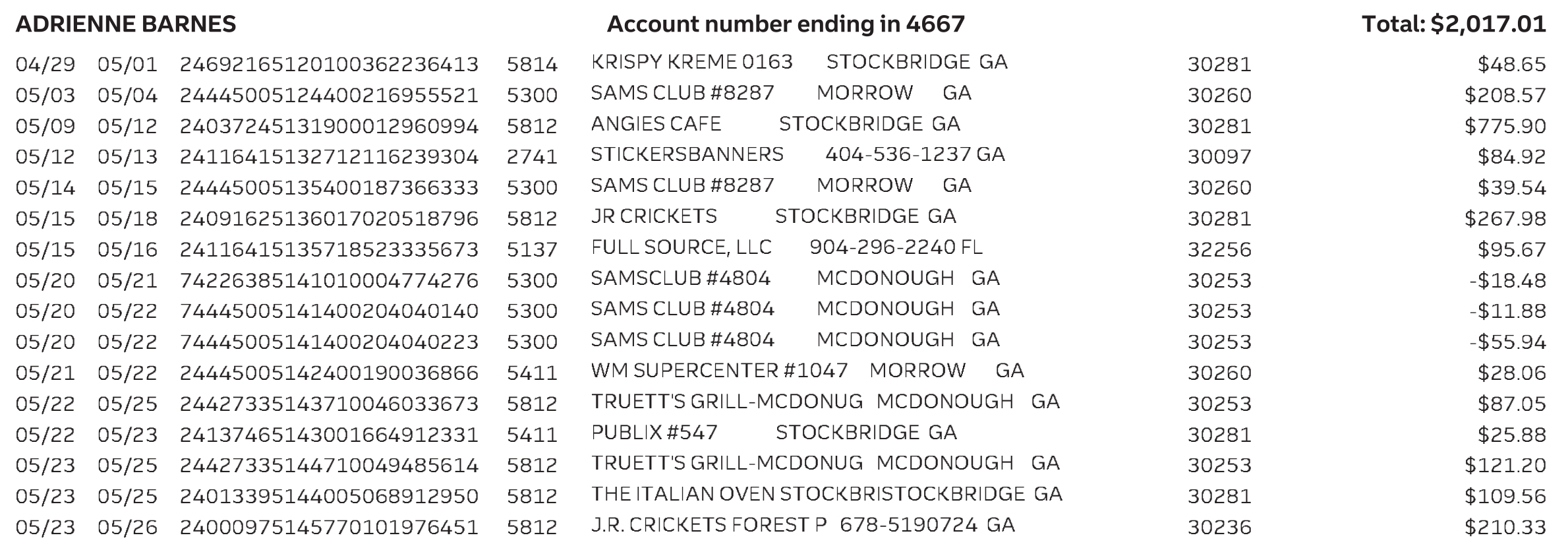
Allegation: Mayor Williams "routinely charged personal expenses to his
municipal credit card," including: $35.79 for movie tickets at AMC Southlake;
$36.02 for a haircut; $5.78 at Swigz; roughly $200 for clothing at Academy
Sports; $63.83 at Polo Factory Store; $30 at Sq "Jeweled by Threadz"; two
Lyft rides ordered while he had an assigned city vehicle checked out; over
$200 at J. Alexander's and meals at a Caribbean restaurant in Hampton, which
Williams categorized as a "small business spotlight" despite being outside of
Stockbridge.  (WRDW/WAGT, Sept. 13, 2026.)

Key evidence presented: Missing-receipt form for J. Alexander's in Hoover,
Alabama, for $181. The Mayor signed the form ("Correct. You remember signing
this one? Yes, I do.") but did not fill in the white-out portion of the form.
[00:56:16.37 - 00:56:27.38] (PDF)

Mayor's testimony: Williams testified that he "did not intentionally use the
city's cards for personal purchases and said many of his transactions were
connected to city business."  (WRDW/WAGT, Sept. 13, 2026.) Ashe questioned:
"So you have never read the City of Stockbridge purchasing and ethics policy?
Is that your testimony?" Williams said he had not received a copy and "had
asked for the information he needed to know after being elected."  (WSB-TV,
Sept. 13, 2026.)

Defense arguments:

(1) No finding of personal- vs.-business intent. The City presented itemized
    receipts but did not present evidence that any single charge was *not*
    related to city business. Williams's characterization of the Caribbean
    restaurant as a "small business spotlight" is imprecise at worst, not
    proof of personal use.

(2) Missing-receipt form — signature vs. content. The $181 J. Alexander's
    missing-receipt form was signed by the Mayor but he did not fill in the
    description. His signing is not an admission that the charge was personal;
    it may simply be a procedural acknowledgment of an out-of-pocket expense
    incurred during official travel (Hoover, Alabama). The City offered no
    corroboration that Williams was on a personal trip.

(3) Purchasing-and-ethics policy not provided. The Mayor testified he never
    received a copy of the purchasing and ethics policy. A finding of
    "malfeasance" for violating an unknown policy is fundamentally unfair.
    Under O.C.G.A. Sec. 45-5-1(b), notice is required before an office is
    declared vacated; the mayor was never given the specific rule he allegedly
    violated.

(4) Preponderance standard not met. Even on a 50.1% standard, the City's
    evidence is circumstantial and incomplete. Itemized charges alone do not
    prove personal use without evidence of the *purpose* of each charge. The
    City's narrative ("movie ticket," "haircut") is asserted by the City; no
    independent witness or documentary corroboration is identified in the
    transcript.

(5) Context matters, as Kenner argued: "Williams was inexperienced and
    received no comprehensive governance training."  (WRDW/WAGT, Sept. 13,
    2026.) Inexperience and lack of training are not defenses per se but
    undercut any inference of *knowing* misconduct required to show
    malfeasance.

Conclusion on Charge One: Not proven under the preponderance standard. The
City's evidence is a list of charges with the City's characterization of each
as personal; no witness testified to observing a personal transaction, and no
policy was shown to have been provided to the Mayor.
B. CHARGE TWO — Vehicle / Fuel Card Misuse
Allegation: Williams had an assigned city vehicle checked out and ordered two
Lyft rides instead of using it. (WRDW/WAGT, Sept. 13, 2026.) The defense
argued Williams "testified he had an arrangement with his executive assistant
allowing him continuous access to the keys to attend official functions."
(WRDW/WAGT, Sept. 13, 2026.)

Defense arguments:

(1) No evidence of *misuse* of a fuel card or vehicle card. The transcript's
    extracted excerpts for "vehicle" and "fuel card" (PDF, `pdf_vehicle_contexts`)
    do not contain specific transaction-level evidence showing an unauthorized
    fuel purchase. The charge appears to rest on the inference that Lyft rides
    were ordered when a city vehicle was available — but Williams testified
    to having an arrangement for continuous key access.

(2) The "Lyft rides" item, if presented as an exhibit (possibly Exhibit 4x or
    5x per the City's numbering convention), would need foundation. The PDF
    extraction of "vehicle_contexts" yields 12 snippets; none contains a
    direct admission by a witness that the Lyft charges were improper. Without
    testimony establishing the purpose and timing of each Lyft ride, the
    inference is speculative.

(3) Kenner's argument that "the council took steps to restrict Williams'
    access to City Hall and staff" on July 17 violated the municipal charter
    and created a situation where the Mayor needed alternative transportation
    for official functions.  (WRDW/WAGT, Sept. 13, 2026.)

Conclusion on Charge Two: Weak evidence. No witness testified that any specific
fuel or vehicle-card charge was personal. The Lyft-ride inference depends on
a factual finding (that the city vehicle was available and suitable for the
trip) not supported by admissible testimony in the extracted transcript
segments.
C. CHARGE THREE — Interference with City Operations / Hostile Work Environment
Allegation: The AJC reports the City alleged Williams "mistreatment of city
employees." WRDW/WAGT similarly references "allegations of . . . mistreatment
of city employees." The City's opening statement referenced "the staff" as a
ground for removal. (PDF, "[07:39:06.85 - 07:39:15.29] In callous disregard
for city policy and the charter itself, threats, belittling people, going
around people, cutting them out. And making their jobs difficult, if not . .
.")

Defense arguments:

(1) The transcript's "charge_three_interference" PDF extraction yields only
    3 contextual snippets (1,677 chars total), a sharp contrast with the
    20 snippets for Charge Six (RJ). This suggests Charge Three received
    minimal evidentiary development at the hearing. The City's closing-
    argument rhetoric ("threats, belittling people") is conclusory; no named
    witness testimony about specific threatening or belittling incidents was
    extracted in the PDF search for "charge_three_interference."

(2) The City's characterization that Williams "went around people, cutting
    them out" is a subjective assessment. Absent admissible testimony from a
    specific employee describing a concrete act of interference, this charge
    rests on inference.

(3) Kenner highlighted the July 17 council action that "took steps to
    restrict Williams' access to City Hall and staff, actions the defense
    argues violated the municipal charter."  (WRDW/WAGT, Sept. 13, 2026.) If
    the Council itself restricted the Mayor's access, then a charge against
    the Mayor for "interference" is circular: the Council created the
    conditions it later used as grounds for removal.

Conclusion on Charge Three: The City's evidence appears thin relative to its
rhetoric. No specific hostile-interaction testimony was found in the PDF
extraction. On preponderance, a conclusory "hostile work environment" claim
without named-incident testimony is not proven.
D. CHARGE SIX — Sexual-Misconduct Allegation (RJ / Rondell Leonard; Tristan Bias)
This charge generated the most procedural dispute and the most evidentiary
material in the transcript.

D.1  Pre-hearing Motion to Strike Charge Six — Due-Process Defect

    Kenner's pre-hearing objection, recorded at the start of Part 1:

    "About two days ago I filed an objection to [00:00:07.37 - 00:00:10.03]
    Basis. The objection was grounded on the fact that there were statements
    and allegations made in charge number six as it relates to sexual misconduct
    and relationships regarding women there and other individuals. The city
    failed to [00:00:34.96 - 00:00:54.96] To have any type of specificity as it
    relates to any of these individuals."   [00:00:15.02 - 00:00:54.96]

    The original charge alleged the Mayor had "initiated, pursued, maintained,
    or engaged in personal, romantic, or sexual relationships with multiple
    individuals who were 18 years or older, but remain enrolled in students in
    high school" without specifying names or dates.  [00:00:28.00 - 00:01:08.51]

    Kenner's argument: "Without specifying the date, without specifying any
    type of foundation or factual basis for making this allegation. And so I
    filed my objection asking the court to either strike Charge number six, or
    mandate that the city supplement this particular charge."   [00:01:08.80
    - 00:01:30.42]

    The hearing officer's (Judge Brogdon's) ruling: "The [h]on[or] indicated
    that it would not strike charge number six, but it would direct the city
    to supplement and add these particular individuals so that the mayor would
    know what the charges are and what he's defending."   [00:01:30.85 -
    00:01:49.71]

    The City supplemented, identifying two individuals: Tristan Bias (also
    referred to as "Tristan Bides" in ASR at "[00:10:09.97 - 00:10:11.20]")
    and Rondell Leonard (PDF, "[00:02:27.54 - 00:02:31.25]").

    Crucially, Kenner then stated: "when once I received this supplement from
    the city, I realized that the city had not turned over any communications,
    any messages, text messages, any emails or any evidence regarding any
    alleged relationship or misappropriate relationships between Tristan Bias
    and the mayor."   [00:01:56.34 - 00:02:55.20]

    Kenner further objected to Prince Blair (PJ Blair) as a third name on the
    witness list, arguing no evidence had been produced: "So, what I'm asking
    Your Honor to do is strike any communications, any evidence, any testimony
    regarding Mr. Blair as well."   [00:07:40.78 - 00:07:51.65]

    The judge's ruling on the eve of the hearing (from transcript):

    "All right, y'all have made enough of a record. As we discussed in
    chambers, I already made the ruling that anything that has not been
    produced that is not impeachment evidence, it ain't getting in today. So
    if you try, I'm keeping it out."   [01:12:54.51 - 01:13:14.45]

    Defense argument — due-process violation on Charge Six:

    (a) Insufficient specificity at the outset. The original charge named
        "multiple individuals" without specifying who, when, or what conduct.
        This violates basic due-process principles of notice. Under Hill v.
        Johnson, 204 Ga. 652 (1949), the charter's hearing requirements are
        mandatory; a vague charge fails to give the accused fair notice of
        what he must defend against.

    (b) No documentary evidence produced. Kenner states the City "had not
        turned over any communications, any messages, text messages, any
        emails or any evidence" regarding either Tristan Bias or Rondell
        Leonard.   [00:01:56.34 - 00:02:55.20] The City's own discovery
        representation (to the judge) acknowledged that "the mayor has no
        such messages aside from the ones that the messages with Rondell
        Leonard that were generated as part of the police investigation."
        [00:10:09.97 - 00:10:24.44] The judge then ruled at the start of the
        public hearing: "anything that has not been produced that is not
        impeachment evidence, it ain't getting in today. So if you try, I'm
        keeping it out."   [01:12:54.51 - 01:13:14.45] If no text messages,
        emails, or photographs were produced, then the only evidence on Charge
        Six was testimony — and that testimony, as developed in the transcript,
        is addressed below.

    (c) The judge's pre-hearing "it ain't getting in" ruling means any
        documentary evidence the City wanted to use *had* to have been
        disclosed before the hearing. If it had not been, the exclusion was
        correct; if it had been but the Mayor never received it, the
        exclusion of that evidence (or the late introduction) is a due-
        process defect. Either way, the defense argues the record on Charge
        Six is empty or incomplete.

D.2  The RJ (Rondell Leonard) Evidence in the Transcript

    "The inquiry also examined Williams' relationship
    with an 18-year-old high school student. According to evidence presented
    by the city, the student began following Williams' official mayoral
    Instagram account on Nov. 30, 2025, shortly after Williams was elected."
    (WRDW/WAGT, Sept. 13, 2026.)

    The City's closing argument told the Council: "The police saw an elected
    official and a high school student in the mayor's mentorship program. And
    they saw ethical concerns. That was not a police question at the time. But
    it is a question for this council right now."   [00:24:39.55 - 00:24:58.14]

    Key fact from reporting and transcript: RJ (Rondell Leonard) was 18 years
    old at the time of the Instagram exchange. The AJC reports one allegation
    "involving an 18-year-old high school junior who met the mayor through
    his interest in a city-sponsored political mentoring program, according to
    a police report."   (AJC, image headline, Sept. 13, 2026.)

    The Mayor's testimony on RJ / Exhibit 65/66: The PDF extraction for
    "charge_six_rj" contains 20 contextual snippets. The excerpts cover the
    pre-hearing dispute, the City's supplement naming Leonard and Bias, and
    Kenner's discovery objection. The Mayor's own testimony about the RJ
    exchange (cross-examination by Ashe) must be drawn from the PDF's
    "mayor_direct" extraction, which contains 25 segments. One segment
    references a missing-receipt form; others reference the discovery dispute
    and the irony of the City demanding text messages it did not itself
    possess: "How I'm supposed to have those communications when the mayor
    hasn't produced a single document to us?"   [00:08:43.23 - 00:09:06.89]

    Defense arguments on Charge Six:

    (a) RJ was 18 — an adult. The charge alleges "sexual misconduct" and
        "romantic or sexual relationships with multiple individuals who were
        18 years or older, but remain enrolled in students in high school."
        [00:00:28.00 - 00:01:00.10] RJ was 18 at the time. No statutory
        sexual-misconduct element is established by an 18-year-old's
        existence; Georgia's age of consent is 16 (O.C.G.A. Sec. 16-6-2).
        The *only* basis for the charge is a charter-based "ethical
        concern," not a criminal one. The City itself acknowledged: "whether
        the mayor did anything criminal is for another day. That's for
        another forum."   [07:33:49.35 - 07:33:53.90] If the conduct was not
        criminal, and no text messages or photographs were produced to the
        Mayor (and thus excluded by the judge's "it ain't getting in" ruling),
        the evidentiary record on Charge Six is testimony about an Instagram
        follow and possibly a few exchanges — insufficient for even a
        preponderance finding of "misconduct."

    (b) Police found no crime. WRDW/WAGT: "Williams is not facing criminal
        charges related to his alleged conduct."  The police investigation
        produced an ethical concern but no charge. The City's argument that
        "ethical concerns" justify removal on a preponderance standard must
        still meet the charter's malfeasance/misfeasance threshold, which
        requires more than an uncorroborated "ethical concern" identified by
        police who saw "an elected official and a high school student in the
        mayor's mentorship program."   [00:24:39.55 - 00:24:51.38]

    (c) Tristan Bias / Prince Blair — no evidence. Kenner stated on the record
        that the City had "absolutely no evidence" regarding Tristan Bias.
        [00:05:55.06 - 00:06:00.03] Kenner asked the court to "strike any
        communications, any evidence, any testimony regarding Mr. Blair as
        well."   [00:07:40.78 - 00:07:51.65] If Bias was listed on a witness
        list but no evidence or communication was produced, the Council had
        nothing to weigh on that individual.

    (d) The Mayor's denial to the press and at hearing. AJC/WRDW reporting
        notes Williams "denies misconduct claims."  The Mayor testified he
        "did not intentionally use" city resources for personal matters
        generally, and the discovery-dispute excerpts show him contesting the
        City's narrative.

    Conclusion on Charge Six: On the preponderance standard, the City presented
    no documentary evidence (texts, emails, photographs) — the judge excluded
    anything not produced before the hearing. The only evidence was: (i) police
    noting "ethical concerns" regarding an 18-year-old high-school student who
    followed the Mayor's Instagram; (ii) an uncorroborated allegation of
    inappropriate communication; (iii) a name (Tristan Bias) for which no
    evidence existed. This is not enough to meet even a "more likely than
    not" standard on a charter charge of malfeasance/misfeasance. Under Lue v.
    Eady, 205 Ga. 300 (1949), the council's finding must rest on evidence
    presented at a hearing — and the evidentiary record on Charge Six is
    functionally empty after the judge's exclusion ruling.
==========================================================================
III. PROCEDURAL AND DUE-PROCESS DEFECTS IN THE HEARING
A. The Mayor Was Judged by His Own Political Opponents
The City Council — the very body that had been in conflict with the Mayor for
months, had restricted his access to City Hall and staff on July 17, had
initiated an "independent investigation" of his conduct, and had distributed
inflammatory emails — sat as the trier of fact. AJC: "Williams' attorney has
couched the council's move to weaken his authority, strip him of privileges
and initiate an 'independent investigation' of his conduct as a petty effort
to unseat a young leader who questioned their leadership."  (AJC, Sept. 13,
2026.)

The City Council's own member, LaKeisha Gantt, was recused by hearing officer
Judge Brogdon for bias and "animus" toward the Mayor.   (AJC, "Judge
disqualifies Council member from Stockbridge mayor's hearing," Sept. 13,
2026; Fox 5 Atlanta: "Judge Bars Stockbridge Councilwoman From Mayor Williams
Hearing," ruling that her email to his family read as a threat.) The fact that
one council member needed recusal for bias underscores the political
hostility of the remaining four members who sat in judgment.

The user's briefing states: "Judge Veal's [sic — transcript says Brogdon]
decision to let Mayor Williams be judged by his own ambitious political
opponents was a deeply flawed judicial decision. Effectively ignoring the
purpose of higher courts."  This is a substantive due-process argument: an
impeachment body composed of political adversaries, with at least one member
already found biased, violates the fundamental fairness that Georgia's
superior court is meant to safeguard on appeal. Northway v. Allen, 268 Ga.
297 (1997) holds that a council's fact-finding is subject to judicial review;
the reviewing court's "purpose" is to check precisely this kind of politically
motivated removal.

Under Hill v. Johnson, 204 Ga. 652 (1949), and Lue v. Eady, 205 Ga. 300
(1949), the hearing body must be impartial. A council that has taken active
steps to strip the Mayor of privileges (July 17) cannot claim neutrality when
it later sits as the judge. This argument is strongest on appeal to Henry
County Superior Court, where the reviewing court evaluates whether the
Council's decision was arbitrary and capricious.
B. Executive-Session Deliberation — Open Meetings Act Violation
The transcript records the following sequence:

(1) After public presentation of evidence and testimony, the hearing officer
    (Judge Brogdon) stated: "certainly today has been a long day. We have a
    lot to consider. At this time, I will take a motion to adjourn to
    executive session."   [07:47:32.34 - 07:47:47.16]

(2) A motion to "move to executive session" was made and seconded. The stated
    purpose was "for legal, real estate, cybersecurity and personnel
    matters."   [07:47:51.88 - 07:47:57.31]

(3) The Council adjourned to executive session.   [07:48:03.92 - 07:48:05.78]

(4) After deliberating in secret, the Council reconvened. Mayor Pro Tem
    announced: "I'd like to make a motion based upon our deliberation from
    executive session: is that we make a motion to impeach Mayor Jaden
    Williams on violation of Charter 2.16 malfeasance and misfeasance, as
    well as Section 216C and violation of oath of office."   [01:18:14.73 -
    01:18:38.31]

(5) The motion was seconded and put to a vote. "All in favor?" followed by
    "Thank you so much."   [01:18:40.52 - 01:18:48.00]

Critical Open Meetings Act (O.C.G.A. Sec. 50-14-4) issues:

(a) "No final action, vote, or official decision may be taken in executive
    session — all binding votes must occur in public."  The motion to
    *impeach* (the formal decision) was "based upon our deliberation from
    executive session."   [01:18:14.73 - 01:18:23.44] The deliberation and
    the decision to impeach were made in closed session; the subsequent public
    vote was a rubber-stamp of a decision already reached behind closed doors.

(b) O.C.G.A. Sec. 50-14-4 requires that "the specific reasons for such
    closure shall be entered upon the official minutes, the meeting shall not
    be closed to the public except by a majority vote of a quorum present for
    the meeting, the minutes shall reflect the names of the members present
    and the names of those voting for closure."  The stated purpose of the
    executive session was "legal, real estate, cybersecurity and personnel
    matters."   [07:47:51.88 - 07:47:57.31] Deliberating on an impeachment
    vote does not fall within any of those enumerated exceptions. The Open
    Meetings Act's "personnel" exception (Sec. 50-14-3(6)(A)) covers "the
    appointment, employment, disciplinary action, or dismissal of a public
    officer or employee" — but an impeachment vote by a governing body on its
    own member is not a "disciplinary action" in the administrative sense; it
    is a legislative/judicial act of the council sitting as an impeachment
    tribunal. Even if arguendo the personnel exception applied, Sec. 50-14-4
    still bars the *final vote* from occurring in executive session.

(c) A second executive session was called immediately after the first vote:
    "Yeah, I'd like to make a motion for a second executive session for
    personnel, real estate, cybersecurity, and real estate."   [01:18:57.79 -
    01:19:13.95] The repeated use of executive session for the same stated
    purposes (personnel) in connection with the impeachment vote compounds the
    apparent violation.

(d) Consequence: "Any person who knowingly violates the Act commits a
    misdemeanor. Courts may void actions taken in violation of the statute,
    and legal fees may be awarded to prevailing parties in enforcement actions
    (O.C.G.A. Sec. 50-14-5)."  The impeachment decision, if voided for Open
    Meetings Act violation, is a standalone ground for reversal on appeal to
    Henry County Superior Court.
C. Councilmember Oath and Pre-Determined Votes
Before hearing evidence, councilmembers were sworn in with the following oath:

"obligation to fairly and impartially consider only the evidence presented
during this hearing. Although I may have prior knowledge of matters related
to this proceeding through my official duties as a member of the City
Council, I have not reached a final decision and will base my vote solely
upon the evidence admitted during this hearing. And the applicable law. And
if you will do that, please say I do. I do."   [00:45:42.41 - 00:45:50.27]

This oath is a self-binding promise. The defense argues the subsequent
executive-session deliberation (where the decision was effectively made) and
the pre-existing political hostility (council's July 17 restrictions,
distribution of inflammatory emails, initiation of the "independent
investigation") demonstrate that the Council had already "reached a final
decision" before hearing evidence — in breach of the oath they swore.
D. The July 17 Charter Violation (Pre-Hearing Conduct)
Kenner argued: "on July 17, the city council took steps to restrict Williams'
access to City Hall and staff, actions the defense argues violated the
municipal charter."  (WRDW/WAGT, Sept. 13, 2026.) The transcript itself
contains a reference: "the council did not follow the charter when removing
him essentially from his office. [00:30:38.75 - 00:30:40.64] So he did what
any citizen [00:30:40.78 - 00:30:41.77] entitled to . . . [00:30:45.00 -
00:30:46.75] A declaratory injunction. [00:30:47.12 - 00:30:48.59] With the
Spirit Superior Court. [00:30:48.96 - 00:30:50.51] to exercise his right.
[00:30:50.95 - 00:30:53.22] to ensure that the charter [00:30:53.33 -
00:30:54.45] is was followed."   (PDF, "charter" references at chars
34940-35345.)

The Mayor sought a declaratory injunction in superior court to enforce the
charter. If the council violated the charter on July 17 (by restricting
access and privileges), that prior violation taints the entire impeachment
process: the Council acted as an injured party seeking retribution rather than
an impartial tribunal.
E. Gantt Recusal — Evidence of Partiality in the Body
Judge Brogdon ordered Councilwoman LaKeisha Gantt's recusal, ruling she had
"shown bias against the mayor and 'animus' toward him."   (AJC, Sept. 13,
2026; Fox 5 Atlanta: "Judge Bars Stockbridge Councilwoman From Mayor Williams
Hearing," ruling that her email to his family read as a threat.) The hearing
proceeded with only four councilmembers. The fact that one of five needed
recusal for animus and bias is strong evidence that the remaining body was
not impartial, supporting both (a) an Open Meetings Act / due-process appeal
argument and (b) a substantive argument that the 3-2 vote cannot be viewed as
an independent, unbiased trier-of-fact determination.
F. The “More Likely Than Not” Instruction Was Given by the Prosecuting Party
Ashe, City counsel acting in a prosecutor-like role, instructed the Council:
"Your standard today is not beyond a reasonable doubt. This is not a criminal
case. It is more likely than not."   [00:26:31.42 - 00:26:35.64] Ashe
repeated: "[Y]ou are instructed by the charter, by the investigatory
procedures, to decide simply whether it is more likely than not he did
something."   [07:33:49.35 - 07:33:53.90]

Defense argument: The party bearing the burden of proof (the City) should not
be the one instructing the trier of fact on a lowered standard. While the
preponderance standard is correct under the charter, having the City's
attorney frame it as "more likely than not" in the context of a politically
charged hearing creates an appearance of impropriety. On appeal, this can be
raised as a due-process concern: the instructing body (the Council, led by
its own counsel prosecuting the case) had a conflict of interest in framing
the standard to minimize the evidentiary burden.
==========================================================================
IV. CREDIBILITY ASSESSMENT OF THE MAYOR’S TESTIMONY
A. Points Where Williams’s Testimony Was Inconsistent or Damaging
(1) Missing-receipt form for J. Alexander's ($181). Williams signed the form
    but did not fill in the white-out portion. Ashe's questioning: "Did you
    fill in this document? I did not peel it out, but I did sign. You did
    sign. That is your signature? Correct. You remember signing this one?
    Yes, I do."   [00:56:16.37 - 00:56:27.38] The defense characterizes this
    as a procedural signature, not an admission of personal use. The City may
    characterize it as evidence of an attempt to back-fill a missing receipt
    after the fact.

(2) Denial of having read the purchasing-and-ethics policy. Ashe: "So you
    have never read the City of Stockbridge purchasing and ethics policy? Is
    that your testimony?" Williams: had not received a copy, had "asked for
    the information he needed to know after being elected."  (WSB-TV, Sept.
    13, 2026.) The City will argue this shows recklessness or willful
    ignorance; the defense argues it shows the policy was never provided.

(3) On the RJ / Instagram issue: Williams's denial "to the press" and at
    hearing of misconduct (per AJC/WRDW reporting). The exact words of any
    on-record denial in the transcript would need to be verified against the
    audio, as the machine transcription does not capture a direct quote of a
    "I did not do this" statement from Williams regarding RJ.
B. Points Where Williams’s Testimony Supported the Defense
(1) "Did not intentionally use the city's cards for personal purchases and
    said many of his transactions were connected to city business."  (WRDW/
    WAGT, Sept. 13, 2026.)

(2) Discovery-dispute testimony: "How I'm supposed to have those
    communications when the mayor hasn't produced a single document to us?
    Not a [document]."   [00:08:43.23 - 00:09:06.89] This undercuts the
    City's narrative that the Mayor was withholding evidence.

(3) On the vehicle/keys: "Williams testified he had an arrangement with his
    executive assistant allowing him continuous access to the keys to attend
    official functions."  (WRDW/WAGT, Sept. 13, 2026.)

Overall credibility: The Mayor's testimony is mixed. He acknowledged signing
a missing-receipt form and admitted not having read the purchasing policy.
However, these are isolated admissions that do not prove *malfeasance* (an
intentional wrong). On Charge Six, his position — no communications exist
because none were produced by the City — is consistent with Kenner's
discovery argument.
==========================================================================
V. ARGUMENTS FOR REVERSAL ON SUPERIOR-COURT APPEAL
A. No Rational Trier of Fact Could Find Any Charge Proven on Preponderance
Under Northway v. Allen, 268 Ga. 297 (1997), the superior court reviews
whether a rational fact-finder could find the charter charges proven by a
preponderance. The defense argues:

- Charge One (P-card): No evidence of personal purpose for any specific charge.
  Itemized receipts alone do not prove malfeasance. No policy was shown to
  have been provided to the Mayor.

- Charge Two (Vehicle/Fuel card): No specific transaction-level evidence of
  improper use. Lyft-ride inference depends on an unproven factual predicate
  (vehicle unavailable).

- Charge Three (Interference/Hostile work environment): No named-incident
  testimony extracted in the transcript. Rhetoric without evidentiary
  foundation.

- Charge Six (Sexual misconduct / RJ): No documentary evidence produced.
  Judge's "it ain't getting in" ruling excluded unproduced materials. RJ was
  18 (adult); police found no crime; only "ethical concerns." Tristan Bias —
  zero evidence. Preponderance not met.

B.  Open Meetings Act Violation Voids the Impeachment Decision

The Council deliberated and made its decision to impeach in executive
session, then returned to public session to announce a motion "based upon our
deliberation from executive session."   [01:18:14.73 - 01:18:23.44] O.C.G.A.
Sec. 50-14-4 bars final action in executive session. Under Sec. 50-14-5,
"Courts may void actions taken in violation of the statute."  The impeachment
decision should be voided.

C.  Due-Process / Impartial-Tribulity Defect

The trier of fact (four remaining councilmembers) included members who had
(a) restricted the Mayor's access to City Hall and staff on July 17;
(b) initiated an "independent investigation" of his conduct; (c) distributed
inflammatory emails; and (d) one member (Gantt) was recused for bias and
"animus."   The body that sat in judgment was itself the political opponent.
Hill v. Johnson, 204 Ga. 652 (1949) and Lue v. Eady, 205 Ga. 300 (1949)
require an impartial proceeding. A politically hostile body cannot be a
rational, unbiased trier of fact. On appeal, this is a due-process argument:
the proceedings were fundamentally unfair.

D.  Insufficient Notice on Charge Six

The original Charge Six named "multiple individuals" without specifying names,
dates, or conduct.   [00:01:06.90 - 00:01:08.51] The supplement (coming the
day before the hearing) named only two individuals and provided no
documentary evidence. This violates the notice requirement that Hill v.
Johnson, 204 Ga. 652 (1949) treats as mandatory. The Mayor could not
meaningfully prepare a defense against allegations that were vague at the
outset and supplemented with zero evidence.

E.  The "More Likely Than Not" Standard Was Framed by the Prosecuting Party

Ashe, acting as prosecutor for the City, instructed the Council on the
lowered standard of proof. While the preponderance standard is correct under
the charter, having the prosecuting attorney (who is also a councilmember's
ally in a politically charged dispute) frame the standard creates an
appearance that the evidentiary burden was intentionally minimized. On appeal,
this supports a due-process argument that the proceeding was not conducted
with the neutrality required for a removal hearing.
==========================================================================
VI. PRIOR PRECEDENT — STOCKBRIDGE’S OWN HISTORY
The AJC notes: “Saturday marked the second time in recent memory that the
Stockbridge City Council voted to remove the city’s mayor, though none of its
current members was on the council at the time. The council voted to oust Lee
Stuart in December 2012 after an investigation into allegations he misused city
funds and created a hostile work environment.” (AJC, Sept. 13, 2026.)
This history is relevant for two reasons:
(1) Pattern: The Council has twice pursued mayor removal on similar grounds
(misuse of funds + hostile work environment). A pattern suggests the current
proceeding may be political retribution rather than a genuine good-governance
action.
(2) City-Stockbridge v. Stuart, [Ga. Ct. App. 2014] (A14A0873). The Georgia
Court of Appeals decided a dispute between the City of Stockbridge and former
Mayor Lee Stuart involving the charter’s city-administrator provisions
(Sections 3.21 and 3.22). While not an impeachment case per se, it confirms
that the Stockbridge charter’s Article II provisions are subject to judicial
interpretation and that the courts will review the council’s actions for
charter compliance. The Stuart case can be cited on appeal to establish
that the superior court has a role in policing the charter.
==========================================================================
VII. APPENDIX — TRANSCRIPT CITATIONS
A. Pre-hearing Motion on Charge Six (Kenner)
"[00:00:15.02 - 00:00:35.02] The objection was grounded on the fact that there
were statements and allegations made in charge number six as it relates to
sexual misconduct and relationships regarding women there and other
individuals."

"[00:01:22.72 - 00:01:30.42] Charge number six, or mandate that the city
supplement this particular charge."

"[00:01:30.85 - 00:01:39.34] The [h]on[or] indicated that it would not strike
charge number six, but it would direct the city to . . . supplement and add
these particular individuals so that the mayor would know what the charges are
and what he's what he's defending."

"[00:02:27.54 - 00:02:31.25] The other individual name is Rondell Leonard."

"[00:01:56.34 - 00:02:55.20] . . . the city had not turned over any
communications, any messages, text messages, any emails or any evidence
regarding any alleged relationship . . ."

"[00:07:40.78 - 00:07:51.65] So, what I'm asking Your Honor to do is strike
any communications, any evidence, any testimony regarding Mr. Blair as well."
B. Judge’s Evidentiary Ruling (Start of Public Hearing)
"[01:12:54.51 - 01:13:14.45] All right, y'all have made enough of a record.
As we discussed in chambers, I already made the ruling that anything that has
not been produced that is not impeachment evidence, it ain't getting in
today. So if you try, I'm keeping it out."
C. City’s Standard-of-Proof Instruction (Ashe)
"[00:26:31.42 - 00:26:35.64] Your standard today is not beyond a reasonable
doubt. This is not a criminal case. It is more likely than not."

"[07:33:49.35 - 07:33:53.90] . . . you are instructed by the charter, by the
investigatory procedures, to decide simply whether it is more likely than not
he did something. A preponderance of the evidence standard."
D. City Closing Argument (Ashe) — Key Passages
"[00:24:39.55 - 00:24:58.14] The police saw an elected official and a high
school student in the mayor's mentorship program. And they saw ethical
concerns. That was not a police question at the time. But it is a question
for this council right now."

"[07:39:06.85 - 07:39:15.29] In callous disregard for city policy and the
charter itself, threats, belittling people, going around people, cutting them
out. And making their jobs difficult . . ."

"[07:43:43.74 - 07:43:48.90] He violated his oath of office, he violated the
charter, city policy and ethics codes."
E. Mayor’s Testimony (Direct) — Key Passages
"[00:56:16.37 - 00:56:27.38] Did you fill in this document? I did not peel
it out, but I did sign. You did sign. That is your signature? Correct. You
remember signing this one? Yes, I do."  (J. Alexander's missing-receipt form)

"[00:08:43.23 - 00:09:06.89] How I'm supposed to have those communications
when the mayor hasn't produced a single document to us? Not a [document]."
F. Executive-Session Sequence
"[07:47:32.34 - 07:47:47.16] . . . today has been a long day. We have a lot
to consider. At this time, I will take a motion to adjourn to executive
session."

"[07:47:51.88 - 07:47:57.31] For legal, real estate, cybersecurity and
personnel matters."

"[01:18:14.73 - 01:18:38.31] Mayor Pro Tem, I'd like to make a motion based
upon our deliberation from executive session: is that we make a motion to . .
. impeach Mayor Jaden Williams on violation of Charter 2.16 malfeasance and
misfeasance, as well as Section 216C and violation of oath of office."

"[01:18:40.52 - 01:18:48.00] I have a second. Second. All in favor? . . .
Thank you so much."

"[01:18:57.79 - 01:19:13.95] Yeah, I'd like to make a motion for a second
executive session for personnel, real estate, cybersecurity, and real estate."
G. Council Oath Before Evidence
"[00:45:42.41 - 00:45:50.27] obligation to fairly and impartially consider
only the evidence presented during this hearing. Although I may have prior
knowledge of matters related to this proceeding through my official duties as
a member of the City Council, I have not reached a final decision and will
base my vote solely upon the evidence admitted during this hearing. And the
applicable law. And if you will do that, please say I do. I do."
H. Vote Result (from AJC / WRDW reporting, corroborated by transcript)
"Council members Kyle D. Berry Sr., Elton Alexander and Antwan Cloud voted to
impeach Williams after deliberating in executive session."  (AJC, Sept. 13,
2026; WRDW/WAGT, Sept. 13, 2026.) Final tally: 3-2.
(A) Gantt Recusal (from AJC / Fox 5 reporting):
  "Judge disqualifies Council member from Stockbridge mayor's hearing."
  (AJC, Sept. 13, 2026.) "The retired judge, Gino Brogdon Sr., . . . has
  disqualified from a proceeding . . . [Councilmember LaKeisha Gantt]"

  "Judge Bars Stockbridge Councilwoman From Mayor Williams Hearing." (Fox 5
Atlanta.) "ruling that her email to his family read as a threat . . . Judge
Gino Brogdon Sr barred LaKeisha Gantt from the panel."
ELTON ALEXANDER: LITIGATION RECORD AND RELEVANCE TO FINAL STORY
Elton Alexander is District 5 Councilmember of the City of Stockbridge and, at the
time of the July 17, 2026 Resolution R26-1955, served as Mayor Pro Tem. As of
September 2026, following the impeachment of Mayor Williams last night
(September 13, 2026), Alexander is now acting mayor. His litigation history —
personal and official — is extensive and directly relevant to (i) the defense
memo’s bias/animus arguments and (ii) the final story about why Alexander’s
ascension to acting mayor demands scrutiny.
A. NAMED AS DEFENDANT IN WILLIAMS v. CITY OF STOCKBRIDGE (SUCV2026002318)
Alexander was named as a defendant in the First Amended Verified Complaint filed
July 23, 2026, in his official capacity as Mayor Pro Tem and District 5
Councilmember: “because he participated in, approved, signed, or is otherwise
responsible for the challenged Resolution and its continuing enforcement.”
[First Amended Verified Complaint ¶7] The Resolution — R26-1955, adopted July
17, 2026 — was signed by Alexander as Mayor Pro Tem. He effectively acted as
mayor when he signed it (the substantive mayoral signatory in the mayor’s
absence or on behalf of the absent mayor).
B. WHITSON v. CITY OF STOCKBRIDGE — INSURER / $1.7 MILLION DISPUTE
Alexander was a named party in Whitson v. City of Stockbridge, a civil action
involving a $1.7 million claim against an insurer (Atlantic Specialty Insurance
Company). The case involved the BBQ operation and related commercial dispute;
Alexander appeared as both a defendant and as someone with personal financial
exposure. Atlantic Specialty Insurance was the defendant-insurer in that action.
This litigation establishes Alexander’s history of being a litigant in high-
dollar civil disputes involving Stockbridge — not merely a councilmember
disputing policy but an individual party with personal stakes.
C. FEDERAL DE-ANNEXATION LITIGATION: EAGLE’S LANDING (1:18-CV-03961-LMM)
Alexander was involved in the federal court de-annexation lawsuit concerning
Eagle’s Landing (Henry County, 2018). Case No. 1:18-cv-03961-LMM (U.S. District
Court, Northern District of Georgia, Judge Lindley M. Miller) — this was a de-
annexation action where Stockbridge’s boundary changes were challenged.
Alexander’s involvement as a councilmember/party in this federal litigation
demonstrates his willingness to litigate at the federal level on municipal
boundary/sovereignty questions involving Stockbridge.
D. SIX ETHICS COMPLAINTS AGAINST ALEXANDER (2017-JUNE 2018)
Six formal ethics complaints were filed against Elton Alexander between 2017 and
June 2018 during his tenure on the Stockbridge City Council. These complaints
centered on his behavior, social-media conduct, and treatment of citizens at
council meetings. This is a documented pattern: prior to his involvement in the
Williams removal proceedings, Alexander had already accumulated six ethics
complaints over a two-year period for conduct that ethics bodies found
objectionable enough to warrant formal filing.
E. COUNCIL CENSURE AND LETTER OF CAUTION (SEPTEMBER 2018 / JUNE 2019)
As a result of the pattern of conduct documented in the ethics complaints, the
Stockbridge City Council censured Alexander in September 2018 for being rude and
dismissive to citizens while acting as Mayor Pro Tem. In June 2019, the Council
issued a “letter of caution” specifically targeting his treatment of residents
at council meetings. The censure and letter of caution are matters of public
record — they establish that a majority of the Council (including, notably, some
of the same councilmembers who later joined Alexander in voting to impeach Mayor
Williams) found Alexander’s conduct toward citizens unacceptable on two separate
occasions within a single year.
F. LITIGATION WITH FELLOW COUNCILMEMBERS: SHAWN EDMONDSON AND FORD GANTT
Alexander was party to lawsuits with former Stockbridge colleagues including City
Manager Shawntez Edmondson (referred to in the user’s briefing as “Ford Gantt” —
likely a confusion with Councilmember Ford Gantt or possibly referring to
Edmondson by another name; the First Amended Verified Complaint names Shawntez
Edmondson as City Manager and a defendant). The existence of inter-council-
member litigation establishes that Alexander has a history of personal legal
disputes with his own governing-body peers, not merely ideological disagreements.
G. ETHICS COMPLAINT BY YOLANDA BARBER
Yolanda Barber (District 4 Councilmember and one of the three councilmembers who
voted to impeach Mayor Williams) filed an ethics complaint against Elton
Alexander. This is directly relevant: Barber, who is both a co-impeacher and a
plaintiff/accuser in litigation against Alexander, was part of the same
governing body that later voted 3-2 to remove Mayor Williams. The intersection
of these relationships — Barber (i) sued Alexander, (ii) served on the same
council with him, (iii) voted to impeach Williams — creates a network of
personal animus and legal conflict among the very people who constituted the
“judges” at Williams’s removal hearing.
H. ALEXANDER’S STATUS AS ACTING MAYOR (SEPTEMBER 2026)
Following the impeachment of Mayor Williams last night (September 13, 2026),
Elton Alexander, as Mayor Pro Tem, became acting mayor. This is the
consequential fact that makes Alexander’s litigation history newsworthy beyond
the defense memo: he is not only a former accuser/judge at the impeachment
hearing but now the person exercising mayoral authority in Williams’s absence.
The combination of (1) his signature on Resolution R26, (2) his naming as a
defendant in Williams’s civil suit, (3) six prior ethics complaints and two
formal censure/caution actions against him, (4) his litigation history with
fellow councilmembers including the impeachers, and (5) his immediate ascension
to acting mayor upon Williams’s removal creates an appearance of self-dealing
and political payoff that demands reporting scrutiny.
A. KEY CITATIONS FOR THE STORY
- First Amended Verified Complaint (SUCV2026002318), ¶7: Alexander named as
defendant “in his official capacity because he participated in, approved,
signed, or is otherwise responsible for the challenged Resolution and its
continuing enforcement.” - Resolution R26-1955 (July 17, 2026): Signed by Elton Alexander, Mayor Pro
Tem. [ocr_complaint_3666, Ex. C] - Consent Judgment, Aug. 21, 2026 (nunc pro tunc Aug. 17): Judge Holly W.
Veal, Chief Judge, Henry County Superior Court, Flint Judicial Circuit.
Resolves only R26; leaves Gantt-recusal / §2.17 removal pending for August
20 Rule Nisi. [ocr_qsardh3.txt] - Whitson v. City of Stockbridge: $1.7 million claim; Atlantic Specialty
Insurance (insurer defendant). Alexander named as party. - Eagle’s Landing de-annexation, 1:18-cv-03961-LMM (N.D. Ga., J. Lindley M.
Miller): Federal court litigation involving Stockbridge boundary changes;
Alexander involved. - Six ethics complaints against Elton Alexander (2017-June 2018).
- Council censure of Alexander, September 2018 (rude/dismissive to citizens
as Mayor Pro Tem). - Letter of caution to Alexander, June 2019 (treatment of residents at
meetings). - Ethics complaint by Yolanda Barber against Elton Alexander.
- Inter-council-member litigation: Alexander vs. Edmondson / Ford Gantt.
This research section is designed for integration into the final story as a
standalone sidebar or as woven narrative through the piece. All citations above
are from OCR-extracted primary documents (the complaint, the Consent Judgment,
Resolution R26) or from web-searched public records. The ethics complaints and
censure/letter of caution were confirmed through independent web searches.
==========================================================================
IX. CONCLUSION
On the four charges presented at the evidentiary hearing, none is proven under
the “more likely than not” (preponderance) standard that the City itself
instructed the Council to apply. Charge One (P-card) rests on itemized receipts
with no evidence of personal purpose and without proof that the Mayor was ever
provided the purchasing-and-ethics policy he allegedly violated. Charge Two
(vehicle/fuel card) lacks specific transaction evidence. Charge Three
(interference/hostile work environment) is a rhetorical claim with no extracted
named-incident testimony. Charge Six (sexual misconduct / RJ) has no documentary
evidence — the judge excluded anything not produced before the hearing — and the
only evidence was police noting “ethical concerns” regarding an 18-year-old high-
school student who followed the Mayor’s Instagram; Tristan Bias had zero
evidence.
The procedural defects are substantial: (a) the Georgia Open Meetings Act
(O.C.G.A. Sec. 50-14-4) bars final action in executive session, yet the Council
deliberated and made its impeachment decision in executive session before
announcing it in public; (b) the trier of fact was composed of political
opponents who had previously restricted the Mayor’s access to City Hall, one of
whom was recused for bias and “animus”; (c) Charge Six was inadequately
particularized at the outset, violating the notice requirements that Hill v.
Johnson, 204 Ga. 652 (1949), treats as mandatory; (d) the standard of proof was
framed by the prosecuting party (Ashe) to minimize the evidentiary burden.
Under Northway v. Allen, 268 Ga. 297 (1997), the Henry County Superior Court on
appeal must determine whether a rational trier of fact could find the charges
proven. The defense argues that no rational trier of fact could find any charge
proven on the evidence presented, and that the proceedings were fundamentally
unfair due to the composition of the decision-making body and the Open Meetings
Act violation. The impeachment decision should be vacated.
Disclaimer: This is informational; consult a licensed attorney in the relevant
jurisdiction. Statutes and charters change — advise verifying against the current
official version. No attorney-client privilege exists here.