A Henry County judge has partially restored City Hall access to Mayor Jayden Williams, ruling that the city council “overstepped its bounds” when it stripped the 22-year-old of his office, email, and records earlier this summer. It’s a legal win for Williams. The council’s investigation priorities tell a different story.
On Aug. 17, Superior Court Judge Holly W. Veal issued her order in case SUCV2026002318, directing the city to return Williams’ key fob and restore his access to private areas during normal operating hours. Veal found that the council’s July 17 restrictions, locking Williams out of his office, cutting him off from official email and city records, and limiting his presence to public meetings only, amounted to a “constructive removal” that effectively suspended his executive authority under the city charter.
The ruling was narrow in scope but significant in principle. Williams still cannot enter the Human Resources and Finance departments. He is barred from participating in budgetary initiatives. He remains excluded from city vehicles, purchasing cards, and gas cards. The council’s removal-track investigative hearing is now scheduled for 10 a.m. Saturday, Aug. 22.
A Mayor With a Mandate
At 22, Williams is the youngest person ever elected to lead a city in Georgia’s history. He defeated incumbent Anthony Ford on Nov. 4, 2025, receiving 2,909 votes (53.89%) to Ford’s 2,489 (46.11%). A Clark Atlanta University graduate born and raised in Stockbridge, Williams took office on Jan. 1, 2026, before a packed ceremony. His campaign centered on accountability and transparency, including a promise to audit city finances. The pledge has taken on new relevance.
Williams earns $22,000 a year and has no dedicated city staff. His attorney says he self-funds outside help for marketing, social media, and organizational support.
A Striking Inversion of Priorities
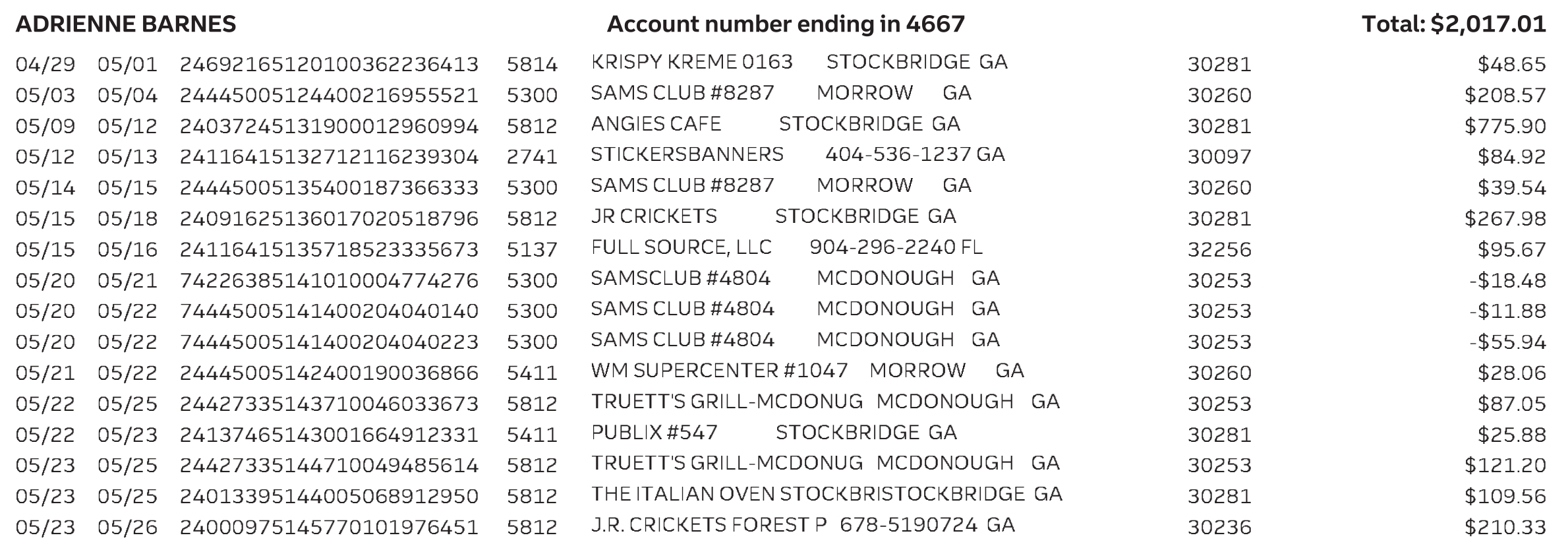
The controversy that has consumed the city is not without merit. But the scope of the investigation reveals a striking inversion of priorities. Williams’ P-card spending, roughly $4,000 in questioned transactions over five months, is nothing compared to the five years of financial malfeasance under his predecessor.
While Williams was being investigated for a barber receipt, the amphitheater on his doorstep was running a $1.6 million annual deficit, a former amphitheater manager was moving $400,000 of taxpayer money through a personal bank account, a $32.9 million budget amendment had passed without council approval, and an independent audit identified four material weaknesses across three consecutive years.
If the council is going to investigate municipal mismanagement, the amphitheater is where the money is. If it’s going to censure someone, LaKeisha Gantt, the council’s loudest voice calling for Williams’ investigation, should be on that list. She was on this council for every year of the Ford-era rot. She acknowledged the amphitheater’s costs. And she did nothing.
The specific transactions that triggered this investigation are modest in isolation. The $35 barber visit was an honest mistake, Williams’ attorney said: the city-issued P-card and Williams’ personal card look identical, and he reimbursed the city immediately. The $161 sporting goods purchase on April 5 was submitted under the form description “golf tournament” but yielded Nike pants and other clothing. Williams said his pants had ripped on the way to an event and he needed replacements. The $21.59 clothing store purchase was on a form labeled “Move with the Mayor” and, again, Williams needed pants for the event.
During a July 26 livestream that ran nearly 90 minutes, Williams defended each transaction individually, called the council’s effort “political,” and told viewers he was “willing to fight, 10 toes down.” His attorney, Robert Kenner Jr., acknowledged that Williams “should not have used” the P-card for some items but maintained the investigation was fundamentally disproportionate. The city never trained him on proper card spending after he took office. The real story was what happened to $32.9 million in budget amendments and $400,000 in a personal account.
The P-card issue is only part of a broader pattern. The city’s 21-page allegations letter, sent by City Attorney Quinton G. Washington on July 17, also cited serious concerns about a city-owned vehicle checked out in Williams’ name for 183 days. The Vehicle Assignment Log showed multiple entries of extended vehicle use without coinciding city business. A city vehicle was present at a nightclub while checked out by Williams, and a vehicle was damaged while checked out under his name. It is unclear whether the damaged vehicle is the same one at the nightclub.
Williams says he did not receive a vehicle-usage policy until “two or three weeks ago” and that two other city employees also had access to the damaged vehicle. The city characterizes the situation as Williams having “unauthorized[ly] retained” a city vehicle for nearly 200 days.
State Legislators’ Double Standard
On Aug. 13, 2026, the same day Williams’ attorney filed an emergency motion in Superior Court to block the council’s hearing, the city’s five-state legislative delegation sent a letter to Governor Brian Kemp calling for a GBI investigation into Williams’ conduct.
The signatories were State Sen. Emanuel Jones, State Sen. Gail Davenport, State Rep. El-Mahdi Holly, State Rep. Demetrius Douglas, and State Rep. Regina Lewis-Ward. Their letter cited “the unauthorized use of city provided purchasing cards, gasoline purchases using municipal funds, and other behavior unbecoming of the Office of the Mayor.” More seriously, it stated: “Additionally, allegations have been made that the mayor has engaged in behavior that could be considered criminal as it relates to minors.”
The letter argued that the council’s pending removal process could “ferment continued distrust in the efficient operation of the City of Stockbridge and could hinder the prosecution of any criminal conduct that may have occurred.” The delegation positioned the GBI, not the council, as the proper forum.
But the delegation did not wait for the independent investigator’s report, which was still ongoing. They did not wait for the Aug. 22 hearing to conclude. They escalated a local dispute into a potential state criminal probe, citing unadjudicated allegations.
There is a conspicuous irony at the center of their letter. The same voters who put Mayor Williams in office also voted Emmanuel Jones out of his office. The grapes of wrath turn sour this late in the season.
The $110,000 European Trip Nobody Talked About
Emanuel Jones, the State Senator who now stands on the front of a letter asking the state to investigate a local mayor over P-card receipts, was one of six state senators who rode along on a taxpayer-funded trip to Germany and the United Kingdom. The 14-person delegation was led by Lt. Gov. Geoff Duncan and Senate Pro Tem Butch Miller, both leaving office at the time.
The AJC reported that an internal senate probe called it a “taxpayer-funded vacation.” The cost: $110,000. The Senate took so long to act that lawmakers had to file Senate Resolution 334 in March 2023 to ban the practice. The AJC broke the story in February 2023.
In August 2026, Senator Jones is on the front of a letter asking the GBI to investigate a 22-year-old mayor who earns $22,000 a year and allegedly spent $4,000 on questionable P-card purchases, including a $35 haircut. They helped spend $110,000 on a European vacation and now want the state’s top law enforcement agency on a barber receipt.
The GBI responded to inquiries Aug. 17 by saying it was “aware of the correspondence” but “has not been requested for any specific criminal allegations in this matter.” Williams offered no comment when asked.
The letter also revealed that the delegation was acting in real time with the council’s internal process. On the same day the letter was sent, the city’s independent investigator, Richard Hyde, who holds subpoena power, was still reviewing Williams’ P-card transactions. Hyde told the AJC he had “made no conclusions yet” and that “when or if there’s a hearing is above my pay grade.” The delegation did not wait. They went straight to the governor.
The Rot Was Already There: Four Years Under Anthony Ford
The controversies swirling around Mayor Williams are real, and they deserve scrutiny. But they did not begin with him. The financial weaknesses he promised to audit were not created in his seven months in office. They were baked into the city’s books over four years under his predecessor, former Mayor Anthony Ford.
Under Ford, the City of Stockbridge accumulated what his administration described as a “$32.9 million discrepancy.” A massive amendment to the FY2024 budget moved funds between accounts without council approval. Ford says it was a staff error, not theft. But independent auditors who reviewed the 2022 and 2023 fiscal years found material weaknesses in internal controls spanning three consecutive years: improper capitalization of assets, improper interfund activity used to conceal amphitheater expenses by shifting them to an unrelated fund, mismanagement of receivables and revenue, and a failure to properly report accrued liabilities.
The 2023 audit identified four material weaknesses and a significant deficiency, an increase from the prior year. Two were repeat findings from 2021 through 2023, meaning they were known, unaddressed, and growing worse. A three-year pattern of deteriorating financial controls, flagged year after year, was met with silence by the council that included LaKeisha Gantt.
The city’s own finance director acknowledged the problem at a September 2025 council meeting. CFO Frank S. Milazi told council members that two sets of reports were being circulated, and the ones they received were not accurate. One council member was shown a report displaying $2.3 million in spending through August, when the year-end total was actually $10 million.
Councilwoman Yolanda Barber, the lone member who voted against the Aug. 12 resolution to hold an investigative hearing and who was absent for the Aug. 17 postponement vote, was repeatedly shut down when asking for financial data. She eventually hired her own attorney to submit a demand letter for information. It took her ten months to receive the 2022 audit results.
Councilwoman LaKeisha Gantt was the council’s most vocal advocate for investigating Williams over roughly $4,000 in purchasing-card transactions. She called the effort “not a witch hunt” and told reporters the city was “suffering” and the hearing needed to move “as soon as possible.” She also acknowledged that some of the $32.9 million amendment covered operational expenses for the amphitheater. Money flowed through the city’s accounts during her tenure.
The inversion is striking. The council member who pushed hardest for a mayor’s investigation over a barber receipt was on the council when $32.9 million moved between accounts without approval, when an amphitheater ran a $1.6 million annual deficit, and when two sets of financial reports were being circulated. She did not call for audits. She did not demand investigations. She voted yes.
Gantt’s public posture during the Ford era was not one of aggressive oversight, but it was something arguably worse. She was present, she was vocal at the right moments, and she performed the theater of concern without ever following through on substance. When Barber was shut down and hired an attorney to demand financial data, Gantt did not publicly side with her. She did not demand that Milazi be more transparent. She did not call for the independent auditors’ findings to be discussed in public session.
She let the rot happen, kept her head down, and waited until a new mayor with a fresh mandate and limited institutional knowledge came in. A 22-year-old who had just been elected and did not yet have the networks to fight back, he arrived before Gantt positioned herself as the city’s moral authority on accountability.
This is the kind of manipulation that is hard to prosecute but impossible to ignore. Gantt cultivated an image as the council’s conscience, the one who cared, the one who pushed for action, while doing nothing while the actual problems festered. She let Barber take the hits. She let Ford’s administration mislead the entire council. And when Williams arrived with his forensic audit promise and started asking questions that threatened the status quo, Gantt was the first to call for his head.
She weaponized the language of accountability to serve her own political interests, turning a genuine concern for transparency into a cudgel against a mayor who was actually doing the work she had avoided for four years. Her performance of concern was a masterclass in political theater. Appearing engaged without taking meaningful action, positioning herself as the victim of mismanagement while benefiting from the very system that enabled it.
The Amphitheater That Broke the Budget
The amphitheater was at the center of the financial rot. The VyStar Amphitheater at The Bridge, a $22.5 million facility with 3,500 seats and paid in full, opened in 2021. Since then, the city has repeatedly subsidized it. In FY2025, amphitheater revenues reached only about $1 million against a $2.6 million budget, meaning the city’s General Fund absorbed the shortfall.
City Councilwoman LaKeisha Gantt acknowledged that some of the $32.9 million amendment covered operational expenses for the amphitheater. Amphitheater manager Harold Young was terminated for breach of contract in June 2025 amid budget overruns.
The VyStar Amphitheater at The Bridge sits at 4,650 North Henry Boulevard in a residentially adjacent neighborhood. VyStar Credit Union serves as its naming sponsor under a roughly $1.2 million, four-year deal, the same credit union that opened its first Georgia branch in the city.
The $400,000 in a Personal Bank Account
On his advocacy blog at stockbridgeamphitheater.com, writer Coren Randazzo (that’s me, lol) published a story on Oct. 23, 2025, titled “The Young and the restless: City claws back $400,000.” The article covered a civil complaint the City of Stockbridge filed in Henry County Superior Court on Aug. 15, 2025, against Harold J. Young, the former General Manager of the Stockbridge Amphitheater.
The complaint, filed ex parte by City Attorney Quinton G. Washington and attorney Megan McCulloch, alleged that Young, while serving as amphitheater manager, opened and operated an unapproved bank account at Ameris Bank in his own name: “Harold J. Young Stockbridge Amphitheater,” account ending in 1358. Through this account, the city alleged, Young transacted “in excess of $400,000 of taxpayer money” that had been budgeted for the 2025 concert series.
The complaint also alleged that Young’s subcontractors billed the city for additional money on top of the $15,000 monthly Young received under his agreement, overbilling of $5,000 or more per month, and that Young maintained at least one other bank account at Wells Fargo (ending in 5929) through which he regularly conducted city business.
Judge Veal granted the city’s ex parte Temporary Restraining Order on Sept. 5, 2025. It was issued three days before it was formally filed with the clerk. The order froze the Ameris account and restrained Young from transferring, liquidating, concealing, or dissipating any funds. It also barred Young from opening any new bank accounts or safety deposit boxes on behalf of the city or the amphitheater.
The mechanics of the alleged fraud are straightforward enough. The amphitheater had a budget. Taxpayer money was allocated for the concert series. Instead of routing that money through the city’s regular accounting channels, where it would have been tracked, audited, and reported, it was funneled through a personal bank account at a regional bank that Young himself opened. The subcontractor overbilling, $5,000 or more per month on top of the $15,000 Young was already being paid, suggests a pattern of systematic extraction rather than a one-time error.
But this story deserves more attention than it received. A former city employee was accused of routing $400,000 of public funds through a personal bank account, with potential overbilling of $60,000 or more annually in subcontractor fees alone. A judge ordered the funds frozen. The city filed a civil complaint. And the mainstream press, the AJC, WSB-TV, 11Alive, Fox 5, did not cover it. The citizens of Stockbridge learned about the complaint from a blog run by a resident who signs his posts “I’m running -$200 ARR.”
The timing compounds the irony. Young was terminated for breach of contract in June 2025. The civil complaint was filed in August 2025. The TRO was granted in September 2025. Williams took office in January 2026 and was being investigated by July 2026 over a $35 barber receipt and $161 Nike pants. The council had months of advance notice about Young’s account. They had a judge’s order freezing it. And they did nothing until Williams started asking questions that made them uncomfortable.
When the Press Isn’t Watching
Why was there no news coverage of $400,000 in a bank account held by a former city employee, opened without authorization, containing taxpayer money, and litigated in front of a superior court judge? That is the question that should be asked of every editor in metro Atlanta.
Stockbridge is not a ghost town. It is home to roughly 30,000 people in Henry County. It has a mayor who was 22 when elected. It has a 3,500-seat amphitheater. It has had $32.9 million in budget amendments, material weaknesses in audits for three consecutive years, and a former amphitheater manager accused of routing $400,000 of public funds through a personal bank account. And yet the only outlet that covered the Young complaint was a partisan advocacy blog.
This is not just a story about Stockbridge. It is a story about what happens when local journalism dies and advocacy blogs fill the void. A councilwoman’s Facebook posts about a mayor’s vehicle use get shared across dozens of comment threads. A legislative delegation writes a letter to the governor. A judge freezes an account. And the mainstream press is silent, but only when a 22-year-old mayor sues his own city does it finally break.
The Harold Young complaint was not the only document the city produced that went unreported. The audit findings. The two sets of books. The $32.9 million amendment. The amphitheater’s annual shortfall. None of it made it into the AJC, WSB-TV, 11Alive, or Fox 5. The citizens of Stockbridge had to find out about their own finances from a blog run by a resident who signs his posts “I’m running -$200 ARR.”
I will make a note here and tell you all to read Reed Williams at AJC. They did manage finally, after many years to publish some valid criticism of Stockbridge City.
Williams promised a forensic audit when he ran. The city delivered him an investigation of his own P-card receipts, a barber, some Nike pants, while $400,000 sat in a personal account and $32.9 million moved between funds.
The Legal Battle
The legal battle over Williams’ access to City Hall was never going to be straightforward. Under the Stockbridge city charter, Williams holds the title of “chief executive” with the administrative powers granted to the city except as the charter specifically provides otherwise. The charter gives the council investigatory authority, including the power to compel testimony and require the return of access devices. But the removal process for elected officers is tightly constrained. Charter section 2.17 requires written notice specifying the grounds for removal, and a public hearing held at least 10 days after that notice is served. The council’s own “Notice of Preliminary Allegations” acknowledged that if removal is pursued, Williams is entitled to that full process.
Williams’ emergency motion cited a prior Georgia Court of Appeals case in which the appeals court affirmed a lower court’s decision that the council could not delegate away mayoral authority granted by the charter. The legal principle is clear: the council can investigate, but it cannot unilaterally strip the mayor of the powers the voters gave him through the charter. Judge Veal’s August 17 ruling, which returned Williams’ key fob and restored limited access, appears to have followed that precedent, even as it left significant restrictions in place. The ruling was a partial victory that acknowledged the city had overstepped, without fully resolving the underlying dispute over the scope of the council’s investigatory authority versus the mayor’s executive authority.
What Comes Next
The story of Mayor Jayden Williams and the Stockbridge City Council has multiple threads still in motion.
The council’s investigative hearing is scheduled for 10 a.m. Saturday, Aug. 22, 2026, postponed from Aug. 15 after the council conceded it would not meet the charter’s 10-day written notice requirement. Councilwoman Yolanda Barber was absent from the Aug. 17 vote; Councilwoman LaKeisha Gantt, the hearing’s most vocal advocate, voted for it.
The city has engaged independent investigator Richard Hyde, who has subpoena power. Hyde was expected to take 30 to 45 days and, as of mid-August, told the AJC he had “made no conclusions yet.” He said he had been having trouble getting Williams to meet with him. A claim Williams’ attorney Robert Kenner Jr. disputed.
The GBI investigation remains in limbo. The GBI said Aug. 17 it was “aware of the correspondence” but had not been “requested for any specific criminal allegations.”
The court case, SUCV2026002318, is pending. Judge Veal’s Aug. 17 ruling restored some access but left significant restrictions in place. The full disposition of the TRO and interlocutory injunction motion remains undecided.
The “behavior that could be considered criminal as it relates to minors” allegation referenced in the Kemp letter remains the most serious but least documented charge. No specific details have been made public.
Williams told reporters on Aug. 17: “I’m happy to get back to work.” Whether he can do so and what happens when the council convenes Aug. 22 depends on decisions yet to be made.
What the citizens of Stockbridge deserve to know is what their council decides to investigate first. The amphitheater that cost them millions over five years of financial malfeasance, or the mayor who spent $4,000 on pants over five months. The cart and the horse are still in the wrong order.