As regards this video I will not be linking to…
Propaganda at Public Rates: The “Gem of the South” and What It Bought
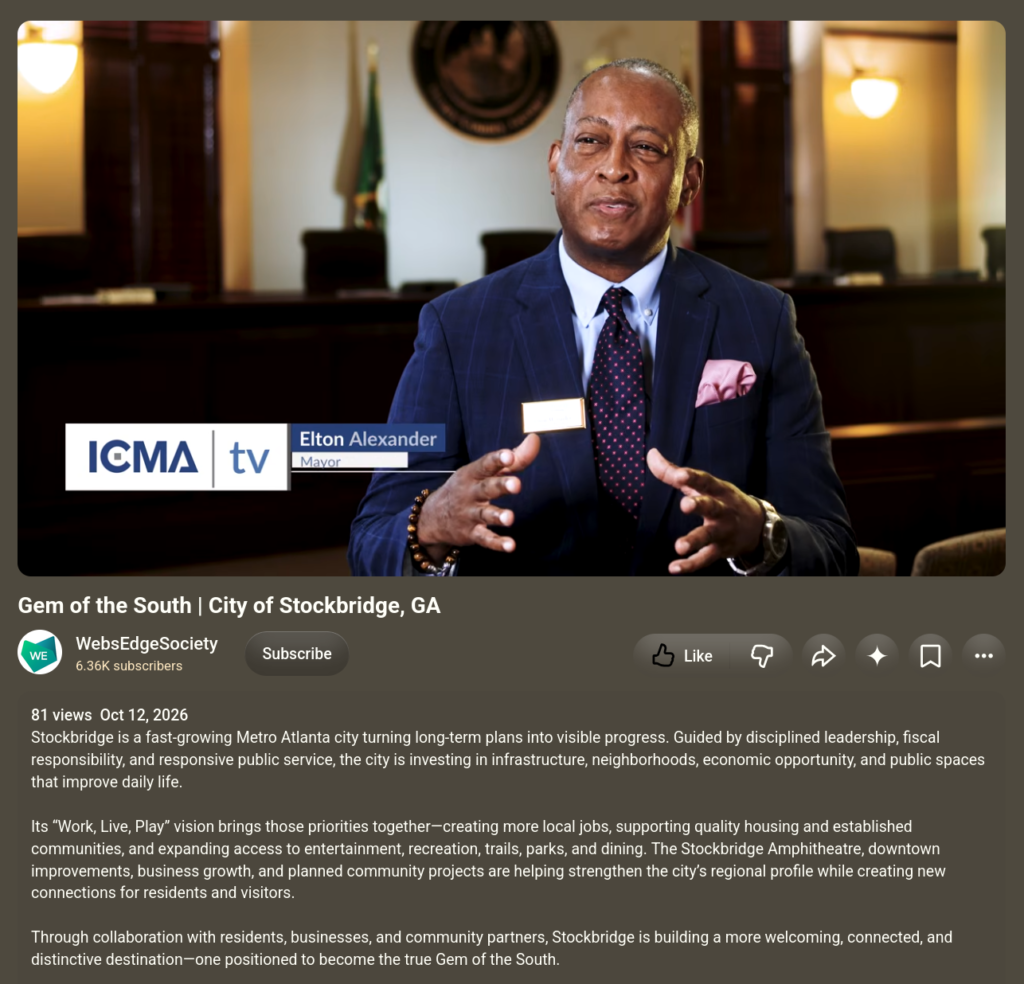
Stockbridge spent about $26,300 in taxpayer money on a five-and-a-half-minute video of itself. The film premiered on October 12 on the WebsEdgeSociety channel. Its title is “Gem of the South | City of Stockbridge, GA.” A young voice opens: “the jewel of the South started right here.” An official closes with the invitation to “come visit Stockbridge and see what we’re all about.” In between, the city’s own officials call themselves “very innovative.” The description promises “disciplined leadership, fiscal responsibility, and responsive public service.”
A campaign ad, not a city ad
This is not selling the city. It is a campaign ad. The candidate is the acting mayor, and the voters pay the bill.
The candidate and the vacancy
On September 12, 2026, the City Council removed Mayor Jayden Williams. He was 23, the youngest mayor in Georgia history. The vote ran 3-0, after a ten-hour evidence hearing. The charges: about $4,000 in improper card charges, a city vehicle he misused, staff he mistreated, and explicit messages to a high school student who had just turned 18. The city must hold a special election by roughly March 2027.
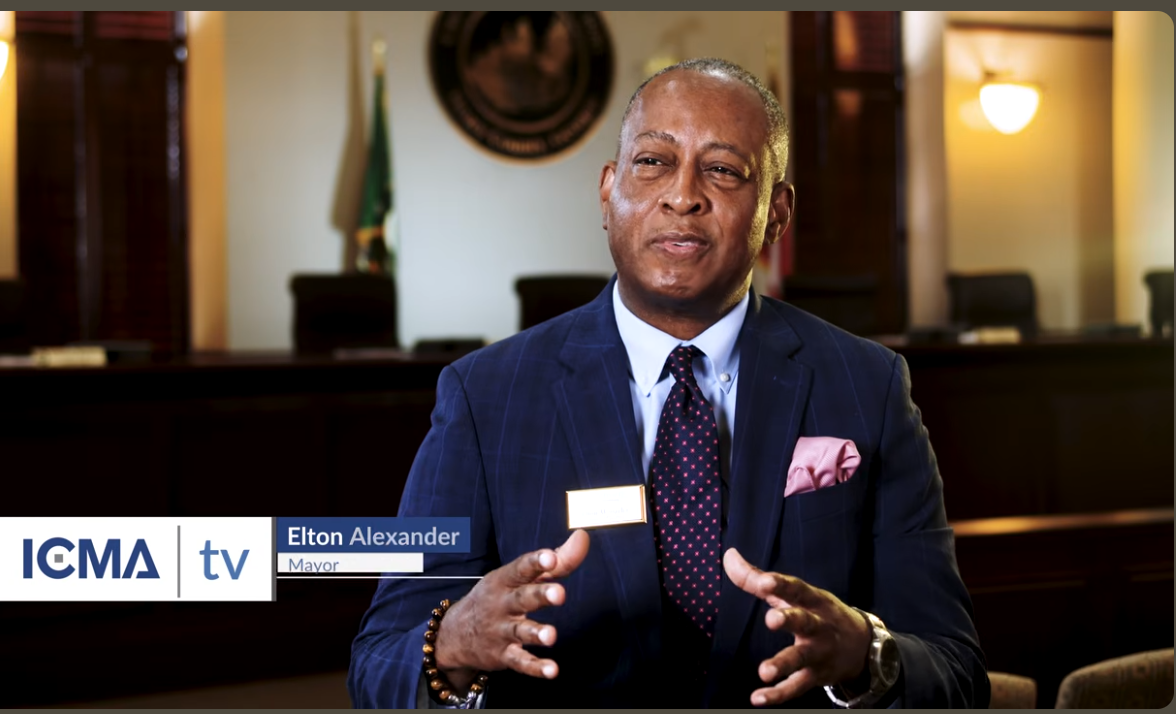
The man who called the removal “a tough decision” was Elton Alexander, the mayor pro tem. He now fronts the city’s new film. The election runway sits open, and his face is already on it.
His record sits in this city’s ledger. He joined the council in January 2016. The council censured him in 2018 and again in 2019. Six ethics investigations followed. Then came the BBQ Masters settlement of April 2021. Arick Whitson owned a barbecue restaurant. Councilman Alexander expected $60 of free food. Whitson said no. Whitson then reported warrantless code inspections, criminal warning notices, “manufactured problems,” a denied alcohol permit, and stalled permits. He sued the city and Alexander. The city’s insurer paid $1.7 million to end the case. Of that, $533,807 went to Whitson’s lawyers. The mayor and two councilmembers demanded Alexander’s resignation at a press conference. It ended in a shouting match. Alexander denied the charges. He opposed the settlement. He stayed.
One free meal cost $60. It cost Stockbridge $1,700,000. The film landed one month after the vacancy, placed to wash that record clean.
What this product costs
WebsEdge keeps offices in London and Washington. It sells the same film to cities across the world, and it keeps no public price list. Its pitch to cities promises “a customized proposal and cost structure.” City councils, however, must vote in public. So the public record prices this product for us:
- Des Plaines, IL (2012): $9,550. A 5:19 film, shown at the ICMA convention.
- Milpitas, CA (2018): $22,500. “ICMA TV film California spotlight.”
- New Rochelle, NY (2023): not to exceed $24,300. A video profile for the Thought Leadership slot.
- Eloy, AZ (2024): $26,300 fixed. Five-minute film, two hours of raw footage, one social cut. The city keeps all rights.
That list tells us two things. First, the price stays flat nationwide. Eloy has 2,500 people. New Rochelle has 80,000. They paid within $2,000 of each other. Second, the price climbs about $1,500 to $2,000 a year.
Stockbridge’s film belongs to the 2026 program. WebsEdge made 35 community films for the ICMA TV show at the Long Beach conference. Same call for cities, same package that Eloy bought in writing. So take Eloy’s published contract and add two years of increases. The honest number is about $26,300. Call it $25,000 to $30,000. Stockbridge has not published its own contract. The city wrapped a $1.7 million settlement in confidentiality, and it treats this one the same way.
Keep the scale in mind. At $26,300, this film costs six and a half times the $4,000 that just cost a sitting mayor his job.
Refuting the claims, one by one
The city’s own meeting transcripts answer the film. Every quote below comes from those transcripts, dated and on the record.
“Our downtown was dirt”
The film says the downtown was dirt “a couple of years ago,” a place no one visited. The amphitheater sits on the old ball field behind City Hall. That field stayed in play until 2019, with homes along its edge. Council said it in 2017: “design for an amphitheater out on the ball field… behind City Hall.” In 2019 the city demolished three homes on Lee Street for the amphitheater project. A resident remembered the site in 2020: “the church was there, the ball field was there… all of that area was wooded and grown up.”
That is not dirt. The downtown decline ran a decade long, and the city recorded it itself: “It died a slow death when all the businesses moved out.” The downtown authority cited “unsightliness and neglect” a full year after the amphitheater opened. The film invented its own before-picture.
The $22.5 million anchor
The film calls the venue “the $22.5 million Stockbridge Amphitheater.” That number is real. The film drops the route to it. Council first framed the build at sixteen million — “We’re building a sixteen million dollar amphitheater” — and itemized it at $15.8 million in 2020. Then came the drift. One $2.3 million change order cleared in a single motion. Council heard it would need “six to six and a half million” more in bonds to finish. The city sold taxable bonds and repaid them with SPLOST sales-tax dollars. Councilwoman Barber said it plainly at the 2021 retreat: “the seven million dollar cost overruns… I got beat up about it.”
So $22.5 million is a $16 million promise plus $7 million of admission. It first left out the chairs — “you can’t have a concert without chairs.” One credit is due: the city paid off “a 30-year mortgage within four years.” But the sales-tax dollars also covered the overruns. And the state’s 2024 audit found “significant adjustments” in the amphitheater funds “due to improper expenditure recording, lack of approvals, and missing supporting documentation.” The film washes an overrun into a sticker price.
“Thousands of businesses”
The film claims the city “brought thousands of businesses” in five years. The city held 1,847 licensed businesses in total, and said so to council in 2017: “of the 1847 businesses that we have, about 50% have already renewed.” A record year added about 214 new registrations. County recruiters located or expanded “10 companies” in one year, with “over a thousand jobs” and $109.5 million of investment. “Thousands in five years” would beat the whole city base. The number has no home in the record.
The slogan has local roots. Staff coined “Stockbridge is open for business” in 2019, while council ran development moratoriums that members had to defend against the plain claim that the city stood closed. In 2024, the city’s own economic-development consultant passed on the era’s biggest win: “you all opened a Costco… I wish we could say that we could take credit for that. We won’t try.”
Future tense, presented as downtown
The film walks you to Starbucks, Whataburger, “our First Watch, or Costco,” and promises “an entertainment facility coming there.” The Jodeco center does have real receipts, and they deserve their due. Costco opened on November 16, 2023, and the mayor announced that opening on the record. The developer bragged in August 2025: “Costco’s sales are between 1.1 and 1.2 million a day… your Sprouts is one of the third best stores in the country.” Sprouts cut its ribbon in November 2024. Whataburger followed in December 2024. First Watch opened in fall 2025 with “the fourth most successful grand opening” in company history.
The padding sits at the edges. Starbucks appears in the record as a committed tenant and a land-disturbance filing, never reliably as an open store. As late as December 2025, a councilmember stood before a Tim Hortons hearing and mused, “We wonder why there had never been a Starbucks here.” The entertainment facility appears nowhere. Ten years of transcripts hold no named tenant, no approval, no construction at Jodeco. “Entertainment” lives in a developer’s wish and in the zoning for the $350 million Patrick Henry Parkway project next door, with no tenant attached. The only entertainment venue the era built is the amphitheater, over a mile away, paid for by the city. The film points at a highway interchange full of future tense and calls it downtown.
“Community input is ingrained”
The film says hearings feed every step of every project. One example answers for the rest. In February 2021, Westminster residents fought a 147-home rezoning on the Highway 42 corridor. One of them told the council: “The last community meeting was held with two days notice and without any signs on the road. This is really not acceptable.” Attendees of the developer’s own meeting said the crowd ran majority against the plan. Planning and Zoning voted no — “every member of it voted against this project.” On March 30, 2021, council approved it anyway, 4-0-1. That is the machinery the film praises, working as designed. Voices gathered. Decision already made.
The pattern repeats across the decade. A 2017 rezoning lost its legal sign the night before the hearing: “anybody that would have an opportunity to speak here did not see the sign.” During the Eagles Landing secession fight, a sitting councilman said, “I live in the city of Eagles Landing myself and I was never asked.” Hearings routinely drew “nothing for or against other than the applicant.” Even the drone showcase contradicts the claim. Staff said the drone project skipped the special-use process, the hearing process, and normal zoning: “we didn’t really have a formal process.” The city bolted community meetings on afterward as a permit condition.
Walmart called us
The film says the city reached out to Walmart’s drone and wing department and brought Georgia its first drone delivery, “the second in the nation.” The transcript flips the subject. “Walmart reached out to us about this particular opportunity.” Walmart’s own director confirmed the national count: one city so far, in North Dallas. Second in the nation checks out. Nobody in any meeting ever said first in Georgia. The city answered an offer fast and voted a text amendment with two community meetings attached. The film turns answering the phone into launching a program.
The STEM school across the street
The film claims credit for “the new $75 million STEM school being constructed across the street.” The school is real. It is not the city’s. Henry County Schools owns it, on the old Stockbridge High site: “The Henry County Board of Education approved to put the STEM school… two blocks from our city hall.” The district awarded the job at $45 million in 2022. By 2025 the council itself quoted $70 million, then $73 million. The film’s $75 million beats every figure the city uses. The school opens for the 2027 school year, draws students from all over the county, and carries no attendance zone. Council helped attract it — the DDA said so on the record. Still, the film delivers the building, the bill, and the neighborhood benefit as three city achievements. The city owns none of them.
The police claim that actually checks
The police facts stand on their own. The city rebuilt its force in 2021, forty-six years after the last one closed. Startup ran about $6.1 million, roughly three-quarters of it federal ARPA money, with a new property tax funding the rest. The film’s language comes straight from the chief’s swearing-in: “a department that will be committed to the principles of 21st century policing… our police are the public and the public are the police.” The film quotes the department’s own brochure back to the department. The audit did flag the grant work — COPS-grant reports came “late, improperly supported,” some with wrong numbers — and the council fought in 2022 over who controls use-of-force policy. The claim is true and still propaganda. It presents borrowed federal money and a new tax as a gift from the people on camera.
A housing plan in the present tense
The film promises “more affordable homes” from a plan in progress. The record shows the plan at its first step, in January of the film year: “the GICH certification is one of the steps… It’s the first step.” Ten years of meetings show the affordable output so far: two donated lots for Habitat houses, three county-funded homes, and $159,000 of SPLOST spent on sewer to make the lots work. The “variety” that got voted means market-rate roofs. A councilmember lives beside the Jodeco towers: “two thousand dollars a month, which is more than my mortgage.” Developers define their affordability as “priced in the high 200s to 300s… affordable for the market.” The city’s own assessment says the affordability that matters already exists, in older neighborhoods “facing aging infrastructure and displaced pressures.” The film speaks of the plan as if people already live in it.
The city’s cards, at the city’s own building
Now look at what the city already spends on itself. The Merle Manders Conference Center houses the Events & Conference Center department, and Events runs the fattest cards in city hall. A watchdog checked every line against the bank statements: 17 billing cycles, February 2025 through June 2026, 2,793 transactions, $744,442.38 on 41 city cards.
Events took $177,261.78 of that — 23.8% of all city card money. One single Events card carried $114,211.02, which is 15.3% of the entire city program, averaging $315.64 a swipe. Now read the timing. August and September 2025 — the festival season that ran into the November election — swallowed $33,020.85 of that card. That is 29% of its two-year total in two months, with no purchase orders in sight.
That one card bought $16,853 in printing and signage. It bought $13,605 at grocery and warehouse clubs, cash and carry. It paid $10,440 through PayPal to named individuals, including one charge of $5,015.35. It paid $9,101 at one hotel inside the city where its own cardholder works, including fifteen charges in three days and eight single room-nights. It paid $8,790 at hotels nowhere near any Stockbridge event: an airport Westin that logged the same $1,559.30 charge twice, and a Nashville Grand Hyatt. It paid for flowers, balloons, and four airline tickets booked the same day.
The double standard, in dollars
Program-wide, the categories a taxpayer should not fund — dinners, gifts, in-town hotels, personal retail, amusements — ran $132,328.68 across 519 transactions. That is 17.8% of every charged dollar. Dining alone hit $67,318.51, and food ran through 35 of the 41 city cards. Then came the reversals: 176 credits, $43,634.50, back to 30 of the 41 cardholders. Sports-betting charges on three management cards netted out to minus $75. An HR card’s $1,349.38 luxury-apartment charge and $1,000 custom-jewelry charge vanished by quiet credit. Williams repaid his charges, and they removed him anyway. His two-year card history shows one reversal: $35.76.
So the election math writes itself. The council’s own cards look clean, at 0.5% improper categories. The program still buys what campaigns buy. Catering keeps elected faces in front of neighbors on the city’s tab. Flowers, signage and vendor payments wait at the ribbon-cuttings, under the same smiles. Fuel tagged MAYOR ran across four vehicle IDs at a seven-month pace of $2,595.53. The city’s own fuel file documents the take-home-vehicle habit. Meanwhile the watchdog still waits for the records behind the $100,000-plus phone bill in District 5 — the district that now employs an acting mayor. The clerk received that request in July. Nothing arrived.
Eighty-one views
As of this writing, the film has 81 views. Not 81 million. Eighty-one. Five and a half minutes of officials praising themselves, shot around an amphitheater that ran $7 million over, staged at a Costco the city’s own consultant says the city did not recruit. It landed one month after this council removed a mayor for $4,000 in charges, and it sits inside a special election the taxpayers will also pay for. Eighty-one people watched. That works out to about $325 per viewer — the removed mayor’s entire alleged offense, repurchased every nine days.
All this — the audit findings, the $32.9 million budget amendment, the finance director’s “we misled you,” the $400,000 sound booth unbuilt four years running, the festival-season card spree, the $1.7 million barbecue settlement, two Habitat houses posing as a housing plan — bought eighty-one views. Suppose the election turns out 10,000 voters. The film reached under 1% of them and burned a quarter of $26,300 doing it. That is not marketing. That is a contribution from the public purse to a candidate whose decade of service the city’s own audits cannot call clean.
Come to Stockbridge, the film says, and see what we’re all about. Fair enough. Count the eighty-one views first. Then vote in the election this film was really paying for — and make sure the city does not spend it twice in these last ninety days.