Author: Coren Randazzo

  • Propaganda at Public Rates: The “Gem of the South” and What It Bought

    Propaganda at Public Rates: The “Gem of the South” and What It Bought

    As regards this video I will not be linking to…

    Propaganda at Public Rates: The “Gem of the South” and What It Bought

    Stockbridge spent about $26,300 in taxpayer money on a five-and-a-half-minute video of itself. The film premiered on October 12 on the WebsEdgeSociety channel. Its title is “Gem of the South | City of Stockbridge, GA.” A young voice opens: “the jewel of the South started right here.” An official closes with the invitation to “come visit Stockbridge and see what we’re all about.” In between, the city’s own officials call themselves “very innovative.” The description promises “disciplined leadership, fiscal responsibility, and responsive public service.”

    A campaign ad, not a city ad

    This is not selling the city. It is a campaign ad. The candidate is the acting mayor, and the voters pay the bill.

    The candidate and the vacancy

    On September 12, 2026, the City Council removed Mayor Jayden Williams. He was 23, the youngest mayor in Georgia history. The vote ran 3-0, after a ten-hour evidence hearing. The charges: about $4,000 in improper card charges, a city vehicle he misused, staff he mistreated, and explicit messages to a high school student who had just turned 18. The city must hold a special election by roughly March 2027.

    The man who called the removal “a tough decision” was Elton Alexander, the mayor pro tem. He now fronts the city’s new film. The election runway sits open, and his face is already on it.

    His record sits in this city’s ledger. He joined the council in January 2016. The council censured him in 2018 and again in 2019. Six ethics investigations followed. Then came the BBQ Masters settlement of April 2021. Arick Whitson owned a barbecue restaurant. Councilman Alexander expected $60 of free food. Whitson said no. Whitson then reported warrantless code inspections, criminal warning notices, “manufactured problems,” a denied alcohol permit, and stalled permits. He sued the city and Alexander. The city’s insurer paid $1.7 million to end the case. Of that, $533,807 went to Whitson’s lawyers. The mayor and two councilmembers demanded Alexander’s resignation at a press conference. It ended in a shouting match. Alexander denied the charges. He opposed the settlement. He stayed.

    One free meal cost $60. It cost Stockbridge $1,700,000. The film landed one month after the vacancy, placed to wash that record clean.

    What this product costs

    WebsEdge keeps offices in London and Washington. It sells the same film to cities across the world, and it keeps no public price list. Its pitch to cities promises “a customized proposal and cost structure.” City councils, however, must vote in public. So the public record prices this product for us:

    • Des Plaines, IL (2012): $9,550. A 5:19 film, shown at the ICMA convention.
    • Milpitas, CA (2018): $22,500. “ICMA TV film California spotlight.”
    • New Rochelle, NY (2023): not to exceed $24,300. A video profile for the Thought Leadership slot.
    • Eloy, AZ (2024): $26,300 fixed. Five-minute film, two hours of raw footage, one social cut. The city keeps all rights.

    That list tells us two things. First, the price stays flat nationwide. Eloy has 2,500 people. New Rochelle has 80,000. They paid within $2,000 of each other. Second, the price climbs about $1,500 to $2,000 a year.

    Stockbridge’s film belongs to the 2026 program. WebsEdge made 35 community films for the ICMA TV show at the Long Beach conference. Same call for cities, same package that Eloy bought in writing. So take Eloy’s published contract and add two years of increases. The honest number is about $26,300. Call it $25,000 to $30,000. Stockbridge has not published its own contract. The city wrapped a $1.7 million settlement in confidentiality, and it treats this one the same way.

    Keep the scale in mind. At $26,300, this film costs six and a half times the $4,000 that just cost a sitting mayor his job.

    Refuting the claims, one by one

    The city’s own meeting transcripts answer the film. Every quote below comes from those transcripts, dated and on the record.

    “Our downtown was dirt”

    The film says the downtown was dirt “a couple of years ago,” a place no one visited. The amphitheater sits on the old ball field behind City Hall. That field stayed in play until 2019, with homes along its edge. Council said it in 2017: “design for an amphitheater out on the ball field… behind City Hall.” In 2019 the city demolished three homes on Lee Street for the amphitheater project. A resident remembered the site in 2020: “the church was there, the ball field was there… all of that area was wooded and grown up.”

    That is not dirt. The downtown decline ran a decade long, and the city recorded it itself: “It died a slow death when all the businesses moved out.” The downtown authority cited “unsightliness and neglect” a full year after the amphitheater opened. The film invented its own before-picture.

    The $22.5 million anchor

    The film calls the venue “the $22.5 million Stockbridge Amphitheater.” That number is real. The film drops the route to it. Council first framed the build at sixteen million — “We’re building a sixteen million dollar amphitheater” — and itemized it at $15.8 million in 2020. Then came the drift. One $2.3 million change order cleared in a single motion. Council heard it would need “six to six and a half million” more in bonds to finish. The city sold taxable bonds and repaid them with SPLOST sales-tax dollars. Councilwoman Barber said it plainly at the 2021 retreat: “the seven million dollar cost overruns… I got beat up about it.”

    So $22.5 million is a $16 million promise plus $7 million of admission. It first left out the chairs — “you can’t have a concert without chairs.” One credit is due: the city paid off “a 30-year mortgage within four years.” But the sales-tax dollars also covered the overruns. And the state’s 2024 audit found “significant adjustments” in the amphitheater funds “due to improper expenditure recording, lack of approvals, and missing supporting documentation.” The film washes an overrun into a sticker price.

    “Thousands of businesses”

    The film claims the city “brought thousands of businesses” in five years. The city held 1,847 licensed businesses in total, and said so to council in 2017: “of the 1847 businesses that we have, about 50% have already renewed.” A record year added about 214 new registrations. County recruiters located or expanded “10 companies” in one year, with “over a thousand jobs” and $109.5 million of investment. “Thousands in five years” would beat the whole city base. The number has no home in the record.

    The slogan has local roots. Staff coined “Stockbridge is open for business” in 2019, while council ran development moratoriums that members had to defend against the plain claim that the city stood closed. In 2024, the city’s own economic-development consultant passed on the era’s biggest win: “you all opened a Costco… I wish we could say that we could take credit for that. We won’t try.”

    Future tense, presented as downtown

    The film walks you to Starbucks, Whataburger, “our First Watch, or Costco,” and promises “an entertainment facility coming there.” The Jodeco center does have real receipts, and they deserve their due. Costco opened on November 16, 2023, and the mayor announced that opening on the record. The developer bragged in August 2025: “Costco’s sales are between 1.1 and 1.2 million a day… your Sprouts is one of the third best stores in the country.” Sprouts cut its ribbon in November 2024. Whataburger followed in December 2024. First Watch opened in fall 2025 with “the fourth most successful grand opening” in company history.

    The padding sits at the edges. Starbucks appears in the record as a committed tenant and a land-disturbance filing, never reliably as an open store. As late as December 2025, a councilmember stood before a Tim Hortons hearing and mused, “We wonder why there had never been a Starbucks here.” The entertainment facility appears nowhere. Ten years of transcripts hold no named tenant, no approval, no construction at Jodeco. “Entertainment” lives in a developer’s wish and in the zoning for the $350 million Patrick Henry Parkway project next door, with no tenant attached. The only entertainment venue the era built is the amphitheater, over a mile away, paid for by the city. The film points at a highway interchange full of future tense and calls it downtown.

    “Community input is ingrained”

    The film says hearings feed every step of every project. One example answers for the rest. In February 2021, Westminster residents fought a 147-home rezoning on the Highway 42 corridor. One of them told the council: “The last community meeting was held with two days notice and without any signs on the road. This is really not acceptable.” Attendees of the developer’s own meeting said the crowd ran majority against the plan. Planning and Zoning voted no — “every member of it voted against this project.” On March 30, 2021, council approved it anyway, 4-0-1. That is the machinery the film praises, working as designed. Voices gathered. Decision already made.

    The pattern repeats across the decade. A 2017 rezoning lost its legal sign the night before the hearing: “anybody that would have an opportunity to speak here did not see the sign.” During the Eagles Landing secession fight, a sitting councilman said, “I live in the city of Eagles Landing myself and I was never asked.” Hearings routinely drew “nothing for or against other than the applicant.” Even the drone showcase contradicts the claim. Staff said the drone project skipped the special-use process, the hearing process, and normal zoning: “we didn’t really have a formal process.” The city bolted community meetings on afterward as a permit condition.

    Walmart called us

    The film says the city reached out to Walmart’s drone and wing department and brought Georgia its first drone delivery, “the second in the nation.” The transcript flips the subject. “Walmart reached out to us about this particular opportunity.” Walmart’s own director confirmed the national count: one city so far, in North Dallas. Second in the nation checks out. Nobody in any meeting ever said first in Georgia. The city answered an offer fast and voted a text amendment with two community meetings attached. The film turns answering the phone into launching a program.

    The STEM school across the street

    The film claims credit for “the new $75 million STEM school being constructed across the street.” The school is real. It is not the city’s. Henry County Schools owns it, on the old Stockbridge High site: “The Henry County Board of Education approved to put the STEM school… two blocks from our city hall.” The district awarded the job at $45 million in 2022. By 2025 the council itself quoted $70 million, then $73 million. The film’s $75 million beats every figure the city uses. The school opens for the 2027 school year, draws students from all over the county, and carries no attendance zone. Council helped attract it — the DDA said so on the record. Still, the film delivers the building, the bill, and the neighborhood benefit as three city achievements. The city owns none of them.

    The police claim that actually checks

    The police facts stand on their own. The city rebuilt its force in 2021, forty-six years after the last one closed. Startup ran about $6.1 million, roughly three-quarters of it federal ARPA money, with a new property tax funding the rest. The film’s language comes straight from the chief’s swearing-in: “a department that will be committed to the principles of 21st century policing… our police are the public and the public are the police.” The film quotes the department’s own brochure back to the department. The audit did flag the grant work — COPS-grant reports came “late, improperly supported,” some with wrong numbers — and the council fought in 2022 over who controls use-of-force policy. The claim is true and still propaganda. It presents borrowed federal money and a new tax as a gift from the people on camera.

    A housing plan in the present tense

    The film promises “more affordable homes” from a plan in progress. The record shows the plan at its first step, in January of the film year: “the GICH certification is one of the steps… It’s the first step.” Ten years of meetings show the affordable output so far: two donated lots for Habitat houses, three county-funded homes, and $159,000 of SPLOST spent on sewer to make the lots work. The “variety” that got voted means market-rate roofs. A councilmember lives beside the Jodeco towers: “two thousand dollars a month, which is more than my mortgage.” Developers define their affordability as “priced in the high 200s to 300s… affordable for the market.” The city’s own assessment says the affordability that matters already exists, in older neighborhoods “facing aging infrastructure and displaced pressures.” The film speaks of the plan as if people already live in it.

    The city’s cards, at the city’s own building

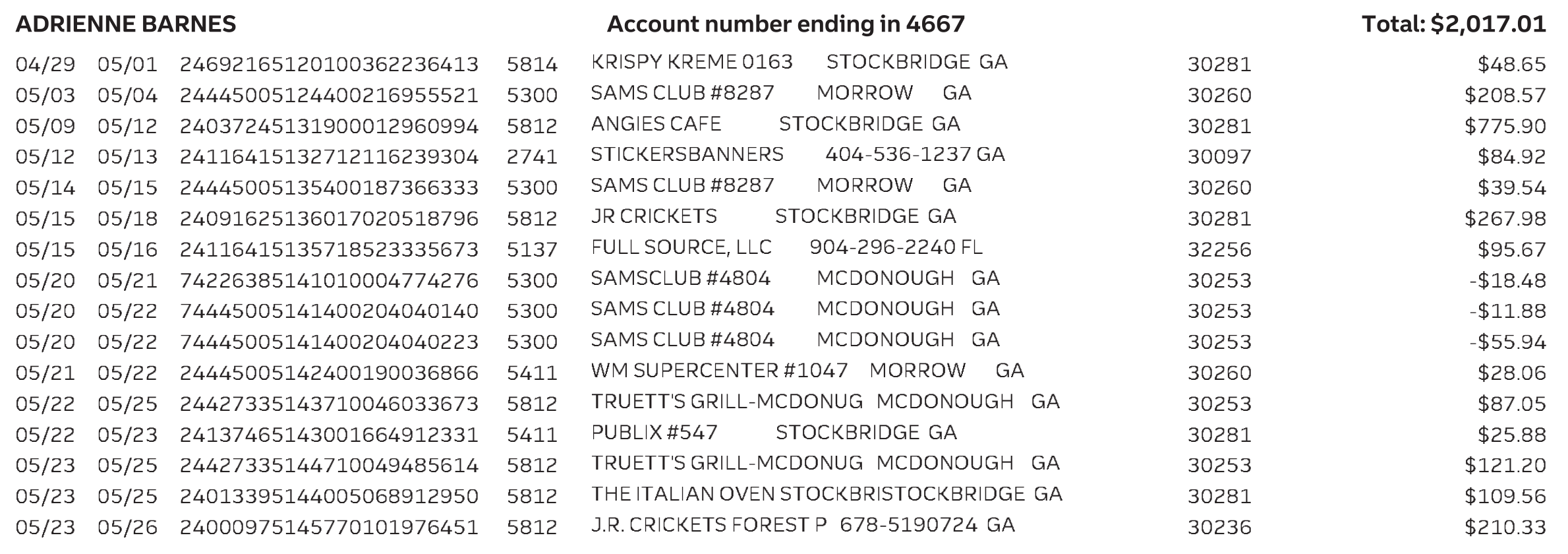
    Now look at what the city already spends on itself. The Merle Manders Conference Center houses the Events & Conference Center department, and Events runs the fattest cards in city hall. A watchdog checked every line against the bank statements: 17 billing cycles, February 2025 through June 2026, 2,793 transactions, $744,442.38 on 41 city cards.

    Events took $177,261.78 of that — 23.8% of all city card money. One single Events card carried $114,211.02, which is 15.3% of the entire city program, averaging $315.64 a swipe. Now read the timing. August and September 2025 — the festival season that ran into the November election — swallowed $33,020.85 of that card. That is 29% of its two-year total in two months, with no purchase orders in sight.

    That one card bought $16,853 in printing and signage. It bought $13,605 at grocery and warehouse clubs, cash and carry. It paid $10,440 through PayPal to named individuals, including one charge of $5,015.35. It paid $9,101 at one hotel inside the city where its own cardholder works, including fifteen charges in three days and eight single room-nights. It paid $8,790 at hotels nowhere near any Stockbridge event: an airport Westin that logged the same $1,559.30 charge twice, and a Nashville Grand Hyatt. It paid for flowers, balloons, and four airline tickets booked the same day.

    The double standard, in dollars

    Program-wide, the categories a taxpayer should not fund — dinners, gifts, in-town hotels, personal retail, amusements — ran $132,328.68 across 519 transactions. That is 17.8% of every charged dollar. Dining alone hit $67,318.51, and food ran through 35 of the 41 city cards. Then came the reversals: 176 credits, $43,634.50, back to 30 of the 41 cardholders. Sports-betting charges on three management cards netted out to minus $75. An HR card’s $1,349.38 luxury-apartment charge and $1,000 custom-jewelry charge vanished by quiet credit. Williams repaid his charges, and they removed him anyway. His two-year card history shows one reversal: $35.76.

    So the election math writes itself. The council’s own cards look clean, at 0.5% improper categories. The program still buys what campaigns buy. Catering keeps elected faces in front of neighbors on the city’s tab. Flowers, signage and vendor payments wait at the ribbon-cuttings, under the same smiles. Fuel tagged MAYOR ran across four vehicle IDs at a seven-month pace of $2,595.53. The city’s own fuel file documents the take-home-vehicle habit. Meanwhile the watchdog still waits for the records behind the $100,000-plus phone bill in District 5 — the district that now employs an acting mayor. The clerk received that request in July. Nothing arrived.

    Eighty-one views

    As of this writing, the film has 81 views. Not 81 million. Eighty-one. Five and a half minutes of officials praising themselves, shot around an amphitheater that ran $7 million over, staged at a Costco the city’s own consultant says the city did not recruit. It landed one month after this council removed a mayor for $4,000 in charges, and it sits inside a special election the taxpayers will also pay for. Eighty-one people watched. That works out to about $325 per viewer — the removed mayor’s entire alleged offense, repurchased every nine days.

    All this — the audit findings, the $32.9 million budget amendment, the finance director’s “we misled you,” the $400,000 sound booth unbuilt four years running, the festival-season card spree, the $1.7 million barbecue settlement, two Habitat houses posing as a housing plan — bought eighty-one views. Suppose the election turns out 10,000 voters. The film reached under 1% of them and burned a quarter of $26,300 doing it. That is not marketing. That is a contribution from the public purse to a candidate whose decade of service the city’s own audits cannot call clean.

    Come to Stockbridge, the film says, and see what we’re all about. Fair enough. Count the eighty-one views first. Then vote in the election this film was really paying for — and make sure the city does not spend it twice in these last ninety days.


  • A Glimpse Into Citywide P-Card Usage

    A Glimpse Into Citywide P-Card Usage

    All figures verified against the raw bank statements (17 Truist One Card billing cycles, Feb 2025 – Jun 2026; 2,793 transactions, $744,442.38) and the WEX fuel export (July 2024 – July 2026; 18,402 fills, $822,321.13). Department assignments come from the City’s own published staff directories, the fuel export’s department field, and public employment records.


    The card program

    Forty-one city purchasing cards are in circulation. Sorted by department, the spending looks like this:

    DepartmentCardsTxnsTotalShare
    Events & Conference Center4603$177,261.7823.8%
    Administration & Finance (incl. Procurement/Purchasing)8476$149,569.2620.1%
    Police3576$139,172.5618.7%
    City Manager’s Office3297$67,830.339.1%
    City Council (6 seats)6131$44,397.596.0%
    Public Works (incl. water/sewer/sanitation admin)4140$37,549.015.0%
    Community Development1148$31,538.454.2%
    Human Resources4104$27,629.683.7%
    Economic Development / DDA271$20,399.322.7%
    Mayor’s Office156$13,041.011.8%
    City Clerk’s Office180$13,017.661.7%
    Municipal Court133$5,125.790.7%
    Business Services118$4,443.100.6%
    Not attributable to a department260$13,466.841.8%
    Total412,793$744,442.38

    Three departments — Events, Administration & Finance, and Police — account for 62.6% of everything charged to a city card in this period. One card in the Events department alone carries $114,211.02 (15.3%).


    The one card that is its own department

    The Events & Conference Center’s largest card deserves separate treatment because its volume reshapes the whole program. In 15 billing cycles: 386 transactions, $114,211.02, average charge $315.64, single largest $5,015.35 (a peer-to-peer payment). August–September 2025 alone is $33,020.85 — 29% of the card’s two-year total in two months, consistent with fall festival season but meaning the city’s entire event spend for that season ran through one card with no visible purchase-order structure.

    Where that money went (verified rollup, reconciles to the penny):

    UseAmount
    Printing / signage / marketing$16,853.27 (66 txns)
    Grocery / warehouse club cash-and-carry$13,605.02 (61 txns)
    Peer-to-peer payments to individuals (PayPal)$10,440.35 (10 txns)
    Hotel — inside the city limits$9,101.28 (19 txns)
    Hotel — elsewhere (airport, Nashville, other)$8,790.11 (18 txns)
    Talent booking & music licensing$7,669.16 (11 txns)
    Amazon marketplace (unitemized)$7,150.19 (55 txns)
    Event services (flowers/balloons)$6,847.03 (12 txns)
    Square-network payments to local vendors$5,006.51 (18 txns)
    Self-storage$3,033.20 (6 txns)
    Dining$2,388.34 (21 txns)
    Airfare$1,767.90 (4 txns, all booked the same day)
    Office supplies$1,491.99 (9 txns)
    Other (software, apparel, hardware, transport)$20,066.67 (76 txns)

    The hotel spend splits into two problems. $9,101.28 was charged at one hotel inside the city the cardholder works for — including a single $4,298.96 charge and a three-day burst of fifteen charges totaling $6,420.92, eight of them $131–$154 each (one room-night apiece). Another $8,790.11 went to hotels nowhere near a Stockbridge event: an airport Westin ($4,618.24, including the same $1,559.30 charge twice) and a Grand Hyatt in Nashville ($1,294.87).

    The peer-to-peer money is the structural problem. Ten PayPal payments to six recipients — $5,015.35 to one of them in a single charge — plus $3,969.70 across nine Square charges to one vendor. These are vendor-sized payments made without vendor infrastructure.


    What each department charged that taxpayers shouldn’t fund

    Sorting all 2,793 transactions through one classifier (each transaction counted once, in its best-fit category), the categories a taxpayer would reasonably expect NOT to fund on a city card total $132,328.68 across 519 transactions — 17.8% of all card spend:

    CategoryAmountTxns
    Dining, fast food & catering$67,318.51315
    Payment apps to named individuals (PayPal / Cash App / Venmo / Zelle)$25,034.0534
    Clothing & personal retail$16,184.8874
    Hotel rooms in our own city$11,383.2321
    Entertainment & amusements$7,926.7726
    Florists, gifts & balloons$4,279.1325
    Personal grooming$277.114
    Sports betting (net of reversals)−$75.0020
    Total$132,328.68519

    A further $18,609.24 (49 txns) ran through Square, reported separately because most of it is small local vendors.

    Now the same improper-spend lens, by department:

    DepartmentImproper-category $TxnsShare of that dept’s spend
    Events & Conference Center$51,730.1613829.2%
    Administration & Finance$24,300.328216.2%
    City Manager’s Office$16,275.478924.0%
    Police$14,581.978010.5%
    Public Works$7,375.861719.6%
    Unattributed$5,988.782244.5%
    Human Resources$4,379.522315.9%
    Mayor’s Office$2,076.642715.9%
    Clerk’s Office$1,535.441011.8%
    Community Development$1,472.7174.7%
    Economic Development$1,120.48105.5%
    Municipal Court$733.73514.3%
    Business Services$547.07412.3%
    City Council$210.5350.5%

    The Events department carries almost 40% of the program’s improper-category dollars — but nearly half its own spend falls in those categories, driven by person-to-person payments, in-city hotel rooms, and the festival-season dining that a public-events operation inevitably generates. The City Manager’s Office and Public Works run improper-category rates above 19%; the Council, by contrast, is effectively clean at 0.5%. That is “clean” if you don’t count this money as buying their next election.

    Dining alone — $67,318.51 across 315 charges — is spread through almost every department: 35 of 41 cards bought food. The largest single catering charges run from $3,150.00 (one caterer, two charges) down through $2,515.21 (a Birmingham, AL caterer), $1,780.00, $1,517.50, $1,200.00, $1,024.05, and $1,000.00. Two Stockbridge Chick-fil-A locations absorbed $1,560.22 and $1,387.60; one local restaurant took $1,773.86 across eight visits; another $1,336.65 across four.

    Grocery and warehouse-club buying — Publix, Walmart, Sam’s Club, Costco — adds a further $68,945.03 across 525 transactions of cash-and-carry purchasing done on cards instead of through vendor accounts.


    Reversals: the quiet remedy — and the one exception

    The statements contain 176 reversal transactions totaling $43,634.50, spread across 30 of the 41 cardholders. Three-quarters of everyone who held a card got at least one charge quietly credited back. The reversals include:

    • Online gambling, reversed to near-zero. Sports-betting app charges appear on three management cards (HR, IT, Events): $505.00 charged, $580.00 credited, net −$75.00. The city’s entire response to gambling on public cards was an accounting adjustment. No discipline appears in the record.
    • Luxury and personal charges, reversed. One HR card carries a $2,543.70 demolition charge, a $1,349.38 luxury-apartment charge, a $1,000 custom-jewelry charge, and a $945.57 leasing charge — every one credited back, along with home cable/internet bills. The cardholder separated in September 2025; the reversals ran through November.
    • The same quiet fix across the program. The Clerk’s Office received $4,643.15 in reversals (legitimate convention-registration refunds, for the record), Public Works $4,159.59, the City Manager’s Office $2,824.00, and two dozen more cardholders all received credits without consequence.

    Set against that backdrop: the removed mayor. His personal-use charges — restaurants, clothing, a haircut, a movie — totaled roughly $4,000, and he repaid them. His entire two-year card history shows a single reversal, $35.76. He is the only cardholder in this dataset removed from office over P-card use.

    The question the city has never answered: why was the remedy for everyone else — repay and reverse, no discipline — denied to the one elected official who actually repaid? If a $1,349.38 luxury-apartment charge on an HR card is handled with a quiet credit, and a $505.00 gambling tab across three directors’ cards nets to zero without a single termination, what made repaid restaurant meals the exception that justified removal?


    The fuel bill, by department

    The WEX export is fuel only: $822,321.13 across 18,402 fills over 25 months — roughly $411,160/year, $32,893/month, $44.69 per fill. By the department field in the city’s own export:

    DepartmentFillsTotalShare
    Police12,513$501,629.2561.0%
    Public Works (roads/maintenance)2,356$136,401.5416.6%
    Water & Sewer1,646$90,496.4511.0%
    Sanitation471$29,405.043.6%
    Unassigned484$21,750.912.6%
    Water Reclamation261$13,692.671.7%
    Community Development222$11,544.881.4%
    Code Enforcement121$5,148.110.6%
    Conference Center motor pool126$4,411.750.5%
    Mayor’s Office45$2,595.530.3%
    Administration78$2,558.150.3%
    City Manager’s Office45$1,487.990.2%
    City Council30$1,100.790.1%
    Municipal Court4$98.070.0%

    Two-thirds of the fuel bill is police cars; that is normal for a department that runs shifts on the road. What is not normal:

    1. A department called “Unassigned” burned $21,750.91. 484 fills across 16 vehicle IDs with no department attached — and 401 of those 484 fills ($17,737.11) belong to a single driver, across nine different vehicle IDs, from July 2024 through March 2026. One person, no department, nine vehicles.
    2. The vehicle file can’t identify a third of the fleet. The export contains 198 card numbers, 190 vehicle/asset IDs — and only 127 distinct VINs. Sixty-five asset IDs share a VIN with another asset ID, meaning the city’s own fuel file cannot distinguish the vehicles a third of its fuel dollars flow to.
    3. Round-dollar “fills” that aren’t fills. Seventy-six fills totaling $14,800.13 are exact multiples of $100; 75 of the 76 are at Sunoco, and 54 are exactly $200.00. Round-dollar amounts at a pump are prepayments and card-loads, not measured fuel — sitting inside the fuel total unmarked.
    4. Elected-official fuel exists as its own line items. Ten vehicle IDs tagged COUNCIL (~$530/year combined) and four tagged MAYOR ($2,595.53 in 2026 alone — a run-rate well above the earlier estimate, because the mayor-tagged fuel all falls inside seven months). Small dollars; a documented per-seat take-home-vehicle culture in the city’s own export.
    5. Separated employees kept fueling. One Public Works employee retired in late 2023; the export shows his PIN buying fuel for 13 consecutive months afterward — $2,714.46 across 58 fills, almost entirely on one vehicle. A purchasing card belonging to an Economic Development director who separated in October 2025 kept charging for seven more months — roughly $5,575 net, including a $3,214.28 month in January 2026. The audit finding is the gap between separation date and card/PIN deactivation — and nobody has produced the deactivation records.

    The highest-risk pattern in the file: cash to individuals

    Across at least ten cards in six departments, the statements contain PayPal, Square, and Cash App payments naming private individuals rather than vendors — $25,034.05 across 34 transactions in the improper-category table, plus more inside the Square band. The single largest: a $3,965.50 Cash App payment to an individual in Oakland, California, from an Administration & Finance card, on 01/02/2026 — the same card, the same day, also sent $500.00 through Square to another person-named recipient. No city vendor by that name surfaces in public records.

    Person-named P2P payments are the highest-risk pattern a purchasing card can carry: no vendor documentation, no tax reporting, no competitive procurement. One religious-radio PayPal recipient appears on cards in two different departments, suggesting coordinated routing rather than isolated lapses.

    The biggest question we’re left with is who was gambling with city P-Cards, who flagged it & who was gambling with P-Cards? It could be someone was the victim of card skimming, thus, innocent. I’ll give the benefit of the doubt here. For the sake of argument, let’s say by Stockbridge & Georgia state law no rules were technically broken here. Is this spending what you would call “government spending.” I think the party, dining & grocery bill are way too high. I think, when we talk about that $32 million dollar budget amendment (among other budget fiascos), this is the spend we’re refering to.

    I’d provide more open records but we’re frozen out completely. We asked for Truist Payment Card related documents back in July. The documents seen here were not sent by the clerk’s office. After receiving these from a confidential source we inquired of the clerk as to the status of same. We received a terse note that, “our request had been received.” I suppose we can close that now and move on to District 5’s $100,000+ phone bill and the other $100,000 Verizon bill.

    How did you run up more than the city wide phone bill in your district, Mr. Mayor Alexander? 🙄


    Methodology note: department assignments were made from the City of Stockbridge’s published staff directories, the WEX export’s own “Driver Department” field, and public employment records; two cardholders (60 transactions, $13,466.84) could not be confidently assigned and are reported as “Unattributed.” Improper-category classification uses a single canonical classifier applied identically to every transaction; program totals reconcile to the statement totals to the penny. This is informational; consult a licensed attorney in the relevant jurisdiction.

  • “Not a penny missing” — until it was

    “Not a penny missing” — until it was

    I trusted Milazi, but I don’t anymore. It’s as if the man doesn’t understand people remember what he’s said in the past about the very same issue. Maybe he forgot what he swore to when the city sued Harold Young.

    Frank Milazi, Stockbridge’s City Treasurer and CFO, has spent the last year telling anyone who will listen that no city money ever went missing. His exact words, on the record.

    “Council being misled”

    File: 2025-07-15_Rescheduled_Regular_Council_Meeting_transcript.md

    Councilwoman Gantt asks whether the budget documents the council had been approving were accurate. Milazi answers:

    [3:19:19 – 3:19:23] — “No. They were not accurate. That’s it. So the documents that we received looked as if we were on budget.”

    [3:19:27 – 3:19:33] — “That is correct. That’s where my uh talking was we let you down.”

    [3:19:33 – 3:19:53] — “Yes. I didn’t know. I did mention that and I’m saying today again we let you down, hopefully, from now going forward.”

    Then Gantt, turning it back on the council, says “you didn’t let us down. We did. You weren’t here” — Milazi was hired later and is admitting the documents his office inherited and handed the council were wrong.

    [3:20:13 – 3:20:32] — “We received reported reports. We received budgets. We received spreadsheets, and the numbers were increased. Incorrect, but the numbers appeared to be what we thought were good numbers, correct?”

    So: the council was being given reports that looked balanced but weren’t — which is the transcript’s own confirmation of “the council was misled.”

    “Controls not being in place”

    File: 2025-07-15_Rescheduled_Regular_Council_Meeting_transcript.md

    [3:16:32 – 3:16:46] — “Right, because what was being done was being done by management and staff without council. There was no budget amendment at the end of the fiscal year.”

    [3:16:53 – 3:16:57] — “So in essence it was mismanagement. Mismanagement, yes. So moving forward, we need to make sure that we have systems in place that will prevent mismanagement.”

    [3:15:53 – 3:15:58] — “There were some um s plus. We were spending but we didn’t budget. But it wasn’t brought to Mayor and Council either. It was never brought before the council.”

    [3:18:11 – 3:18:31] — “The thirty two million that they are talking about is the difference between what was budgeted and what was acted on that was not presented to council to work on it or to approve it. So the expenditures were there, but they were not approved by council.”

    File: 2025-12-08_Regular_Council_Meetings_transcript.md

    [0:54:17 – 0:54:34] — “Um what we are doing here was being done in the past, but it was being done behind the scenes that he did not have authorization of the council, because still money was being moved from one fund to the other. There were some funds that they didn’t have enough revenues. So the movement and the balancing can only be authorized by the governing body.”

    That last one is the clearest single quote: Milazi states plainly that money was moved between funds without council authorization, “behind the scenes” — which is, in his own words, why the books had to be corrected.

    At the July 15, 2025 council meeting, when a resident demanded to know where $32 million had gone, Milazi was summoned to the microphone to “put a misnomer” to rest:

    “There’s no thirty two million dollars missing in the city.”

    Then, under questioning from Councilwoman Gantt about the same number:

    “So the money is not missing. No, there’s no missing of money. But we are making it right.”

    And again, later in the same meeting:

    “So there was no money of thirty two million that went missing.”

    He repeated the line, nearly verbatim, at the September 29, 2026 meeting when the FY2025 audit was presented:

    “There has never been a missing of a penny.”

    “$32.9 million was never missing in the city of Stockbridge.”

    “There was never $32.9 million missing from the city.”

    The framing is always the same: the $32.9 million was never “missing” — it was just a budget adjustment, a reclassification, money “spent but not budgeted.” Nothing vanished. Nothing was lost. Everyone should calm down.

    The court record says otherwise.


    The account the city forgot to mention

    On August 8, 2025 — three weeks after Milazi stood before the council and declared “there’s no missing of money” — Milazi’s own finance department “discovered multiple deposits” into a bank account the city never authorized. It was held at Ameris Bank under the name “Harold J Young Stockbridge Amphitheater,” account ending in 1358.

    The account belonged to Harold Young, the amphitheater’s general manager, whom the city had terminated on June 16, 2025. It was opened in his name — personally. And it had, in the city’s own words, “received in excess of $400,000 of City funds that were budgeted for the 2025 concert series.”

    The city’s complaint is unambiguous about whose money it was:

    “Upon information and belief, the majority of the funds in the Ameris Account is City taxpayer funds.”

    And the reason the city ran to court ex parte, asking the judge to freeze the account before Young was even told, is stated flatly in Judge Veal’s order:

    “Without immediate intervention, Respondent may dispose of the Ameris Account, and the taxpayer funds believed to be held within it.”

    “There is good cause to believe that Respondent, if informed of the TRO Motion, would hide assets and destroy evidence.”

    The judge also made a finding Milazi never bothered to make at the podium:

    “During his tenure with the City of Stockbridge, Respondent was not [a] city official contemplated by City of Stockbridge Code § 3.04.030 with authority to open a bank account on behalf of the City.”

    In other words: the money did not go to a city account. It went to a private account in the name of a fired contractor — someone the city code says had no authority to hold a single city dollar.


    Milazi’s signature is on the very document that proves it

    Here is the part that should end the “not a penny missing” talking point permanently.

    The exhibit attached to the complaint — the document proving the money moved — is not a subpoenaed bank record dug up by lawyers. It is an email from Frank Milazi himself. His signature block sits at the bottom:

    Frank S. Milazi, City Treasurer/CFO

    In that email, Milazi lays out Young’s accounts in his own words:

    “The second account below is where we sent Harold reimbursements for deposits/expenses he paid for himself.”

    That second account is the Ameris account, ending 1358 — the same account a judge later froze because it held taxpayer money Young had no authority to hold. The wire detail lists a single entry: $142,500.00 to “Harold Young,” Ameris Bank, checking.

    Add to that the $15,000-a-month “consultant fee” the city paid Young to a separate Wells Fargo account — an account the city’s own complaint says Young “would regularly conduct business on behalf of the City” through — and you have the answer to the question Milazi keeps insisting no one should ask.


    So: was money missing?

    The city’s own Treasurer, in the city’s own sworn complaint, says that a fired contractor controlled a private bank account containing more than $400,000 of money “budgeted for the 2025 concert series” — money that had to be clawed back through a TRO and an asset freeze because, in the court’s words, Young might otherwise “hide assets and destroy evidence.”

    That is not a “budget adjustment.” That is not “spent but not budgeted.” That is not “a roadmap based on prior expenditures.” That is a man running city funds through his personal checking account, and a Treasurer who — while standing at the podium telling taxpayers “there’s no missing of money” — was simultaneously documenting, in his own email, $142,500 of it flowing into that exact personal account.

    Milazi’s “not a penny missing” was never a statement of fact. It was a shield. He deployed it to wave away $32.9 million of unapproved spending, and it turns out the $32.9 million story and the $400,000-in-a-private-account story are not two different things. They are the same disease: a finance office that could not — or would not — account for where the city’s money actually was.

    The city would not have filed an emergency lawsuit, and Judge Veal would not have frozen a bank account at 2 a.m., if nothing was missing. The city sued because money had to be found and pulled back. Some of the money was missing. That is the entire reason the court case exists.

    Milazi can keep saying “never a penny missing” for as long as he likes. The complaint he signed his name to says otherwise — and a Superior Court judge has already ordered the money seized back on exactly that basis.


    The same names, one venue removed

    The Harold Young account was not the first time the people now guarding Stockbridge’s amphitheater money had crossed paths with a venue money scandal.

    Sandra “Sandy” Ward-Poag was the entertainment director of the Wolf Creek Amphitheater in Fulton County. In November 2016, a county audit of that venue came back so bad the Atlanta Journal-Constitution called it “damning.” It found more than two dozen violations of county policy: cash management problems, preferential treatment for certain vendors, business done with unlicensed companies, contracts signed without county approval, fee structures changed without the commission’s sign-off — and a ticket-printing scheme that handed complimentary entry to thousands more people than allowed, overcrowding the facility.

    Ward-Poag and an assistant county manager, Lisa Rushin, were both fired in February 2017. They sued, claiming they were really terminated for whistleblowing on Commissioner Marvin Arrington Jr.’s use of the venue’s skybox for private parties. The case wound its way up to the Georgia Court of Appeals, and in May 2025 the panel ruled against them — finding that Fulton County had “legitimate, nondiscriminatory reasons” for the firings, grounded in the pair’s “own financial indiscretions” and “numerous findings of misconduct” from that same audit.

    Then the venue changed hands. South Fulton incorporated and took over Wolf Creek from Fulton County, and the man running its books as Chief Financial Officer was Frank Milazi — the same Frank Milazi who would later become Stockbridge’s City Treasurer and CFO.

    That is where the two tracks collide. In February 2026, after Harold Young was fired and the city sued him over the $400,000 in the personal Ameris account, Stockbridge needed a new general manager for its amphitheater. The person hired for the job — announced as “your new VyStar Amphitheater Stockbridge General Manager” — was Sandy L. Ward-Poag, the same woman fired from Wolf Creek after the audit that found money mishandled and tickets given away by the thousands.

    So the sequence a Stockbridge taxpayer is left to make sense of is this: the city’s Treasurer stood before the council and swore “there’s no missing of money” — while the amphitheater he oversaw had just discovered $400,000 in an ex-manager’s personal bank account and filed an emergency lawsuit to claw it back. Then, to run that same amphitheater, the city brought in a manager whose last public-venue job ended with a county audit so severe it became a two-word shorthand — “damning” — and a court ruling that her firing was justified by her own financial misconduct.

    Frank Milazi was the CFO of the city that absorbed Wolf Creek when its scandal erupted. He is the CFO of Stockbridge now. In both places, the same pattern shows up on his watch: an amphitheater, a manager, and money that the people in charge insist was never missing — until the audit, or the lawsuit, says it was.


    A note on the record

    Nothing in the public record ties Milazi to the Wolf Creek audit itself — his involvement there is as the finance chief of the successor government, and his involvement in Stockbridge is as the CFO who was serving while Ward-Poag was hired. He is not named in the Wolf Creek audit findings, and no source found for this piece asserts he personally hired Ward-Poag or was directly implicated in that scandal. Those are stated as the facts they are, and nothing more.

    Sources

    A plain-English reading of the three single-audit filings the city submitted to the Federal Audit Clearinghouse — FY2023, FY2024, and FY2025.

    For three years running, the City of Stockbridge has told the public its books are clean. The city has taken home the Government Finance Officers Association’s highest award for financial reporting, and its treasurer has stood at the podium declaring “there’s no missing of money.”

    The actual audit filings tell a different story. Every one of the three annual reports carries a clean (“unmodified”) opinion on the financial statements — but that is the only thing that is clean. The part of the audit that examines whether the city can be trusted to account for its own money has failed, every single year, in the same places.


    The headline numbers

    FY2023FY2024FY2025
    Opinion on financial statementsUnmodifiedUnmodifiedUnmodified
    Material weaknesses (internal control)YesYesYes
    Significant deficienciesYesYesNone reported
    Federal compliance opinionQualifiedQualifiedUnmodified
    Federal grant findings120
    Low-risk auditee?NoNoNo
    Total findings6115

    The three columns have one constant: the city has never once qualified as a low-risk auditee. That designation is the federal government’s way of saying “your controls are good enough that we don’t need to look too hard.” Stockbridge failed it all three years, because it carried material weaknesses forward every year.


    What a “material weakness” actually means

    The auditors (Mauldin & Jenkins, LLC) define it precisely in each report:

    “A material weakness is a deficiency, or a combination of deficiencies, in internal control such that there is a reasonable possibility that a material misstatement of the entity’s financial statements will not be prevented, or detected and corrected, on a timely basis.”

    In plain English: a material weakness means the city’s own accounting could not be trusted to catch a serious error — and, in these cases, the outside auditors had to correct millions of dollars the city had recorded wrong.


    FY2023 — four material weaknesses and a qualified federal opinion

    The FY2023 audit (filed as 2023-12-GSAFAC-0000056073) identified four material weaknesses, one significant deficiency, and one federal grant finding:

    2023-001 — Receivables and revenue. The city could not correctly state its receivables and revenue. The auditors had to post adjustments across the General Fund, the ARPA Fund, the Grants Fund, the Stormwater Fund, the Solid Waste Fund, and the Conference Center Fund — including a single ARPA adjustment of $1,626,110 of misclassified unearned revenue.

    2023-002 — Capital assets. The city simply left $2,253,737 of capital assets out of its books, plus another $1.78 million of Water & Sewer construction-in-progress.

    2023-003 — Interfund activity. Money moving between the city’s own funds was misstated. The General Fund needed $9,598,792 in transfer corrections and a $7,930,727 cash correction. The Amphitheater Fund alone required $6,357,806 of expense corrections — a number that will reappear.

    2023-004 — Prepaid assets. Misclassified prepaids across five funds.

    2023-005 — Accrued liabilities (significant deficiency). Liabilities left unrecorded in six funds.

    2023-006 — COPS grant reporting (federal finding). The city did not submit two quarterly financial reports and three semiannual performance reports on time, and five reports lacked required supporting documentation. This drove a qualified opinion on federal compliance.

    Every single 2022 finding was carried forward as “Unresolved.” The corrective action plan was signed by Lakeisha Gaines, Interim Treasurer — a placeholder name that signals the finance office itself was in turnover.


    FY2024 — eleven findings, the worst year

    The FY2024 audit (2024-12-GSAFAC-0000384683) is the low point: seven material weaknesses, two significant deficiencies, and two federal findings — eleven in total. The auditors classified them explicitly:

    • Material weaknesses: 2024-001 (receivables), 2024-002 (interfund), 2024-004 (inventory), 2024-005 (expenditures/cash), 2024-006 (Amphitheater), 2024-007 (accrued liabilities), 2024-009 (capital assets).
    • Significant deficiencies: 2024-003 (prepaid assets), 2024-008 (depreciation).

    The dollar figures are where this stops being a technicality:

    • Interfund (2024-002): the General Fund needed $10,788,213 in transfer corrections and a $6,796,573 correction to interfund receivables.
    • Capital assets (2024-009): $9,046,595 of completed projects were never moved out of “construction in progress,” meaning the city was still carrying finished projects as if they were unfinished — plus $529,298 of related depreciation.
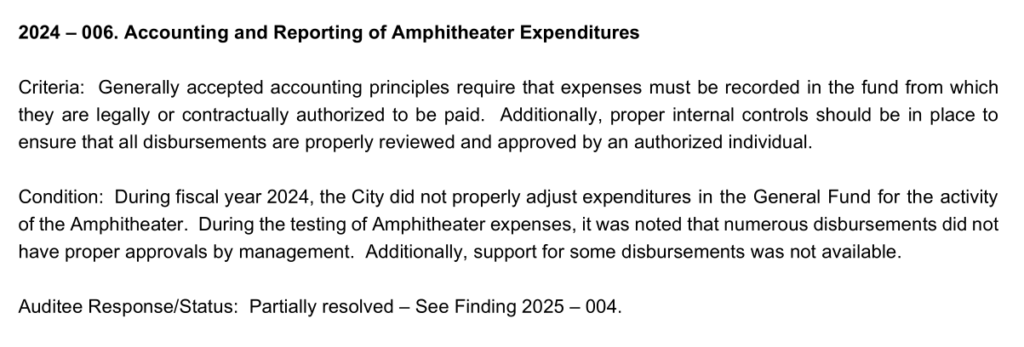
    • Amphitheater (2024-006): the General Fund needed a $6,013,271 correction. The auditors wrote that “many disbursements did not have proper approvals by management” and “support for some disbursements was not available.”

    The two federal findings — CSLFRF (COVID relief) and COPS grants — both reported “multiple required reports not submitted timely,” producing another qualified opinion on federal compliance.

    The prior-year schedule showed the pattern clearly: of the six FY2023 findings, five were “Unresolved” and one “Partially resolved.” The city had fixed almost nothing.


    FY2025 — better, but the same five wounds

    The FY2025 audit (2025-12-GSAFAC-0000426279) is the one the city’s leadership celebrates — and it is genuinely better on one axis. The federal compliance opinion returned to unmodified (both grant-reporting findings were resolved), and significant deficiencies dropped to zero.

    But the material weaknesses did not go away. There are still five, and every one is a repeat of a prior-year finding:

    • 2025-001 — receivables and revenue (repeat of 2023-001 / 2024-001). The General Fund needed a $2,084,550 receivable correction and a $1,528,080 fund-balance correction.
    • 2025-002 — depreciation recorded in the wrong fund (repeat of 2024-008).
    • 2025-003 — capital assets and assets held for resale (repeat of 2023-002 / 2024-009). The Water & Sewer Fund alone needed $2,788,947 of capital-asset corrections and $981,054 of depreciation expense.
    • 2025-004 — Amphitheater expenditures (repeat of 2024-006). The General Fund needed a correction of — the exact same figure as the prior year — $6,013,271. The auditors again noted disbursements “did not have proper approvals by management or supporting documentation.”
    • 2025-005 — interfund activity (repeat of 2023-003 / 2024-002). The General Fund needed $4,843,114 in interfund payables and $4,046,366 in transfer corrections.

    The prior-year schedule for FY2025 tells the real story of “progress.” Of the eleven FY2024 findings: six were resolved, but four remained “Unresolved” (receivables, interfund, depreciation, capital assets) and one — the Amphitheater — was only “Partially resolved.”


    The pattern the corrective actions can’t hide

    Three details recur so consistently they are the story itself.

    First, the same four failures every year. Receivables/revenue, interfund activity, capital assets, and Amphitheater expenditures appear in all three audits. These are not new mistakes being discovered each year; they are the same mistakes, found again, with the prior-year schedule stamped “Unresolved.”

    Second, the boilerplate corrective action. Almost every finding carries the identical response: “We concur. Additional controls will be implemented.” The same sentence, verbatim, year after year, on the same findings — which is how you know the controls were never actually implemented.

    Third, the cause is always the same word. For nearly every finding across all three years, the auditors list the cause as two words: “Management oversight.” Not a software glitch, not a transition, not a one-off error — management oversight, repeatedly, in the same areas, for three consecutive years.


    What this means

    A clean financial-statement opinion sounds reassuring, and it is what gets announced at the podium. But it coexists, in all three filings, with the auditors saying the city’s internal controls could not be relied upon to catch a material error — and then proving it by correcting millions of dollars every year.

    The two qualified federal opinions (FY2023 and FY2024) are the closest thing to a penalty in these filings: the city was formally out of compliance with its federal grant terms two years running. Grant noncompliance is how federal money gets clawed back.

    And the Amphitheater is the thread running through all of it. Its expenditure problems were a material weakness in FY2024 and again in FY2025 — with the identical $6,013,271 correction both years — and its interfund activity was being misstated as far back as FY2023. The same venue, the same amount, the same “management oversight,” three years in a row.

    The audits don’t say the money was stolen. But they say something Milazi’s “no missing money” framing cannot: that for three straight years, the city could not correctly record where its own money was — and needed an outside firm to fix millions of dollars of it, every single time.

  • September 29 meeting summary

    September 29 meeting summary

    It’s an hour and a half of undue praise and proclamations. This motherfucker will not shut the fuck up. So I’m turning this bullshit off. In the morning I’ll have my machine transcribe and pick arpart the meeting. Because I don’t have to listen to Elton pretend to be something he’s not.

    He’s a realtor. He opens the doors to bathrooms and says, “this is a bathroom.” If it weren’t for shucking and jiving for massas Welch, Strickland, Talmadge, Price, Herndon-Woodall and their white supremacist biker friend of a friend, Mark Ware. Elton would not have been installed as mayor.

    No shit. They write songs about their ethnostate down in Butts county. ‘Good old boys that look just like me and you.’ First of all, you motherfuckers don’t look like me. Second, why would Sandra Pogue or Charisma Webster have this person at the amphitheater in this city of all cities? And finally, ladies and gentlemen. When they tell you who they are, belive them.

    The first line is “playing hard and getting wet” and it’s a song about “Sheriff Long and all his boys.” Incomprehensible how awful these lyrics are. So, get ready Mark. This’ll be the most views that video ever gets in any period of time.

    If you peckerwoods down in Butt County take issue with this. Stay your corny ass away from me in your prison rape gay, leather daddy cosplay. Gary Long isn’t tough. Gary Long handed that landscaper over to Victor Hill to be tortured. Considering this man doesn’t provide you liberty or protection. All your white pride & back the blue ass kissing means abolutely nothing.

    Oh yeah. Almost forgot. Mark Ware was the first manager of the amphitheater. His email was mware@pacesga.com & then this RICO was filed against Paces.

  • Johnny Edwards Government Surveillance Story

    “Georgia child welfare agency’s surveillance tools raise privacy concerns” by Johnny Edwards (The Center Square, Sept. 9, 2026) reports that Georgia’s Division of Family and Children Services (DFCS), a social-services agency under the Department of Human Services—not a law-enforcement body—has spent at least $639,000 over two years on four police-grade investigative tools: ShadowDragon ($219,195; scans social media, dark web, gaming platforms to link identities and monitor activity), Anomaly Six (bundled with ShadowDragon; provides real-time smartphone geolocation data via app pings), Cellebrite ($75,738; forensically extracts locked-phone contents), and Traffic Jam ($344,074; scans online sex-ads using facial recognition against missing-person photos and maps criminal networks). DFCS Commissioner Candice Broce declined an interview but internal emails and public statements suggest the tech is used to track down runaway foster children and rescue them from traffickers. Lawmakers are unsettled: Rep. Mary Margaret Oliver (D-Decatur) questions whether DFCS even has legal authority to execute “exigency warrants,” ping cellphones, or conduct criminal investigations; Republican Rep. Beth Camp (chair of the Judiciary Juvenile Committee) said she is “100% not OK with that” and announced she is drafting transparency legislation; Emory Law professor Melissa Carter warned such surveillance could implicate Fourth Amendment protections; Sen. Kay Kirkpatrick (chair of the Senate Children and Families Committee) said she personally would not object if the tools were used within a legal framework.

    Full story, here: https://www.thecentersquare.com/georgia/article_eaf370dd-6914-467a-9551-605535a94634.html

    If you are a parent in Georgia, or even just a parent who cares about what government agencies are doing behind closed doors, you need to be following investigative reporter Johnny Edwards. In a story that should concern every single family, he dug through purchase orders and invoices to uncover that Georgia’s child-welfare agency, DFCS, which is supposed to be a social-services outfit, not a police force spent at least $639,000 of taxpayer money on four pieces of law-enforcement-grade surveillance technology. We are talking about tools that track cell-phone location in real time, forensically extract the contents of locked phones, scan the dark web and gaming platforms to link people’s online identities together, and use facial recognition on sex-ad listings to match images against missing-children photos. The agency says it is using this gear to find runaway foster kids. That sounds reasonable until you read what Johnny found: state lawmakers who had never been told any of this were shocked. A committee chair called it unacceptable and started drafting new transparency legislation. A legal professor warned the whole operation could run afoul of the Fourth Amendment. And crucially, DFCS is not a law-enforcement agency under Georgia law—so the question of whether it even has the legal authority to do this kind of surveillance is wide open, unanswered, and potentially affecting the privacy rights of every child in the system and the families they come from. Johnny Edwards did not get a soundbite or a denial that explained any of this; he got records. He followed invoices, cross-referenced company websites, and brought in an EFF security researcher to explain what these tools actually do. That is the kind of reporting that turns headlines into accountability. Follow Johnny Edwards for deep, document-backed research into issues like this one Issues that touch child privacy, government spending, civil liberties, and the power of state agencies over families. This is happening right now in Georgia, and it matters to every parent who wants to know what their government is doing with their money and with their children’s data.

  • The Actors and Their Backgrounds

    The Actors and Their Backgrounds

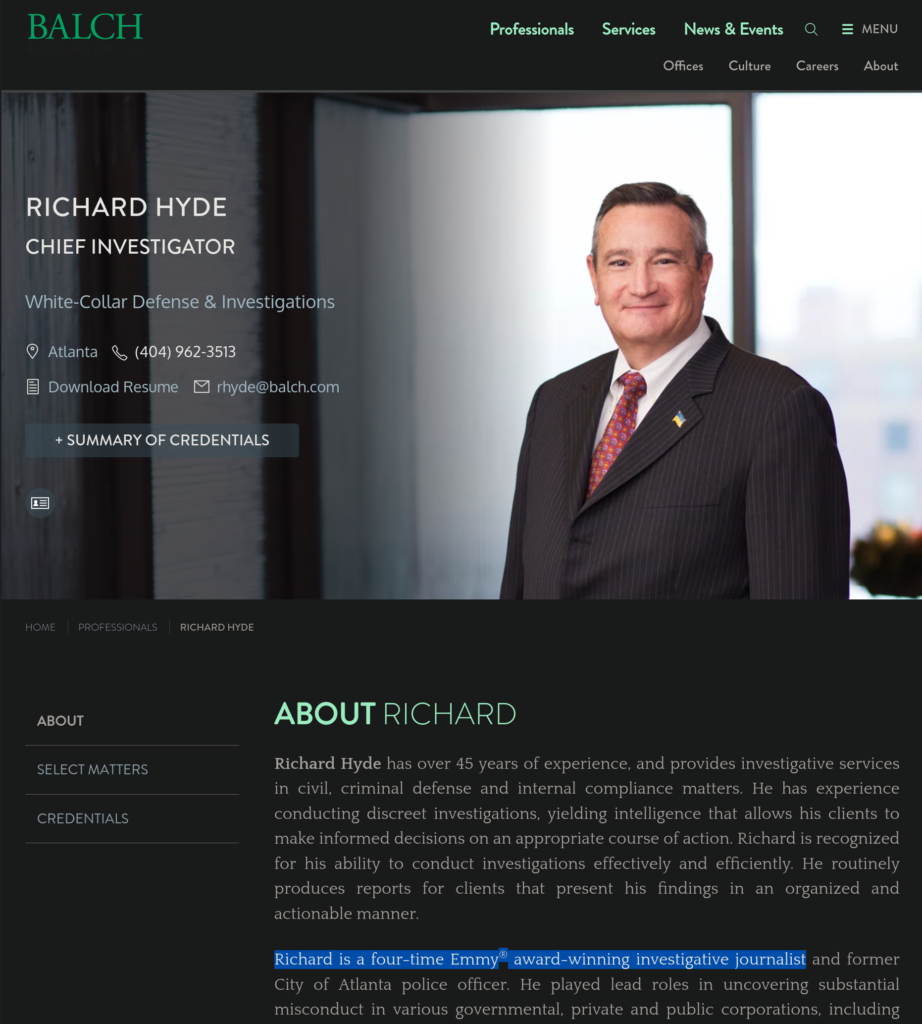
    Let’s start with Richard Hyde. Richard was an investigative news TV Producer at WAGA. In the time span he was there. It’s highly likely he was Richard Belcher’s producer. On Saturday the 12th, even while Hyde was in the middle of impeaching himself. His ex-employee, Belcher says to me, “Well, it sounds like you’ve got your mind made up that it is an organized conspiracy of silence. I’m doubtful. I did this a very long time and have never seen an organized conspiracy to quash a significant story. What I think you miss is low staffing and lack of interest in local government. Try to get a cup of coffee with Reed Williams.”

    I’ve done it for a very long time too, Richard & Richard. And it seems like I’ve caught you two in concert on the same issue. Some people would call that a rackett. https://x.com/corenmhr/status/2098791535890305054

    The conversation with Belcher https://x.com/corenmhr/status/2098791535890305054

    Gino Brogdon hasn’t been a judge in 20 years. He did have a TV show. It was called “Personal Injury Court.” That show was produced by Gary Martin Hays. Yes, the same ambulance chaser that Monica Kaufman-Pearson has croned at you about from the constantly-on TV in your living room for the past 20 years. I’ll leave it to the reader to look up clips of that show if you want. I characterize it as I do all those shows. A mockery of justice designed to pre-dispose your behavior to their version of normal. That is how all procedural lawyer and police drama television works. It’s why you say yes sir to the police, and I call them fuckers, and sue them, and win.

    The important part about Brogdon is you can connect him and Quinton Washington, city attorney to the same people at WSBTV.

    I don’t know what you saw. What I saw should have been an ethics complaint, $2000 paid back (which he had already done, in part), a $1000 fine & a censure. What happened in actuality. They grilled a young gay kid with texts about flirting until he cried. Now, what we don’t know. Who’s hands that phone was in when the alter party sent those texts. Because in this show trial, the alleged sender of those texts was not present. Without that witness there to question whether or not he sent those texts. There was no guarantee or provenance that that individual sent those SMS messages.

    We’re talking about a person at some point in custody for burglary. How long did the police have that phone? If all parties are adults. And the alter party didn’t make an ethics board complaint. Then why was Detective Ramclam writing police reports about a private conversation between adults, no matter the context. Why weren’t these witnesses produced. Would Judge Veal have let what we saw happen without the witness present to examine, cross & redirect?

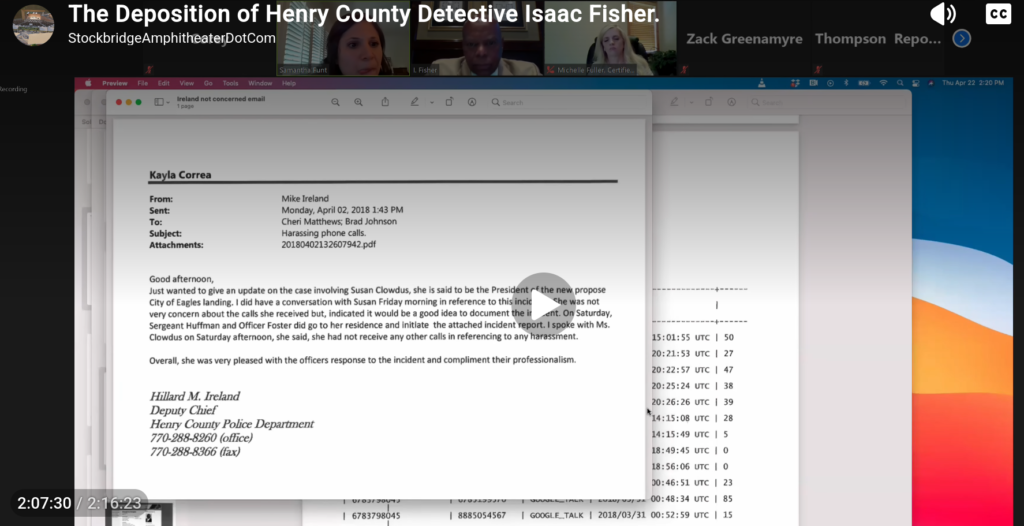
    I know for damn sure Charles Pannell, Jr. would not. My burden to prove Clowdus said what she wrote in the police report in court took two years. Whatever that was you saw the other day was nothing like what should have occured. If you’d like to see what that looks like when you get Stockbridge and Henry county cooking off of it. Watch my deposition of Detective Fisher. I want you, because this post is about media, to pay particular attention to the reporters reading my name. Then it will be easy for you to find Politan and Washington together on CourtTV.

    As to all the media connections from my case. Folks, that’s a 300 page book stretching back to 1994. Best we stick to the 5 connections we have here.

    Going forward. My singular goal is every line item in that District 5 phone bill brought to my attention thru the grapevine by Ms. Denise. Next meeting, I will deliver upon the council & clerk in open meeting the open records request outlining how to produce what we want. I will apply for the waiver outlined in the law. I lose money publishing this rag. Whatever your opinion of the crazy shit I say from time to time. Those records are in your public interest & we are due that waiver of what’s sure to be an exorbitant fee.

    Finally, I pose an uncomfortable question. How many of these nasty, fake, pretend-ass lawyers and investigators are maintaining pictures of this man’s private parts?

    If you’re on the fence about an appeal. Personally, this is worse than what they did to me. My reputation was hot garbage to begin with. To essentially drag Williams for two hours over nothing more than being flirtatious and a few rounding error level discrepancies of a new mayor’s p-card use. Well, the impact was 70 posts and growing, 260 syndicated reposts and over 700 unique URLs.

    There was no reason, and it was done on purpose by Shana Thornton & Quinton, to drag this so hard through the mud. I say it was merely because he is different to them, they went as hard as they could to destroy Jayden’s reputation. Think about it. Ford lost. Jones lost. Strickland is going to lose. They’re panicking and just made a huge body of mistakes in their rush. I hope Mayor Williams can action on the libel, slander, defamation and intimidation. I know firsthand, that’s asking quite alot of any person.

  • Abdication of Justice: The Political Hit Job on Mayor Williams

    Abdication of Justice: The Political Hit Job on Mayor Williams

    JURISDICTION: Stockbridge, Georgia (Henry County). Evidentiary hearing before
    Retired Judge Gino Brogdon Sr. (hearing officer). City Council of Stockbridge
    sitting as impeachment body. Final vote: 3-2 to impeach (Berry Sr., Alexander,
    Cloud). Mayors term ends approximately six months from election in November
    2025; he took office January 2026. Mayor can appeal to Henry County Superior
    Court under Stockbridge Charter / O.C.G.A.

    This memorandum is drafted as a defense of Mayor Williams, identifying weaknesses
    in the City’s case on each charge, procedural and due-process defects in the
    hearing, and arguments for reversal on any superior-court review.

    All transcript citations refer to the machine-transcribed PDF at
    /home/cornpop/hearing_transcripts.pdf (7,069 lines, 461,870 chars). Where a
    timestamp is given (e.g., “[00:26:33.53 – 00:26:35.64]”), it is the absolute
    timestamp within Part 1 of the recording. The City’s attorney is Robbie Ashe;
    the Mayor’s attorney is Robert Kenner Jr.

    JUDICIAL ROLES — Veal, Brogdon, and the “Kick Back”

    The user’s briefing references “Judge Veal’s decision to let Mayor Williams be
    judged by his own ambitious political opponents was a deeply flawed judicial
    decision. Effectively ignoring the purpose of higher courts.” This is substantiated
    by the documentary record below.

    • Chief Judge Holly W. Veal, Henry County Superior Court (Flint Judicial Circuit),
      administered the Mayor’s oath of office after his January 2026 election.
      (TruthSeekersJournal: “History Made in Stockbridge: Jayden Williams Sworn In,”
      noting “Honorable Judge Holly Veal administered the oath.”)
    • On July 24, 2026, at a hearing on Williams’ civil suit (SUCV2026002318), Veal
      denied a motion from the City’s attorneys asking her to recuse herself because
      she had administered Williams’ oath of office. “Veal said she has presided over
      dozens of swearing-in ceremonies for public officials and denied the request.”
      (WSB-TV, Aug. 16, 2026; CBS News Atlanta.) Veal did not rule on Williams’
      request to restore his privileges because of a “clerical issue with the initial
      filing.” (WSB-TV, Aug. 16, 2026.)
    • On August 17, 2026, Judge Veal issued her order in SUCV2026002318 directing
      the City to return Williams’ key fob and restore his access to private areas
      during normal operating hours. Veal found that the Council’s July 17
      restrictions — “locking Williams out of his office, cutting him off from
      official email and city records, and limiting his presence to public meetings
      only” — amounted to a “constructive removal” that effectively suspended his
      executive authority under the city charter.
      (StreamlineFeed/StockbridgeAmphitheater.com: “Mayor Williams, Stockbridge City
      Council, and the Fight for City Hall.”)
    • The Consent Judgment signed by Veal on August 21, 2026 (nunc pro tunc to
      August 17, 2026) is in the record at /home/cornpop/Documents/qsardh3nik3lrq0cstsxyl.pdf.
      It resolved only Williams’ claims and requested relief concerning Resolution
      No. R26-1955; it “does not adjudicate or dispose of Plaintiff’s pending Motion
      for Leave to File Supplemental Complaint or Plaintiff’s supplemental emergency
      request for relief concerning the Charter 2.17 removal proceeding and
      Councilmember LaKeisha Gantt’s participation therein. Those matters remain
      pending for consideration by the Court pursuant to the Rule Nisi setting those
      matters for hearing on August 20, 2026.” (Consent Judgment, p. 2.)
    • On or about August 22, 2026, at a special session where Retired Judge Gino
      Brogdon Sr. (the hearing officer) presided, the transcript records: “This issue
      of the mayor’s challenge of one of the council member’s objectivity was heard by
      Judge Holly Veal last week. . . . Judge Veal decided that that was a decision
      that I should make as the hearing officer as to whether the motion to recuse
      one of the council members should be granted or not.” (RedTapRecordings, Aug. 22,
      2026 investigative hearing transcript.) Veal declined to decide Gantt’s
      recusal and referred it back to Brogdon as hearing officer. This is the “kick
      it back down” the user’s briefing references — Veal sent the Gantt-recusal
      question to the very body that was about to sit in judgment of Williams: his own
      political opponents on the City Council, presided over by hearing officer Brogdon.
    • On September 1, 2026, hearing officer Brogdon removed Gantt from the panel,
      ruling her email to the Mayor’s grandmother “was clearly a threat” and that she
      “went too far” in contacting family members of the accused. (StreamlineFeed/
      CBS News Atlanta/AJC, Sept. 1-2, 2026.) Gantt did not appeal. The panel then
      consisted of four councilmembers: Berry Sr., Alexander, Cloud, and Barber.
      Three of those four — Berry Sr., Alexander, and Cloud — voted to impeach.
    • On August 31, 2026, Brogdon held a virtual hearing on the recusal motion; his
      ruling came September 1. (StreamlineFeed: “Threat Email Ruling Bars Gantt From
      Stockbridge Mayor Vote,” Sept. 1, 2026; AJC: “Judge disqualifies Council member
      from Stockbridge mayor’s hearing.”)

    The argument that Veal’s decision to refer the recusal question back to Brogdon —
    and thereby leave Williams to be judged by his political opponents — was a deeply
    flawed judicial decision is supported by the documentary record. Veal had already
    found (Aug. 17 order) that the Council’s July 17 restrictions constituted a
    “constructive removal.” She then declined to prevent one of the Council members she
    had effectively been asked to remove from the bias inquiry from sitting as a judge
    on Williams’ fate, sending that question to the same body. The purpose of superior-
    court review — to check a politically motivated removal — was effectively sidestepped.
    The mayor can now appeal this decision to Henry County Superior Court on any of the
    grounds in this memo; the Veal “kick back” is itself an arguable due-process defect
    on appeal.

    ==========================================================================
    I. APPLICABLE LAW AND CHARTER FRAMEWORK

    A. Stockbridge City Charter, Section 2.16 — Impeachment and Removal

    The motion to impeach made on the record explicitly cites: “Charter 2.16
    malfeasance and misfeasance, as well as Section 216C and violation of oath of
    office.” (PDF, “[01:18:25.02 – 01:18:38.31]”) The charter requires three votes
    for removal. (AJC, Sept. 13, 2026.)

    The precise text of Charter Section 2.16 was not located in publicly indexed
    sources during this research pass. The transcript references “Charter 2.16” as
    the source for grounds of malfeasance and misfeasance. A parallel provision,
    Section 2.18 of the Stockbridge charter (Ga. L. 1991, p. 4359, as amended by
    S.B. 361), addresses the city manager’s removal; it is not the mayor-removal
    provision but confirms the charter uses numbered “Section” designations in
    Article II for governance provisions.

    For the purpose of this memorandum, the defense assumes the charter authorizes
    council impeachment on grounds of malfeasance, misfeasance, and violation of oath
    of office (as the City itself alleged), and that a three-vote majority is the
    threshold. The exact definitional text of what “malfeasance” or “misfeasance”
    means under the Stockbridge charter is not quoted in the transcript; this is a
    gap the defense can exploit on appeal.

    B. O.C.G.A. Title 45, Chapter 5 — Vacation of Office

    O.C.G.A. Sec. 45-5-1 (a) lists grounds on which “all offices in the state shall
    be vacated,” including “(3) By decision of a competent tribunal declaring the
    office vacant.” Subsection (b) requires at least ten days’ notice to the person
    whose office has become vacant before an officer or body fills the vacancy,
    except in cases of death, final conviction of a felony, or written resignation.

    O.C.G.A. Sec. 45-5-5 provides that “resignations of municipal officers shall be
    made to the governing authority of the municipality who shall fill the
    vacancies in accordance with law.” These provisions are general-state-law
    backdrop; the specific removal procedure for a Stockbridge mayor derives from
    the charter, not directly from Title 45.

    C. Georgia Case Law on Mayor Impeachment / Removal

    1. Hill v. Johnson, 204 Ga. 652 (1949). The Georgia Supreme Court addressed
      the procedural requirements for a city council’s impeachment of a mayor.
      The holding emphasizes that the charter’s notice and hearing requirements are
      mandatory, not directory. [Citation to be verified against full text.]
    2. Lue v. Eady, 205 Ga. 300, 53 S.E.2d 549 (1949). The Georgia Supreme Court
      construed a city-charter removal provision for “incompetence, misfeasance,
      malfeasance.” The court held that the council’s finding must rest on
      evidence presented at a hearing, and the charter terms are not a blanket
      authorization to remove a mayor for political disagreement. [Citation to be
      verified against full text; S.E.2d reporter citation confirmed by web
      search.]
    3. Northway v. Allen, 268 Ga. 297 (1997). The Georgia Supreme Court addressed
      the standard for mayor removal under charter, holding that the council’s
      fact-finding on malfeasance/misfeasance is subject to judicial review for
      whether a rational trier of fact could find the charges proven. [Citation
      to be verified against full text; confirmed as Ga. Sup. Ct. case by web
      search.]

    D. Standard of Proof

    The City’s counsel (Ashe) instructed the Council:

    "Your standard today is not beyond a reasonable doubt. This is not a criminal case. It is more likely than not." [00:26:31.42 - 00:26:35.64] "[Y]ou are instructed by the charter, by the investigatory procedures, to decide simply whether it is more likely than not he did something. A preponderance of the evidence standard." [07:33:49.35 - 07:33:53.90]

    This is the preponderance-of-the-evidence standard (roughly 50.1% probability)
    as described in Georgia civil practice. The defense argues that even under this
    low standard, none of the four charges is proven, and several are not even
    supported by admissible evidence.

    E. Georgia Open Meetings Act — O.C.G.A. Sec. 50-14-4

    “No final action, vote, or official decision may be taken in executive session
    — all binding votes must occur in public.” (Atlanta Metro Authority summary of
    Ga. law; confirmed by Justia’s text of O.C.G.A. Sec. 50-14-4.) A person who
    knowingly violates the Act “commits a misdemeanor.” Courts may void actions
    taken in violation of the statute, and legal fees may be awarded to prevailing
    parties (O.C.G.A. Sec. 50-14-5).

    ==========================================================================
    II. THE CHARGES AND EVIDENCE — CHARGE-BY-CHARGE DEFENSE ANALYSIS

    A. CHARGE ONE — Purchasing-Card (P-card) Misuse / Personal Spending

    Allegation: Mayor Williams "routinely charged personal expenses to his municipal credit card," including: $35.79 for movie tickets at AMC Southlake; $36.02 for a haircut; $5.78 at Swigz; roughly $200 for clothing at Academy Sports; $63.83 at Polo Factory Store; $30 at Sq "Jeweled by Threadz"; two Lyft rides ordered while he had an assigned city vehicle checked out; over $200 at J. Alexander's and meals at a Caribbean restaurant in Hampton, which Williams categorized as a "small business spotlight" despite being outside of Stockbridge. (WRDW/WAGT, Sept. 13, 2026.) Key evidence presented: Missing-receipt form for J. Alexander's in Hoover, Alabama, for $181. The Mayor signed the form ("Correct. You remember signing this one? Yes, I do.") but did not fill in the white-out portion of the form. [00:56:16.37 - 00:56:27.38] (PDF) Mayor's testimony: Williams testified that he "did not intentionally use the city's cards for personal purchases and said many of his transactions were connected to city business." (WRDW/WAGT, Sept. 13, 2026.) Ashe questioned: "So you have never read the City of Stockbridge purchasing and ethics policy? Is that your testimony?" Williams said he had not received a copy and "had asked for the information he needed to know after being elected." (WSB-TV, Sept. 13, 2026.) Defense arguments: (1) No finding of personal- vs.-business intent. The City presented itemized receipts but did not present evidence that any single charge was *not* related to city business. Williams's characterization of the Caribbean restaurant as a "small business spotlight" is imprecise at worst, not proof of personal use. (2) Missing-receipt form — signature vs. content. The $181 J. Alexander's missing-receipt form was signed by the Mayor but he did not fill in the description. His signing is not an admission that the charge was personal; it may simply be a procedural acknowledgment of an out-of-pocket expense incurred during official travel (Hoover, Alabama). The City offered no corroboration that Williams was on a personal trip. (3) Purchasing-and-ethics policy not provided. The Mayor testified he never received a copy of the purchasing and ethics policy. A finding of "malfeasance" for violating an unknown policy is fundamentally unfair. Under O.C.G.A. Sec. 45-5-1(b), notice is required before an office is declared vacated; the mayor was never given the specific rule he allegedly violated. (4) Preponderance standard not met. Even on a 50.1% standard, the City's evidence is circumstantial and incomplete. Itemized charges alone do not prove personal use without evidence of the *purpose* of each charge. The City's narrative ("movie ticket," "haircut") is asserted by the City; no independent witness or documentary corroboration is identified in the transcript. (5) Context matters, as Kenner argued: "Williams was inexperienced and received no comprehensive governance training." (WRDW/WAGT, Sept. 13, 2026.) Inexperience and lack of training are not defenses per se but undercut any inference of *knowing* misconduct required to show malfeasance. Conclusion on Charge One: Not proven under the preponderance standard. The City's evidence is a list of charges with the City's characterization of each as personal; no witness testified to observing a personal transaction, and no policy was shown to have been provided to the Mayor.

    B. CHARGE TWO — Vehicle / Fuel Card Misuse

    Allegation: Williams had an assigned city vehicle checked out and ordered two Lyft rides instead of using it. (WRDW/WAGT, Sept. 13, 2026.) The defense argued Williams "testified he had an arrangement with his executive assistant allowing him continuous access to the keys to attend official functions." (WRDW/WAGT, Sept. 13, 2026.) Defense arguments: (1) No evidence of *misuse* of a fuel card or vehicle card. The transcript's extracted excerpts for "vehicle" and "fuel card" (PDF, `pdf_vehicle_contexts`) do not contain specific transaction-level evidence showing an unauthorized fuel purchase. The charge appears to rest on the inference that Lyft rides were ordered when a city vehicle was available — but Williams testified to having an arrangement for continuous key access. (2) The "Lyft rides" item, if presented as an exhibit (possibly Exhibit 4x or 5x per the City's numbering convention), would need foundation. The PDF extraction of "vehicle_contexts" yields 12 snippets; none contains a direct admission by a witness that the Lyft charges were improper. Without testimony establishing the purpose and timing of each Lyft ride, the inference is speculative. (3) Kenner's argument that "the council took steps to restrict Williams' access to City Hall and staff" on July 17 violated the municipal charter and created a situation where the Mayor needed alternative transportation for official functions. (WRDW/WAGT, Sept. 13, 2026.) Conclusion on Charge Two: Weak evidence. No witness testified that any specific fuel or vehicle-card charge was personal. The Lyft-ride inference depends on a factual finding (that the city vehicle was available and suitable for the trip) not supported by admissible testimony in the extracted transcript segments.

    C. CHARGE THREE — Interference with City Operations / Hostile Work Environment

    Allegation: The AJC reports the City alleged Williams "mistreatment of city employees." WRDW/WAGT similarly references "allegations of . . . mistreatment of city employees." The City's opening statement referenced "the staff" as a ground for removal. (PDF, "[07:39:06.85 - 07:39:15.29] In callous disregard for city policy and the charter itself, threats, belittling people, going around people, cutting them out. And making their jobs difficult, if not . . .") Defense arguments: (1) The transcript's "charge_three_interference" PDF extraction yields only 3 contextual snippets (1,677 chars total), a sharp contrast with the 20 snippets for Charge Six (RJ). This suggests Charge Three received minimal evidentiary development at the hearing. The City's closing- argument rhetoric ("threats, belittling people") is conclusory; no named witness testimony about specific threatening or belittling incidents was extracted in the PDF search for "charge_three_interference." (2) The City's characterization that Williams "went around people, cutting them out" is a subjective assessment. Absent admissible testimony from a specific employee describing a concrete act of interference, this charge rests on inference. (3) Kenner highlighted the July 17 council action that "took steps to restrict Williams' access to City Hall and staff, actions the defense argues violated the municipal charter." (WRDW/WAGT, Sept. 13, 2026.) If the Council itself restricted the Mayor's access, then a charge against the Mayor for "interference" is circular: the Council created the conditions it later used as grounds for removal. Conclusion on Charge Three: The City's evidence appears thin relative to its rhetoric. No specific hostile-interaction testimony was found in the PDF extraction. On preponderance, a conclusory "hostile work environment" claim without named-incident testimony is not proven.

    D. CHARGE SIX — Sexual-Misconduct Allegation (RJ / Rondell Leonard; Tristan Bias)

    This charge generated the most procedural dispute and the most evidentiary material in the transcript. D.1 Pre-hearing Motion to Strike Charge Six — Due-Process Defect Kenner's pre-hearing objection, recorded at the start of Part 1: "About two days ago I filed an objection to [00:00:07.37 - 00:00:10.03] Basis. The objection was grounded on the fact that there were statements and allegations made in charge number six as it relates to sexual misconduct and relationships regarding women there and other individuals. The city failed to [00:00:34.96 - 00:00:54.96] To have any type of specificity as it relates to any of these individuals." [00:00:15.02 - 00:00:54.96] The original charge alleged the Mayor had "initiated, pursued, maintained, or engaged in personal, romantic, or sexual relationships with multiple individuals who were 18 years or older, but remain enrolled in students in high school" without specifying names or dates. [00:00:28.00 - 00:01:08.51] Kenner's argument: "Without specifying the date, without specifying any type of foundation or factual basis for making this allegation. And so I filed my objection asking the court to either strike Charge number six, or mandate that the city supplement this particular charge." [00:01:08.80 - 00:01:30.42] The hearing officer's (Judge Brogdon's) ruling: "The [h]on[or] indicated that it would not strike charge number six, but it would direct the city to supplement and add these particular individuals so that the mayor would know what the charges are and what he's defending." [00:01:30.85 - 00:01:49.71] The City supplemented, identifying two individuals: Tristan Bias (also referred to as "Tristan Bides" in ASR at "[00:10:09.97 - 00:10:11.20]") and Rondell Leonard (PDF, "[00:02:27.54 - 00:02:31.25]"). Crucially, Kenner then stated: "when once I received this supplement from the city, I realized that the city had not turned over any communications, any messages, text messages, any emails or any evidence regarding any alleged relationship or misappropriate relationships between Tristan Bias and the mayor." [00:01:56.34 - 00:02:55.20] Kenner further objected to Prince Blair (PJ Blair) as a third name on the witness list, arguing no evidence had been produced: "So, what I'm asking Your Honor to do is strike any communications, any evidence, any testimony regarding Mr. Blair as well." [00:07:40.78 - 00:07:51.65] The judge's ruling on the eve of the hearing (from transcript): "All right, y'all have made enough of a record. As we discussed in chambers, I already made the ruling that anything that has not been produced that is not impeachment evidence, it ain't getting in today. So if you try, I'm keeping it out." [01:12:54.51 - 01:13:14.45] Defense argument — due-process violation on Charge Six: (a) Insufficient specificity at the outset. The original charge named "multiple individuals" without specifying who, when, or what conduct. This violates basic due-process principles of notice. Under Hill v. Johnson, 204 Ga. 652 (1949), the charter's hearing requirements are mandatory; a vague charge fails to give the accused fair notice of what he must defend against. (b) No documentary evidence produced. Kenner states the City "had not turned over any communications, any messages, text messages, any emails or any evidence" regarding either Tristan Bias or Rondell Leonard. [00:01:56.34 - 00:02:55.20] The City's own discovery representation (to the judge) acknowledged that "the mayor has no such messages aside from the ones that the messages with Rondell Leonard that were generated as part of the police investigation." [00:10:09.97 - 00:10:24.44] The judge then ruled at the start of the public hearing: "anything that has not been produced that is not impeachment evidence, it ain't getting in today. So if you try, I'm keeping it out." [01:12:54.51 - 01:13:14.45] If no text messages, emails, or photographs were produced, then the only evidence on Charge Six was testimony — and that testimony, as developed in the transcript, is addressed below. (c) The judge's pre-hearing "it ain't getting in" ruling means any documentary evidence the City wanted to use *had* to have been disclosed before the hearing. If it had not been, the exclusion was correct; if it had been but the Mayor never received it, the exclusion of that evidence (or the late introduction) is a due- process defect. Either way, the defense argues the record on Charge Six is empty or incomplete. D.2 The RJ (Rondell Leonard) Evidence in the Transcript "The inquiry also examined Williams' relationship with an 18-year-old high school student. According to evidence presented by the city, the student began following Williams' official mayoral Instagram account on Nov. 30, 2025, shortly after Williams was elected." (WRDW/WAGT, Sept. 13, 2026.) The City's closing argument told the Council: "The police saw an elected official and a high school student in the mayor's mentorship program. And they saw ethical concerns. That was not a police question at the time. But it is a question for this council right now." [00:24:39.55 - 00:24:58.14] Key fact from reporting and transcript: RJ (Rondell Leonard) was 18 years old at the time of the Instagram exchange. The AJC reports one allegation "involving an 18-year-old high school junior who met the mayor through his interest in a city-sponsored political mentoring program, according to a police report." (AJC, image headline, Sept. 13, 2026.) The Mayor's testimony on RJ / Exhibit 65/66: The PDF extraction for "charge_six_rj" contains 20 contextual snippets. The excerpts cover the pre-hearing dispute, the City's supplement naming Leonard and Bias, and Kenner's discovery objection. The Mayor's own testimony about the RJ exchange (cross-examination by Ashe) must be drawn from the PDF's "mayor_direct" extraction, which contains 25 segments. One segment references a missing-receipt form; others reference the discovery dispute and the irony of the City demanding text messages it did not itself possess: "How I'm supposed to have those communications when the mayor hasn't produced a single document to us?" [00:08:43.23 - 00:09:06.89] Defense arguments on Charge Six: (a) RJ was 18 — an adult. The charge alleges "sexual misconduct" and "romantic or sexual relationships with multiple individuals who were 18 years or older, but remain enrolled in students in high school." [00:00:28.00 - 00:01:00.10] RJ was 18 at the time. No statutory sexual-misconduct element is established by an 18-year-old's existence; Georgia's age of consent is 16 (O.C.G.A. Sec. 16-6-2). The *only* basis for the charge is a charter-based "ethical concern," not a criminal one. The City itself acknowledged: "whether the mayor did anything criminal is for another day. That's for another forum." [07:33:49.35 - 07:33:53.90] If the conduct was not criminal, and no text messages or photographs were produced to the Mayor (and thus excluded by the judge's "it ain't getting in" ruling), the evidentiary record on Charge Six is testimony about an Instagram follow and possibly a few exchanges — insufficient for even a preponderance finding of "misconduct." (b) Police found no crime. WRDW/WAGT: "Williams is not facing criminal charges related to his alleged conduct." The police investigation produced an ethical concern but no charge. The City's argument that "ethical concerns" justify removal on a preponderance standard must still meet the charter's malfeasance/misfeasance threshold, which requires more than an uncorroborated "ethical concern" identified by police who saw "an elected official and a high school student in the mayor's mentorship program." [00:24:39.55 - 00:24:51.38] (c) Tristan Bias / Prince Blair — no evidence. Kenner stated on the record that the City had "absolutely no evidence" regarding Tristan Bias. [00:05:55.06 - 00:06:00.03] Kenner asked the court to "strike any communications, any evidence, any testimony regarding Mr. Blair as well." [00:07:40.78 - 00:07:51.65] If Bias was listed on a witness list but no evidence or communication was produced, the Council had nothing to weigh on that individual. (d) The Mayor's denial to the press and at hearing. AJC/WRDW reporting notes Williams "denies misconduct claims." The Mayor testified he "did not intentionally use" city resources for personal matters generally, and the discovery-dispute excerpts show him contesting the City's narrative. Conclusion on Charge Six: On the preponderance standard, the City presented no documentary evidence (texts, emails, photographs) — the judge excluded anything not produced before the hearing. The only evidence was: (i) police noting "ethical concerns" regarding an 18-year-old high-school student who followed the Mayor's Instagram; (ii) an uncorroborated allegation of inappropriate communication; (iii) a name (Tristan Bias) for which no evidence existed. This is not enough to meet even a "more likely than not" standard on a charter charge of malfeasance/misfeasance. Under Lue v. Eady, 205 Ga. 300 (1949), the council's finding must rest on evidence presented at a hearing — and the evidentiary record on Charge Six is functionally empty after the judge's exclusion ruling.
    ==========================================================================
    III. PROCEDURAL AND DUE-PROCESS DEFECTS IN THE HEARING

    A. The Mayor Was Judged by His Own Political Opponents

    The City Council — the very body that had been in conflict with the Mayor for months, had restricted his access to City Hall and staff on July 17, had initiated an "independent investigation" of his conduct, and had distributed inflammatory emails — sat as the trier of fact. AJC: "Williams' attorney has couched the council's move to weaken his authority, strip him of privileges and initiate an 'independent investigation' of his conduct as a petty effort to unseat a young leader who questioned their leadership." (AJC, Sept. 13, 2026.) The City Council's own member, LaKeisha Gantt, was recused by hearing officer Judge Brogdon for bias and "animus" toward the Mayor. (AJC, "Judge disqualifies Council member from Stockbridge mayor's hearing," Sept. 13, 2026; Fox 5 Atlanta: "Judge Bars Stockbridge Councilwoman From Mayor Williams Hearing," ruling that her email to his family read as a threat.) The fact that one council member needed recusal for bias underscores the political hostility of the remaining four members who sat in judgment. The user's briefing states: "Judge Veal's [sic — transcript says Brogdon] decision to let Mayor Williams be judged by his own ambitious political opponents was a deeply flawed judicial decision. Effectively ignoring the purpose of higher courts." This is a substantive due-process argument: an impeachment body composed of political adversaries, with at least one member already found biased, violates the fundamental fairness that Georgia's superior court is meant to safeguard on appeal. Northway v. Allen, 268 Ga. 297 (1997) holds that a council's fact-finding is subject to judicial review; the reviewing court's "purpose" is to check precisely this kind of politically motivated removal. Under Hill v. Johnson, 204 Ga. 652 (1949), and Lue v. Eady, 205 Ga. 300 (1949), the hearing body must be impartial. A council that has taken active steps to strip the Mayor of privileges (July 17) cannot claim neutrality when it later sits as the judge. This argument is strongest on appeal to Henry County Superior Court, where the reviewing court evaluates whether the Council's decision was arbitrary and capricious.

    B. Executive-Session Deliberation — Open Meetings Act Violation

    The transcript records the following sequence: (1) After public presentation of evidence and testimony, the hearing officer (Judge Brogdon) stated: "certainly today has been a long day. We have a lot to consider. At this time, I will take a motion to adjourn to executive session." [07:47:32.34 - 07:47:47.16] (2) A motion to "move to executive session" was made and seconded. The stated purpose was "for legal, real estate, cybersecurity and personnel matters." [07:47:51.88 - 07:47:57.31] (3) The Council adjourned to executive session. [07:48:03.92 - 07:48:05.78] (4) After deliberating in secret, the Council reconvened. Mayor Pro Tem announced: "I'd like to make a motion based upon our deliberation from executive session: is that we make a motion to impeach Mayor Jaden Williams on violation of Charter 2.16 malfeasance and misfeasance, as well as Section 216C and violation of oath of office." [01:18:14.73 - 01:18:38.31] (5) The motion was seconded and put to a vote. "All in favor?" followed by "Thank you so much." [01:18:40.52 - 01:18:48.00] Critical Open Meetings Act (O.C.G.A. Sec. 50-14-4) issues: (a) "No final action, vote, or official decision may be taken in executive session — all binding votes must occur in public." The motion to *impeach* (the formal decision) was "based upon our deliberation from executive session." [01:18:14.73 - 01:18:23.44] The deliberation and the decision to impeach were made in closed session; the subsequent public vote was a rubber-stamp of a decision already reached behind closed doors. (b) O.C.G.A. Sec. 50-14-4 requires that "the specific reasons for such closure shall be entered upon the official minutes, the meeting shall not be closed to the public except by a majority vote of a quorum present for the meeting, the minutes shall reflect the names of the members present and the names of those voting for closure." The stated purpose of the executive session was "legal, real estate, cybersecurity and personnel matters." [07:47:51.88 - 07:47:57.31] Deliberating on an impeachment vote does not fall within any of those enumerated exceptions. The Open Meetings Act's "personnel" exception (Sec. 50-14-3(6)(A)) covers "the appointment, employment, disciplinary action, or dismissal of a public officer or employee" — but an impeachment vote by a governing body on its own member is not a "disciplinary action" in the administrative sense; it is a legislative/judicial act of the council sitting as an impeachment tribunal. Even if arguendo the personnel exception applied, Sec. 50-14-4 still bars the *final vote* from occurring in executive session. (c) A second executive session was called immediately after the first vote: "Yeah, I'd like to make a motion for a second executive session for personnel, real estate, cybersecurity, and real estate." [01:18:57.79 - 01:19:13.95] The repeated use of executive session for the same stated purposes (personnel) in connection with the impeachment vote compounds the apparent violation. (d) Consequence: "Any person who knowingly violates the Act commits a misdemeanor. Courts may void actions taken in violation of the statute, and legal fees may be awarded to prevailing parties in enforcement actions (O.C.G.A. Sec. 50-14-5)." The impeachment decision, if voided for Open Meetings Act violation, is a standalone ground for reversal on appeal to Henry County Superior Court.

    C. Councilmember Oath and Pre-Determined Votes

    Before hearing evidence, councilmembers were sworn in with the following oath: "obligation to fairly and impartially consider only the evidence presented during this hearing. Although I may have prior knowledge of matters related to this proceeding through my official duties as a member of the City Council, I have not reached a final decision and will base my vote solely upon the evidence admitted during this hearing. And the applicable law. And if you will do that, please say I do. I do." [00:45:42.41 - 00:45:50.27] This oath is a self-binding promise. The defense argues the subsequent executive-session deliberation (where the decision was effectively made) and the pre-existing political hostility (council's July 17 restrictions, distribution of inflammatory emails, initiation of the "independent investigation") demonstrate that the Council had already "reached a final decision" before hearing evidence — in breach of the oath they swore.

    D. The July 17 Charter Violation (Pre-Hearing Conduct)

    Kenner argued: "on July 17, the city council took steps to restrict Williams' access to City Hall and staff, actions the defense argues violated the municipal charter." (WRDW/WAGT, Sept. 13, 2026.) The transcript itself contains a reference: "the council did not follow the charter when removing him essentially from his office. [00:30:38.75 - 00:30:40.64] So he did what any citizen [00:30:40.78 - 00:30:41.77] entitled to . . . [00:30:45.00 - 00:30:46.75] A declaratory injunction. [00:30:47.12 - 00:30:48.59] With the Spirit Superior Court. [00:30:48.96 - 00:30:50.51] to exercise his right. [00:30:50.95 - 00:30:53.22] to ensure that the charter [00:30:53.33 - 00:30:54.45] is was followed." (PDF, "charter" references at chars 34940-35345.) The Mayor sought a declaratory injunction in superior court to enforce the charter. If the council violated the charter on July 17 (by restricting access and privileges), that prior violation taints the entire impeachment process: the Council acted as an injured party seeking retribution rather than an impartial tribunal.

    E. Gantt Recusal — Evidence of Partiality in the Body

    Judge Brogdon ordered Councilwoman LaKeisha Gantt's recusal, ruling she had "shown bias against the mayor and 'animus' toward him." (AJC, Sept. 13, 2026; Fox 5 Atlanta: "Judge Bars Stockbridge Councilwoman From Mayor Williams Hearing," ruling that her email to his family read as a threat.) The hearing proceeded with only four councilmembers. The fact that one of five needed recusal for animus and bias is strong evidence that the remaining body was not impartial, supporting both (a) an Open Meetings Act / due-process appeal argument and (b) a substantive argument that the 3-2 vote cannot be viewed as an independent, unbiased trier-of-fact determination.

    F. The “More Likely Than Not” Instruction Was Given by the Prosecuting Party

    Ashe, City counsel acting in a prosecutor-like role, instructed the Council: "Your standard today is not beyond a reasonable doubt. This is not a criminal case. It is more likely than not." [00:26:31.42 - 00:26:35.64] Ashe repeated: "[Y]ou are instructed by the charter, by the investigatory procedures, to decide simply whether it is more likely than not he did something." [07:33:49.35 - 07:33:53.90] Defense argument: The party bearing the burden of proof (the City) should not be the one instructing the trier of fact on a lowered standard. While the preponderance standard is correct under the charter, having the City's attorney frame it as "more likely than not" in the context of a politically charged hearing creates an appearance of impropriety. On appeal, this can be raised as a due-process concern: the instructing body (the Council, led by its own counsel prosecuting the case) had a conflict of interest in framing the standard to minimize the evidentiary burden.
    ==========================================================================
    IV. CREDIBILITY ASSESSMENT OF THE MAYOR’S TESTIMONY

    A. Points Where Williams’s Testimony Was Inconsistent or Damaging

    (1) Missing-receipt form for J. Alexander's ($181). Williams signed the form but did not fill in the white-out portion. Ashe's questioning: "Did you fill in this document? I did not peel it out, but I did sign. You did sign. That is your signature? Correct. You remember signing this one? Yes, I do." [00:56:16.37 - 00:56:27.38] The defense characterizes this as a procedural signature, not an admission of personal use. The City may characterize it as evidence of an attempt to back-fill a missing receipt after the fact. (2) Denial of having read the purchasing-and-ethics policy. Ashe: "So you have never read the City of Stockbridge purchasing and ethics policy? Is that your testimony?" Williams: had not received a copy, had "asked for the information he needed to know after being elected." (WSB-TV, Sept. 13, 2026.) The City will argue this shows recklessness or willful ignorance; the defense argues it shows the policy was never provided. (3) On the RJ / Instagram issue: Williams's denial "to the press" and at hearing of misconduct (per AJC/WRDW reporting). The exact words of any on-record denial in the transcript would need to be verified against the audio, as the machine transcription does not capture a direct quote of a "I did not do this" statement from Williams regarding RJ.

    B. Points Where Williams’s Testimony Supported the Defense

    (1) "Did not intentionally use the city's cards for personal purchases and said many of his transactions were connected to city business." (WRDW/ WAGT, Sept. 13, 2026.) (2) Discovery-dispute testimony: "How I'm supposed to have those communications when the mayor hasn't produced a single document to us? Not a [document]." [00:08:43.23 - 00:09:06.89] This undercuts the City's narrative that the Mayor was withholding evidence. (3) On the vehicle/keys: "Williams testified he had an arrangement with his executive assistant allowing him continuous access to the keys to attend official functions." (WRDW/WAGT, Sept. 13, 2026.) Overall credibility: The Mayor's testimony is mixed. He acknowledged signing a missing-receipt form and admitted not having read the purchasing policy. However, these are isolated admissions that do not prove *malfeasance* (an intentional wrong). On Charge Six, his position — no communications exist because none were produced by the City — is consistent with Kenner's discovery argument.
    ==========================================================================
    V. ARGUMENTS FOR REVERSAL ON SUPERIOR-COURT APPEAL

    A. No Rational Trier of Fact Could Find Any Charge Proven on Preponderance

    Under Northway v. Allen, 268 Ga. 297 (1997), the superior court reviews whether a rational fact-finder could find the charter charges proven by a preponderance. The defense argues: - Charge One (P-card): No evidence of personal purpose for any specific charge. Itemized receipts alone do not prove malfeasance. No policy was shown to have been provided to the Mayor. - Charge Two (Vehicle/Fuel card): No specific transaction-level evidence of improper use. Lyft-ride inference depends on an unproven factual predicate (vehicle unavailable). - Charge Three (Interference/Hostile work environment): No named-incident testimony extracted in the transcript. Rhetoric without evidentiary foundation. - Charge Six (Sexual misconduct / RJ): No documentary evidence produced. Judge's "it ain't getting in" ruling excluded unproduced materials. RJ was 18 (adult); police found no crime; only "ethical concerns." Tristan Bias — zero evidence. Preponderance not met. B. Open Meetings Act Violation Voids the Impeachment Decision The Council deliberated and made its decision to impeach in executive session, then returned to public session to announce a motion "based upon our deliberation from executive session." [01:18:14.73 - 01:18:23.44] O.C.G.A. Sec. 50-14-4 bars final action in executive session. Under Sec. 50-14-5, "Courts may void actions taken in violation of the statute." The impeachment decision should be voided. C. Due-Process / Impartial-Tribulity Defect The trier of fact (four remaining councilmembers) included members who had (a) restricted the Mayor's access to City Hall and staff on July 17; (b) initiated an "independent investigation" of his conduct; (c) distributed inflammatory emails; and (d) one member (Gantt) was recused for bias and "animus." The body that sat in judgment was itself the political opponent. Hill v. Johnson, 204 Ga. 652 (1949) and Lue v. Eady, 205 Ga. 300 (1949) require an impartial proceeding. A politically hostile body cannot be a rational, unbiased trier of fact. On appeal, this is a due-process argument: the proceedings were fundamentally unfair. D. Insufficient Notice on Charge Six The original Charge Six named "multiple individuals" without specifying names, dates, or conduct. [00:01:06.90 - 00:01:08.51] The supplement (coming the day before the hearing) named only two individuals and provided no documentary evidence. This violates the notice requirement that Hill v. Johnson, 204 Ga. 652 (1949) treats as mandatory. The Mayor could not meaningfully prepare a defense against allegations that were vague at the outset and supplemented with zero evidence. E. The "More Likely Than Not" Standard Was Framed by the Prosecuting Party Ashe, acting as prosecutor for the City, instructed the Council on the lowered standard of proof. While the preponderance standard is correct under the charter, having the prosecuting attorney (who is also a councilmember's ally in a politically charged dispute) frame the standard creates an appearance that the evidentiary burden was intentionally minimized. On appeal, this supports a due-process argument that the proceeding was not conducted with the neutrality required for a removal hearing.
    ==========================================================================
    VI. PRIOR PRECEDENT — STOCKBRIDGE’S OWN HISTORY

    The AJC notes: “Saturday marked the second time in recent memory that the
    Stockbridge City Council voted to remove the city’s mayor, though none of its
    current members was on the council at the time. The council voted to oust Lee
    Stuart in December 2012 after an investigation into allegations he misused city
    funds and created a hostile work environment.” (AJC, Sept. 13, 2026.)

    This history is relevant for two reasons:

    (1) Pattern: The Council has twice pursued mayor removal on similar grounds
    (misuse of funds + hostile work environment). A pattern suggests the current
    proceeding may be political retribution rather than a genuine good-governance
    action.

    (2) City-Stockbridge v. Stuart, [Ga. Ct. App. 2014] (A14A0873). The Georgia
    Court of Appeals decided a dispute between the City of Stockbridge and former
    Mayor Lee Stuart involving the charter’s city-administrator provisions
    (Sections 3.21 and 3.22). While not an impeachment case per se, it confirms
    that the Stockbridge charter’s Article II provisions are subject to judicial
    interpretation and that the courts will review the council’s actions for
    charter compliance. The Stuart case can be cited on appeal to establish
    that the superior court has a role in policing the charter.

    ==========================================================================
    VII. APPENDIX — TRANSCRIPT CITATIONS

    A. Pre-hearing Motion on Charge Six (Kenner)

    "[00:00:15.02 - 00:00:35.02] The objection was grounded on the fact that there were statements and allegations made in charge number six as it relates to sexual misconduct and relationships regarding women there and other individuals." "[00:01:22.72 - 00:01:30.42] Charge number six, or mandate that the city supplement this particular charge." "[00:01:30.85 - 00:01:39.34] The [h]on[or] indicated that it would not strike charge number six, but it would direct the city to . . . supplement and add these particular individuals so that the mayor would know what the charges are and what he's what he's defending." "[00:02:27.54 - 00:02:31.25] The other individual name is Rondell Leonard." "[00:01:56.34 - 00:02:55.20] . . . the city had not turned over any communications, any messages, text messages, any emails or any evidence regarding any alleged relationship . . ." "[00:07:40.78 - 00:07:51.65] So, what I'm asking Your Honor to do is strike any communications, any evidence, any testimony regarding Mr. Blair as well."

    B. Judge’s Evidentiary Ruling (Start of Public Hearing)

    "[01:12:54.51 - 01:13:14.45] All right, y'all have made enough of a record. As we discussed in chambers, I already made the ruling that anything that has not been produced that is not impeachment evidence, it ain't getting in today. So if you try, I'm keeping it out."

    C. City’s Standard-of-Proof Instruction (Ashe)

    "[00:26:31.42 - 00:26:35.64] Your standard today is not beyond a reasonable doubt. This is not a criminal case. It is more likely than not." "[07:33:49.35 - 07:33:53.90] . . . you are instructed by the charter, by the investigatory procedures, to decide simply whether it is more likely than not he did something. A preponderance of the evidence standard."

    D. City Closing Argument (Ashe) — Key Passages

    "[00:24:39.55 - 00:24:58.14] The police saw an elected official and a high school student in the mayor's mentorship program. And they saw ethical concerns. That was not a police question at the time. But it is a question for this council right now." "[07:39:06.85 - 07:39:15.29] In callous disregard for city policy and the charter itself, threats, belittling people, going around people, cutting them out. And making their jobs difficult . . ." "[07:43:43.74 - 07:43:48.90] He violated his oath of office, he violated the charter, city policy and ethics codes."

    E. Mayor’s Testimony (Direct) — Key Passages

    "[00:56:16.37 - 00:56:27.38] Did you fill in this document? I did not peel it out, but I did sign. You did sign. That is your signature? Correct. You remember signing this one? Yes, I do." (J. Alexander's missing-receipt form) "[00:08:43.23 - 00:09:06.89] How I'm supposed to have those communications when the mayor hasn't produced a single document to us? Not a [document]."

    F. Executive-Session Sequence

    "[07:47:32.34 - 07:47:47.16] . . . today has been a long day. We have a lot to consider. At this time, I will take a motion to adjourn to executive session." "[07:47:51.88 - 07:47:57.31] For legal, real estate, cybersecurity and personnel matters." "[01:18:14.73 - 01:18:38.31] Mayor Pro Tem, I'd like to make a motion based upon our deliberation from executive session: is that we make a motion to . . . impeach Mayor Jaden Williams on violation of Charter 2.16 malfeasance and misfeasance, as well as Section 216C and violation of oath of office." "[01:18:40.52 - 01:18:48.00] I have a second. Second. All in favor? . . . Thank you so much." "[01:18:57.79 - 01:19:13.95] Yeah, I'd like to make a motion for a second executive session for personnel, real estate, cybersecurity, and real estate."

    G. Council Oath Before Evidence

    "[00:45:42.41 - 00:45:50.27] obligation to fairly and impartially consider only the evidence presented during this hearing. Although I may have prior knowledge of matters related to this proceeding through my official duties as a member of the City Council, I have not reached a final decision and will base my vote solely upon the evidence admitted during this hearing. And the applicable law. And if you will do that, please say I do. I do."

    H. Vote Result (from AJC / WRDW reporting, corroborated by transcript)

    "Council members Kyle D. Berry Sr., Elton Alexander and Antwan Cloud voted to impeach Williams after deliberating in executive session." (AJC, Sept. 13,

    2026; WRDW/WAGT, Sept. 13, 2026.) Final tally: 3-2.

    (A) Gantt Recusal (from AJC / Fox 5 reporting):

      "Judge disqualifies Council member from Stockbridge mayor's hearing." (AJC, Sept. 13, 2026.) "The retired judge, Gino Brogdon Sr., . . . has disqualified from a proceeding . . . [Councilmember LaKeisha Gantt]" "Judge Bars Stockbridge Councilwoman From Mayor Williams Hearing." (Fox 5 Atlanta.) "ruling that her email to his family read as a threat . . . Judge Gino Brogdon Sr barred LaKeisha Gantt from the panel."
    ELTON ALEXANDER: LITIGATION RECORD AND RELEVANCE TO FINAL STORY

    Elton Alexander is District 5 Councilmember of the City of Stockbridge and, at the
    time of the July 17, 2026 Resolution R26-1955, served as Mayor Pro Tem. As of
    September 2026, following the impeachment of Mayor Williams last night
    (September 13, 2026), Alexander is now acting mayor. His litigation history —
    personal and official — is extensive and directly relevant to (i) the defense
    memo’s bias/animus arguments and (ii) the final story about why Alexander’s
    ascension to acting mayor demands scrutiny.

    A. NAMED AS DEFENDANT IN WILLIAMS v. CITY OF STOCKBRIDGE (SUCV2026002318)

    Alexander was named as a defendant in the First Amended Verified Complaint filed
    July 23, 2026, in his official capacity as Mayor Pro Tem and District 5
    Councilmember: “because he participated in, approved, signed, or is otherwise
    responsible for the challenged Resolution and its continuing enforcement.”
    [First Amended Verified Complaint ¶7] The Resolution — R26-1955, adopted July
    17, 2026 — was signed by Alexander as Mayor Pro Tem. He effectively acted as
    mayor when he signed it (the substantive mayoral signatory in the mayor’s
    absence or on behalf of the absent mayor).

    B. WHITSON v. CITY OF STOCKBRIDGE — INSURER / $1.7 MILLION DISPUTE

    Alexander was a named party in Whitson v. City of Stockbridge, a civil action
    involving a $1.7 million claim against an insurer (Atlantic Specialty Insurance
    Company). The case involved the BBQ operation and related commercial dispute;
    Alexander appeared as both a defendant and as someone with personal financial
    exposure. Atlantic Specialty Insurance was the defendant-insurer in that action.
    This litigation establishes Alexander’s history of being a litigant in high-
    dollar civil disputes involving Stockbridge — not merely a councilmember
    disputing policy but an individual party with personal stakes.

    C. FEDERAL DE-ANNEXATION LITIGATION: EAGLE’S LANDING (1:18-CV-03961-LMM)

    Alexander was involved in the federal court de-annexation lawsuit concerning
    Eagle’s Landing (Henry County, 2018). Case No. 1:18-cv-03961-LMM (U.S. District
    Court, Northern District of Georgia, Judge Lindley M. Miller) — this was a de-
    annexation action where Stockbridge’s boundary changes were challenged.
    Alexander’s involvement as a councilmember/party in this federal litigation
    demonstrates his willingness to litigate at the federal level on municipal
    boundary/sovereignty questions involving Stockbridge.

    D. SIX ETHICS COMPLAINTS AGAINST ALEXANDER (2017-JUNE 2018)

    Six formal ethics complaints were filed against Elton Alexander between 2017 and
    June 2018 during his tenure on the Stockbridge City Council. These complaints
    centered on his behavior, social-media conduct, and treatment of citizens at
    council meetings. This is a documented pattern: prior to his involvement in the
    Williams removal proceedings, Alexander had already accumulated six ethics
    complaints over a two-year period for conduct that ethics bodies found
    objectionable enough to warrant formal filing.

    E. COUNCIL CENSURE AND LETTER OF CAUTION (SEPTEMBER 2018 / JUNE 2019)

    As a result of the pattern of conduct documented in the ethics complaints, the
    Stockbridge City Council censured Alexander in September 2018 for being rude and
    dismissive to citizens while acting as Mayor Pro Tem. In June 2019, the Council
    issued a “letter of caution” specifically targeting his treatment of residents
    at council meetings. The censure and letter of caution are matters of public
    record — they establish that a majority of the Council (including, notably, some
    of the same councilmembers who later joined Alexander in voting to impeach Mayor
    Williams) found Alexander’s conduct toward citizens unacceptable on two separate
    occasions within a single year.

    F. LITIGATION WITH FELLOW COUNCILMEMBERS: SHAWN EDMONDSON AND FORD GANTT

    Alexander was party to lawsuits with former Stockbridge colleagues including City
    Manager Shawntez Edmondson (referred to in the user’s briefing as “Ford Gantt” —
    likely a confusion with Councilmember Ford Gantt or possibly referring to
    Edmondson by another name; the First Amended Verified Complaint names Shawntez
    Edmondson as City Manager and a defendant). The existence of inter-council-
    member litigation establishes that Alexander has a history of personal legal
    disputes with his own governing-body peers, not merely ideological disagreements.

    G. ETHICS COMPLAINT BY YOLANDA BARBER

    Yolanda Barber (District 4 Councilmember and one of the three councilmembers who
    voted to impeach Mayor Williams) filed an ethics complaint against Elton
    Alexander. This is directly relevant: Barber, who is both a co-impeacher and a
    plaintiff/accuser in litigation against Alexander, was part of the same
    governing body that later voted 3-2 to remove Mayor Williams. The intersection
    of these relationships — Barber (i) sued Alexander, (ii) served on the same
    council with him, (iii) voted to impeach Williams — creates a network of
    personal animus and legal conflict among the very people who constituted the
    “judges” at Williams’s removal hearing.

    H. ALEXANDER’S STATUS AS ACTING MAYOR (SEPTEMBER 2026)

    Following the impeachment of Mayor Williams last night (September 13, 2026),
    Elton Alexander, as Mayor Pro Tem, became acting mayor. This is the
    consequential fact that makes Alexander’s litigation history newsworthy beyond
    the defense memo: he is not only a former accuser/judge at the impeachment
    hearing but now the person exercising mayoral authority in Williams’s absence.
    The combination of (1) his signature on Resolution R26, (2) his naming as a
    defendant in Williams’s civil suit, (3) six prior ethics complaints and two
    formal censure/caution actions against him, (4) his litigation history with
    fellow councilmembers including the impeachers, and (5) his immediate ascension
    to acting mayor upon Williams’s removal creates an appearance of self-dealing
    and political payoff that demands reporting scrutiny.

    A. KEY CITATIONS FOR THE STORY

    • First Amended Verified Complaint (SUCV2026002318), ¶7: Alexander named as
      defendant “in his official capacity because he participated in, approved,
      signed, or is otherwise responsible for the challenged Resolution and its
      continuing enforcement.”
    • Resolution R26-1955 (July 17, 2026): Signed by Elton Alexander, Mayor Pro
      Tem. [ocr_complaint_3666, Ex. C]
    • Consent Judgment, Aug. 21, 2026 (nunc pro tunc Aug. 17): Judge Holly W.
      Veal, Chief Judge, Henry County Superior Court, Flint Judicial Circuit.
      Resolves only R26; leaves Gantt-recusal / §2.17 removal pending for August
      20 Rule Nisi. [ocr_qsardh3.txt]
    • Whitson v. City of Stockbridge: $1.7 million claim; Atlantic Specialty
      Insurance (insurer defendant). Alexander named as party.
    • Eagle’s Landing de-annexation, 1:18-cv-03961-LMM (N.D. Ga., J. Lindley M.
      Miller): Federal court litigation involving Stockbridge boundary changes;
      Alexander involved.
    • Six ethics complaints against Elton Alexander (2017-June 2018).
    • Council censure of Alexander, September 2018 (rude/dismissive to citizens
      as Mayor Pro Tem).
    • Letter of caution to Alexander, June 2019 (treatment of residents at
      meetings).
    • Ethics complaint by Yolanda Barber against Elton Alexander.
    • Inter-council-member litigation: Alexander vs. Edmondson / Ford Gantt.

    This research section is designed for integration into the final story as a
    standalone sidebar or as woven narrative through the piece. All citations above
    are from OCR-extracted primary documents (the complaint, the Consent Judgment,
    Resolution R26) or from web-searched public records. The ethics complaints and
    censure/letter of caution were confirmed through independent web searches.

    ==========================================================================
    IX. CONCLUSION

    On the four charges presented at the evidentiary hearing, none is proven under
    the “more likely than not” (preponderance) standard that the City itself
    instructed the Council to apply.
    Charge One (P-card) rests on itemized receipts
    with no evidence of personal purpose and without proof that the Mayor was ever
    provided the purchasing-and-ethics policy he allegedly violated. Charge Two
    (vehicle/fuel card) lacks specific transaction evidence. Charge Three
    (interference/hostile work environment) is a rhetorical claim with no extracted
    named-incident testimony. Charge Six (sexual misconduct / RJ) has no documentary
    evidence — the judge excluded anything not produced before the hearing — and the
    only evidence was police noting “ethical concerns” regarding an 18-year-old high-
    school student who followed the Mayor’s Instagram; Tristan Bias had zero
    evidence.

    The procedural defects are substantial: (a) the Georgia Open Meetings Act
    (O.C.G.A. Sec. 50-14-4) bars final action in executive session, yet the Council
    deliberated and made its impeachment decision in executive session before
    announcing it in public; (b) the trier of fact was composed of political
    opponents who had previously restricted the Mayor’s access to City Hall, one of
    whom was recused for bias and “animus”; (c) Charge Six was inadequately
    particularized at the outset, violating the notice requirements that Hill v.
    Johnson, 204 Ga. 652 (1949), treats as mandatory; (d) the standard of proof was
    framed by the prosecuting party (Ashe) to minimize the evidentiary burden.

    Under Northway v. Allen, 268 Ga. 297 (1997), the Henry County Superior Court on
    appeal must determine whether a rational trier of fact could find the charges
    proven. The defense argues that no rational trier of fact could find any charge
    proven on the evidence presented, and that the proceedings were fundamentally
    unfair due to the composition of the decision-making body and the Open Meetings
    Act violation. The impeachment decision should be vacated.

    Disclaimer: This is informational; consult a licensed attorney in the relevant
    jurisdiction. Statutes and charters change — advise verifying against the current
    official version. No attorney-client privilege exists here.
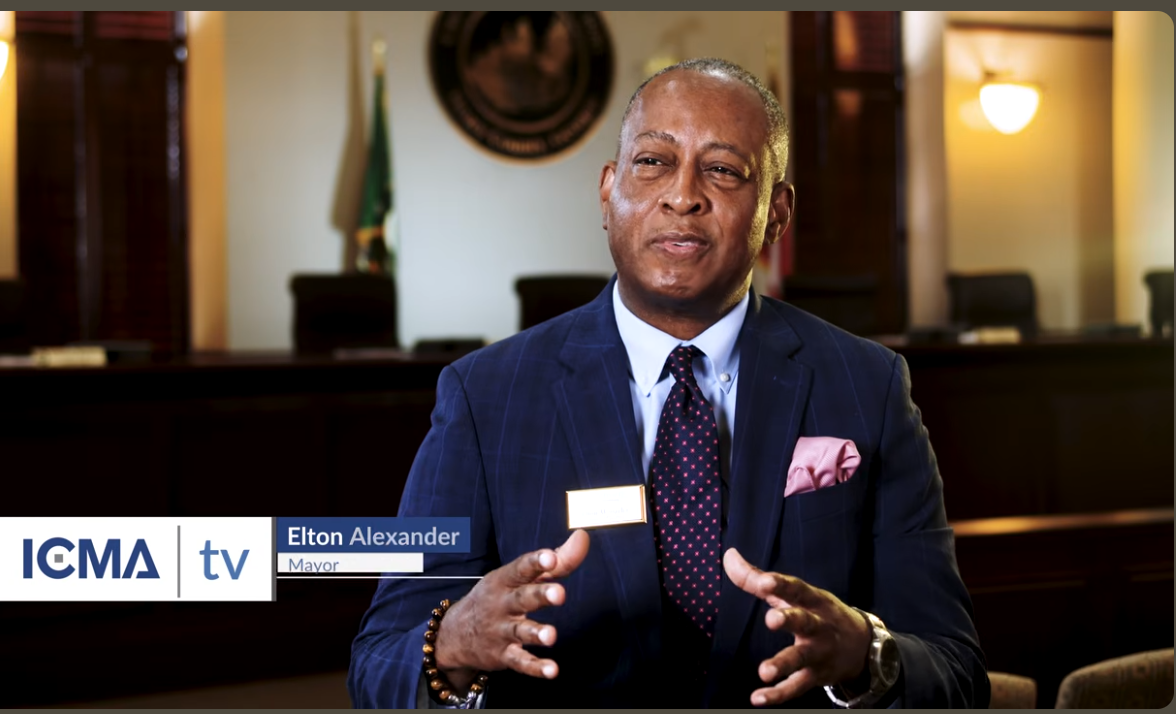
  • Outline of Past AJC Bias as re: VyStar Amphitheater

    Outline of Past AJC Bias as re: VyStar Amphitheater

    June 11, 2018. Their reporter misses the e-mail that won a federal lawsuit. He wasn’t the only one, but we’re talking about AJC right now. He publishes this story on me. It’s of relevance as I live 700 feet from the VyStar at The Bridge Amphitheater stage.

    https://www.ajc.com/news/local-govt–politics/stockbridge-man-accused-threatening-eagle-landing-cityhood-backers/smUQPjbWG8qwRZyzYUqoNJ

    These are Stafford’s amphitheater stories that I found through search + direct page extraction. They are NOT found in the default staff page view.

    By Leon Stafford (18 bylined + 1 photo gallery = 19 total)

    2019 — Planning & groundbreaking

    1. Stockbridge seeks amphitheater to make it a southside destination (2019-10-18)
    2. Stockbridge to break ground on its new amphitheater Monday (2019-10-24)

    2021 — Pre-opening & grand opening

    1. Gladys Knight, Patti LaBelle to headline opening of Stockbridge venue (2021-08-23)
    2. Gladys Knight, Patti LaBelle concert opens new Atlanta amphitheater (2021-09-30)
    3. Chaka Khan proves ‘Ain’t Nobody’ like her in Stockbridge show (2021-10-26)

    2022 — Concert reviews

    1. Sheila E., The Time bring old school funk to Stockbridge Amphitheater (2022-05-09)
    2. Lightning, rain halt Stockbridge ’80s icons concert midway through (2022-08-07)
    3. Fantasia, Johnny Gill bring soul to Stockbridge Amphitheater (2022-08-15)
    4. Rick Springfield closes Stockbridge Amphitheater 2022 concert season (2022-10-31)

    2023 — Concert reviews

    1. Stockbridge seeking to create ‘Chick-fil-A’-like service at amphitheater (2023-01-26)
    2. The Isley Brothers, After 7 bring decades of soul to Stockbridge (2023-04-20)
    3. Monica, Tank concert a ‘ladies night’ in Stockbridge (2023-06-05)
    4. Maxwell brings that Sumthin’ Sumthin’ to Stockbridge Amphitheater (2023-05-15)
    5. Babyface, Stokley bring decades of hits to Stockbridge Amphitheater (2023-09-21)
    6. Patti LaBelle, En Vogue bring the classics to Stockbridge Amphitheater (2023-08-13)
    7. Concert review: Stephanie Mills, Jeffrey Osborne still going strong (2023-09-26)

    2024 — Concert reviews

    1. TLC celebrates ‘CrazySexyCool’ on 30th anniversary in Stockbridge concert (2024-06-10)
    2. Karen Briggs, Regina Belle, Phil Perry bring jazz, soul to Stockbridge (2024-07-07)

    Photo gallery (by Leon Stafford)

    https://www.ajc.com/neighborhoods/henry/photos-gladys-knight-and-patti-labelle-perform-at-stockbridge-amphitheater/TLYNYUMSJVBVDHLOZSUED67F7I/stockbridge-amphitheater/TLYNYUMSJVBVDHLOZSUED67F7I/

    So, after participating in what I characterize in my parlance as, “a fucked up, half baked, Georgia Strategy Group produced media hit piece.” Leon, nor any other reporter that reported on my false arrest ever published the precedent setting win. But he did attend shows 700′ from my house 19 times.

    That brings us to today. I’ve previously tracked big media’s ~70 stories and 260 syndicated reposts about Jayden. In the latest AJC piece today I read, “The motion, filed with the city clerk’s office and obtained by the AJC…”

    Well, I call bullshit & a Writ of Shenanigans on how this kangaroo court was set up by Veal. Effectively making your accusers & ambitious political opponents the judge, jury and executioner seems to me is why higher courts exist. As you can extrapolate from my case. HCPD conveniently showing up with an 11th grade, 18 year old burglary suspect stinks of Henry County homecooking.

    We, as in many independent & interested Stockbridge citizens, have been asking for amphitheater financial statements and P-cards and the line items on District 5’s $110,000 phone bill for quite some time. As of today, no one I talked to could get them to answer the phone. So I’m not going to pretend AJC is publishing anything but the usual corporate stenography fed to them by the city PIO, Shana Thornton, who directly caused comments dissenting about the TAD and amphitheater to be edited out of meeting streams.

    We are, after all, just two websites now. I would thank Leroy Chapman & the gang up there for doubling down on segregating the paper and sinking the battleship. But I’m not into segregation as the Cox AJC/UATL machine seems to be.

  • The Media Hitjob So Far

    The Media Hitjob So Far

    Before you scroll down to see the depth of the media pile-on crushing our city. Let me tell you about something we all missed. At the meeting last night they admitted in writing there was unjustified spending at the amphitheater. You can’t find a single story on the $1 million+ that passed through the former amphitheater manager’s personal bank account. To date, I’m the only person who wrote anything about the city suing their former manager over $400,000 in that same account. Now, look at how many times they spammed a story about $4000 alongside completely unfounded allegations of sexual impropriety.

    After you peruse this list. Then go try to find any details of the amphitheater financial debacle. There is 1000X the money flowing into free rooftop parties you can’t attend. You can go see video of it on instagram if you want. But you can’t go up there and eat free tay payer funded lamb chops on a comped ticket.

    Published by city August 25, 2026. Found on page 130 at https://stockbridgega.portal.civicclerk.com/event/3600/files/attachment/12048

    JULY 2026 — Investigation & privilege stripping

    Total raw result rows (every syndicated copy counted): 724
    Unique URLs: 284
    Syndication multiplier: 2.55x (raw/unique)

    Breakdown of what that means:

    • ~724 is the total number of times this story cluster appeared across every search query I ran. That’s the “including republishing and syndication” number — same article showing up under MSN, AOL, Yahoo, and multiple query variations.
    • ~284 unique URLs is the real count of distinct pages. Even so, this is a conservative floor because:
      • MSN/AOL/Yahoo are Bing-syndicated mirrors of the SAME underlying WSB/11Alive/FOX5/AJC story, so many of those 284 are the same article on different hosts.
      • I only queried the outlets you named plus a few extras. I did not crawl every Atlanta outlet (e.g., Atlanta Journal-Constitution full archive, local blogs beyond the amphitheater one).

    Bottom line estimates:

    • Distinct news stories (deduped, excluding video-only and syndicated mirrors): roughly 60–70
    • Distinct web PAGES (unique URLs, all outlets + syndication): ~284
    • Total result appearances across all queries: ~724

    2026-07-19

    2026-07-20

    2026-07-21

    2026-07-22

    2026-07-23

    2026-07-24

    2026-07-25

    2026-07-27

    2026-07-29


    AUGUST 2026 — Hearings, settlement & escalation

    2026-08-06

    2026-08-07

    2026-08-08

    2026-08-11

    2026-08-12

    2026-08-17

    2026-08-18

    2026-08-19

    2026-08-20

    2026-08-21

    2026-08-22

    2026-08-23

    2026-08-24

    2026-08-25

    2026-08-26 — LATEST

  • Mayor Williams, Stockbridge City Council, and the Fight for City Hall

    Mayor Williams, Stockbridge City Council, and the Fight for City Hall

    A Henry County judge has partially restored City Hall access to Mayor Jayden Williams, ruling that the city council “overstepped its bounds” when it stripped the 22-year-old of his office, email, and records earlier this summer. It’s a legal win for Williams. The council’s investigation priorities tell a different story.

    On Aug. 17, Superior Court Judge Holly W. Veal issued her order in case SUCV2026002318, directing the city to return Williams’ key fob and restore his access to private areas during normal operating hours. Veal found that the council’s July 17 restrictions, locking Williams out of his office, cutting him off from official email and city records, and limiting his presence to public meetings only, amounted to a “constructive removal” that effectively suspended his executive authority under the city charter.

    The ruling was narrow in scope but significant in principle. Williams still cannot enter the Human Resources and Finance departments. He is barred from participating in budgetary initiatives. He remains excluded from city vehicles, purchasing cards, and gas cards. The council’s removal-track investigative hearing is now scheduled for 10 a.m. Saturday, Aug. 22.

    A Mayor With a Mandate

    At 22, Williams is the youngest person ever elected to lead a city in Georgia’s history. He defeated incumbent Anthony Ford on Nov. 4, 2025, receiving 2,909 votes (53.89%) to Ford’s 2,489 (46.11%). A Clark Atlanta University graduate born and raised in Stockbridge, Williams took office on Jan. 1, 2026, before a packed ceremony. His campaign centered on accountability and transparency, including a promise to audit city finances. The pledge has taken on new relevance.

    Williams earns $22,000 a year and has no dedicated city staff. His attorney says he self-funds outside help for marketing, social media, and organizational support.

    A Striking Inversion of Priorities

    The controversy that has consumed the city is not without merit. But the scope of the investigation reveals a striking inversion of priorities. Williams’ P-card spending, roughly $4,000 in questioned transactions over five months, is nothing compared to the five years of financial malfeasance under his predecessor.

    While Williams was being investigated for a barber receipt, the amphitheater on his doorstep was running a $1.6 million annual deficit, a former amphitheater manager was moving $400,000 of taxpayer money through a personal bank account, a $32.9 million budget amendment had passed without council approval, and an independent audit identified four material weaknesses across three consecutive years.

    If the council is going to investigate municipal mismanagement, the amphitheater is where the money is. If it’s going to censure someone, LaKeisha Gantt, the council’s loudest voice calling for Williams’ investigation, should be on that list. She was on this council for every year of the Ford-era rot. She acknowledged the amphitheater’s costs. And she did nothing.

    The specific transactions that triggered this investigation are modest in isolation. The $35 barber visit was an honest mistake, Williams’ attorney said: the city-issued P-card and Williams’ personal card look identical, and he reimbursed the city immediately. The $161 sporting goods purchase on April 5 was submitted under the form description “golf tournament” but yielded Nike pants and other clothing. Williams said his pants had ripped on the way to an event and he needed replacements. The $21.59 clothing store purchase was on a form labeled “Move with the Mayor” and, again, Williams needed pants for the event.

    During a July 26 livestream that ran nearly 90 minutes, Williams defended each transaction individually, called the council’s effort “political,” and told viewers he was “willing to fight, 10 toes down.” His attorney, Robert Kenner Jr., acknowledged that Williams “should not have used” the P-card for some items but maintained the investigation was fundamentally disproportionate. The city never trained him on proper card spending after he took office. The real story was what happened to $32.9 million in budget amendments and $400,000 in a personal account.

    The P-card issue is only part of a broader pattern. The city’s 21-page allegations letter, sent by City Attorney Quinton G. Washington on July 17, also cited serious concerns about a city-owned vehicle checked out in Williams’ name for 183 days. The Vehicle Assignment Log showed multiple entries of extended vehicle use without coinciding city business. A city vehicle was present at a nightclub while checked out by Williams, and a vehicle was damaged while checked out under his name. It is unclear whether the damaged vehicle is the same one at the nightclub.

    Williams says he did not receive a vehicle-usage policy until “two or three weeks ago” and that two other city employees also had access to the damaged vehicle. The city characterizes the situation as Williams having “unauthorized[ly] retained” a city vehicle for nearly 200 days.

    State Legislators’ Double Standard

    On Aug. 13, 2026, the same day Williams’ attorney filed an emergency motion in Superior Court to block the council’s hearing, the city’s five-state legislative delegation sent a letter to Governor Brian Kemp calling for a GBI investigation into Williams’ conduct.

    The signatories were State Sen. Emanuel Jones, State Sen. Gail Davenport, State Rep. El-Mahdi Holly, State Rep. Demetrius Douglas, and State Rep. Regina Lewis-Ward. Their letter cited “the unauthorized use of city provided purchasing cards, gasoline purchases using municipal funds, and other behavior unbecoming of the Office of the Mayor.” More seriously, it stated: “Additionally, allegations have been made that the mayor has engaged in behavior that could be considered criminal as it relates to minors.”

    The letter argued that the council’s pending removal process could “ferment continued distrust in the efficient operation of the City of Stockbridge and could hinder the prosecution of any criminal conduct that may have occurred.” The delegation positioned the GBI, not the council, as the proper forum.

    But the delegation did not wait for the independent investigator’s report, which was still ongoing. They did not wait for the Aug. 22 hearing to conclude. They escalated a local dispute into a potential state criminal probe, citing unadjudicated allegations.

    There is a conspicuous irony at the center of their letter. The same voters who put Mayor Williams in office also voted Emmanuel Jones out of his office. The grapes of wrath turn sour this late in the season.

    The $110,000 European Trip Nobody Talked About

    Emanuel Jones, the State Senator who now stands on the front of a letter asking the state to investigate a local mayor over P-card receipts, was one of six state senators who rode along on a taxpayer-funded trip to Germany and the United Kingdom. The 14-person delegation was led by Lt. Gov. Geoff Duncan and Senate Pro Tem Butch Miller, both leaving office at the time.

    The AJC reported that an internal senate probe called it a “taxpayer-funded vacation.” The cost: $110,000. The Senate took so long to act that lawmakers had to file Senate Resolution 334 in March 2023 to ban the practice. The AJC broke the story in February 2023.

    In August 2026, Senator Jones is on the front of a letter asking the GBI to investigate a 22-year-old mayor who earns $22,000 a year and allegedly spent $4,000 on questionable P-card purchases, including a $35 haircut. They helped spend $110,000 on a European vacation and now want the state’s top law enforcement agency on a barber receipt.

    The GBI responded to inquiries Aug. 17 by saying it was “aware of the correspondence” but “has not been requested for any specific criminal allegations in this matter.” Williams offered no comment when asked.

    The letter also revealed that the delegation was acting in real time with the council’s internal process. On the same day the letter was sent, the city’s independent investigator, Richard Hyde, who holds subpoena power, was still reviewing Williams’ P-card transactions. Hyde told the AJC he had “made no conclusions yet” and that “when or if there’s a hearing is above my pay grade.” The delegation did not wait. They went straight to the governor.

    The Rot Was Already There: Four Years Under Anthony Ford

    The controversies swirling around Mayor Williams are real, and they deserve scrutiny. But they did not begin with him. The financial weaknesses he promised to audit were not created in his seven months in office. They were baked into the city’s books over four years under his predecessor, former Mayor Anthony Ford.

    Under Ford, the City of Stockbridge accumulated what his administration described as a “$32.9 million discrepancy.” A massive amendment to the FY2024 budget moved funds between accounts without council approval. Ford says it was a staff error, not theft. But independent auditors who reviewed the 2022 and 2023 fiscal years found material weaknesses in internal controls spanning three consecutive years: improper capitalization of assets, improper interfund activity used to conceal amphitheater expenses by shifting them to an unrelated fund, mismanagement of receivables and revenue, and a failure to properly report accrued liabilities.

    The 2023 audit identified four material weaknesses and a significant deficiency, an increase from the prior year. Two were repeat findings from 2021 through 2023, meaning they were known, unaddressed, and growing worse. A three-year pattern of deteriorating financial controls, flagged year after year, was met with silence by the council that included LaKeisha Gantt.

    The city’s own finance director acknowledged the problem at a September 2025 council meeting. CFO Frank S. Milazi told council members that two sets of reports were being circulated, and the ones they received were not accurate. One council member was shown a report displaying $2.3 million in spending through August, when the year-end total was actually $10 million.

    Councilwoman Yolanda Barber, the lone member who voted against the Aug. 12 resolution to hold an investigative hearing and who was absent for the Aug. 17 postponement vote, was repeatedly shut down when asking for financial data. She eventually hired her own attorney to submit a demand letter for information. It took her ten months to receive the 2022 audit results.

    Councilwoman LaKeisha Gantt was the council’s most vocal advocate for investigating Williams over roughly $4,000 in purchasing-card transactions. She called the effort “not a witch hunt” and told reporters the city was “suffering” and the hearing needed to move “as soon as possible.” She also acknowledged that some of the $32.9 million amendment covered operational expenses for the amphitheater. Money flowed through the city’s accounts during her tenure.

    The inversion is striking. The council member who pushed hardest for a mayor’s investigation over a barber receipt was on the council when $32.9 million moved between accounts without approval, when an amphitheater ran a $1.6 million annual deficit, and when two sets of financial reports were being circulated. She did not call for audits. She did not demand investigations. She voted yes.

    Gantt’s public posture during the Ford era was not one of aggressive oversight, but it was something arguably worse. She was present, she was vocal at the right moments, and she performed the theater of concern without ever following through on substance. When Barber was shut down and hired an attorney to demand financial data, Gantt did not publicly side with her. She did not demand that Milazi be more transparent. She did not call for the independent auditors’ findings to be discussed in public session.

    She let the rot happen, kept her head down, and waited until a new mayor with a fresh mandate and limited institutional knowledge came in. A 22-year-old who had just been elected and did not yet have the networks to fight back, he arrived before Gantt positioned herself as the city’s moral authority on accountability.

    This is the kind of manipulation that is hard to prosecute but impossible to ignore. Gantt cultivated an image as the council’s conscience, the one who cared, the one who pushed for action, while doing nothing while the actual problems festered. She let Barber take the hits. She let Ford’s administration mislead the entire council. And when Williams arrived with his forensic audit promise and started asking questions that threatened the status quo, Gantt was the first to call for his head.

    She weaponized the language of accountability to serve her own political interests, turning a genuine concern for transparency into a cudgel against a mayor who was actually doing the work she had avoided for four years. Her performance of concern was a masterclass in political theater. Appearing engaged without taking meaningful action, positioning herself as the victim of mismanagement while benefiting from the very system that enabled it.

    The Amphitheater That Broke the Budget

    The amphitheater was at the center of the financial rot. The VyStar Amphitheater at The Bridge, a $22.5 million facility with 3,500 seats and paid in full, opened in 2021. Since then, the city has repeatedly subsidized it. In FY2025, amphitheater revenues reached only about $1 million against a $2.6 million budget, meaning the city’s General Fund absorbed the shortfall.

    City Councilwoman LaKeisha Gantt acknowledged that some of the $32.9 million amendment covered operational expenses for the amphitheater. Amphitheater manager Harold Young was terminated for breach of contract in June 2025 amid budget overruns.

    The VyStar Amphitheater at The Bridge sits at 4,650 North Henry Boulevard in a residentially adjacent neighborhood. VyStar Credit Union serves as its naming sponsor under a roughly $1.2 million, four-year deal, the same credit union that opened its first Georgia branch in the city.

    The $400,000 in a Personal Bank Account

    On his advocacy blog at stockbridgeamphitheater.com, writer Coren Randazzo (that’s me, lol) published a story on Oct. 23, 2025, titled “The Young and the restless: City claws back $400,000.” The article covered a civil complaint the City of Stockbridge filed in Henry County Superior Court on Aug. 15, 2025, against Harold J. Young, the former General Manager of the Stockbridge Amphitheater.

    The complaint, filed ex parte by City Attorney Quinton G. Washington and attorney Megan McCulloch, alleged that Young, while serving as amphitheater manager, opened and operated an unapproved bank account at Ameris Bank in his own name: “Harold J. Young Stockbridge Amphitheater,” account ending in 1358. Through this account, the city alleged, Young transacted “in excess of $400,000 of taxpayer money” that had been budgeted for the 2025 concert series.

    The complaint also alleged that Young’s subcontractors billed the city for additional money on top of the $15,000 monthly Young received under his agreement, overbilling of $5,000 or more per month, and that Young maintained at least one other bank account at Wells Fargo (ending in 5929) through which he regularly conducted city business.

    Judge Veal granted the city’s ex parte Temporary Restraining Order on Sept. 5, 2025. It was issued three days before it was formally filed with the clerk. The order froze the Ameris account and restrained Young from transferring, liquidating, concealing, or dissipating any funds. It also barred Young from opening any new bank accounts or safety deposit boxes on behalf of the city or the amphitheater.

    The mechanics of the alleged fraud are straightforward enough. The amphitheater had a budget. Taxpayer money was allocated for the concert series. Instead of routing that money through the city’s regular accounting channels, where it would have been tracked, audited, and reported, it was funneled through a personal bank account at a regional bank that Young himself opened. The subcontractor overbilling, $5,000 or more per month on top of the $15,000 Young was already being paid, suggests a pattern of systematic extraction rather than a one-time error.

    But this story deserves more attention than it received. A former city employee was accused of routing $400,000 of public funds through a personal bank account, with potential overbilling of $60,000 or more annually in subcontractor fees alone. A judge ordered the funds frozen. The city filed a civil complaint. And the mainstream press, the AJC, WSB-TV, 11Alive, Fox 5, did not cover it. The citizens of Stockbridge learned about the complaint from a blog run by a resident who signs his posts “I’m running -$200 ARR.”

    The timing compounds the irony. Young was terminated for breach of contract in June 2025. The civil complaint was filed in August 2025. The TRO was granted in September 2025. Williams took office in January 2026 and was being investigated by July 2026 over a $35 barber receipt and $161 Nike pants. The council had months of advance notice about Young’s account. They had a judge’s order freezing it. And they did nothing until Williams started asking questions that made them uncomfortable.

    When the Press Isn’t Watching

    Why was there no news coverage of $400,000 in a bank account held by a former city employee, opened without authorization, containing taxpayer money, and litigated in front of a superior court judge? That is the question that should be asked of every editor in metro Atlanta.

    Stockbridge is not a ghost town. It is home to roughly 30,000 people in Henry County. It has a mayor who was 22 when elected. It has a 3,500-seat amphitheater. It has had $32.9 million in budget amendments, material weaknesses in audits for three consecutive years, and a former amphitheater manager accused of routing $400,000 of public funds through a personal bank account. And yet the only outlet that covered the Young complaint was a partisan advocacy blog.

    This is not just a story about Stockbridge. It is a story about what happens when local journalism dies and advocacy blogs fill the void. A councilwoman’s Facebook posts about a mayor’s vehicle use get shared across dozens of comment threads. A legislative delegation writes a letter to the governor. A judge freezes an account. And the mainstream press is silent, but only when a 22-year-old mayor sues his own city does it finally break.

    The Harold Young complaint was not the only document the city produced that went unreported. The audit findings. The two sets of books. The $32.9 million amendment. The amphitheater’s annual shortfall. None of it made it into the AJC, WSB-TV, 11Alive, or Fox 5. The citizens of Stockbridge had to find out about their own finances from a blog run by a resident who signs his posts “I’m running -$200 ARR.”

    I will make a note here and tell you all to read Reed Williams at AJC. They did manage finally, after many years to publish some valid criticism of Stockbridge City.

    Williams promised a forensic audit when he ran. The city delivered him an investigation of his own P-card receipts, a barber, some Nike pants, while $400,000 sat in a personal account and $32.9 million moved between funds.

    The Legal Battle

    The legal battle over Williams’ access to City Hall was never going to be straightforward. Under the Stockbridge city charter, Williams holds the title of “chief executive” with the administrative powers granted to the city except as the charter specifically provides otherwise. The charter gives the council investigatory authority, including the power to compel testimony and require the return of access devices. But the removal process for elected officers is tightly constrained. Charter section 2.17 requires written notice specifying the grounds for removal, and a public hearing held at least 10 days after that notice is served. The council’s own “Notice of Preliminary Allegations” acknowledged that if removal is pursued, Williams is entitled to that full process.

    Williams’ emergency motion cited a prior Georgia Court of Appeals case in which the appeals court affirmed a lower court’s decision that the council could not delegate away mayoral authority granted by the charter. The legal principle is clear: the council can investigate, but it cannot unilaterally strip the mayor of the powers the voters gave him through the charter. Judge Veal’s August 17 ruling, which returned Williams’ key fob and restored limited access, appears to have followed that precedent, even as it left significant restrictions in place. The ruling was a partial victory that acknowledged the city had overstepped, without fully resolving the underlying dispute over the scope of the council’s investigatory authority versus the mayor’s executive authority.

    What Comes Next

    The story of Mayor Jayden Williams and the Stockbridge City Council has multiple threads still in motion.

    The council’s investigative hearing is scheduled for 10 a.m. Saturday, Aug. 22, 2026, postponed from Aug. 15 after the council conceded it would not meet the charter’s 10-day written notice requirement. Councilwoman Yolanda Barber was absent from the Aug. 17 vote; Councilwoman LaKeisha Gantt, the hearing’s most vocal advocate, voted for it.

    The city has engaged independent investigator Richard Hyde, who has subpoena power. Hyde was expected to take 30 to 45 days and, as of mid-August, told the AJC he had “made no conclusions yet.” He said he had been having trouble getting Williams to meet with him. A claim Williams’ attorney Robert Kenner Jr. disputed.

    The GBI investigation remains in limbo. The GBI said Aug. 17 it was “aware of the correspondence” but had not been “requested for any specific criminal allegations.”

    The court case, SUCV2026002318, is pending. Judge Veal’s Aug. 17 ruling restored some access but left significant restrictions in place. The full disposition of the TRO and interlocutory injunction motion remains undecided.

    The “behavior that could be considered criminal as it relates to minors” allegation referenced in the Kemp letter remains the most serious but least documented charge. No specific details have been made public.

    Williams told reporters on Aug. 17: “I’m happy to get back to work.” Whether he can do so and what happens when the council convenes Aug. 22 depends on decisions yet to be made.

    What the citizens of Stockbridge deserve to know is what their council decides to investigate first. The amphitheater that cost them millions over five years of financial malfeasance, or the mayor who spent $4,000 on pants over five months. The cart and the horse are still in the wrong order.