The FY2027 budget is flat on the cover. Underneath, the city moved money out of the departments that keep the town working and into the ones that put on events and grow city hall.
One number matters most
Public Works is cut $835,498. That is 17%, the deepest cut in the General Fund. Public Works is the department that paves the roads, clears the storm drains, and maintains every city building and facility. The budget packet is 240 pages. Not one page says which services the Public Works cut removes. Not one page names a road that stops getting resurfaced, a drain that stops getting cleaned, a building that stops getting repaired. The city took 17% out of the department that maintains everything, and wrote no explanation for it.
Where the money went
Twelve departments were cut to fund five. On the way down: Finance down $376,254 (13%). Information Technology down $273,077 (16%). Governing Body down $193,748 (21%). Government Buildings down $212,167 (16%). Non-Departmental down $271,360 (23%). Parks down $31,570 (12%). Economic Development down $54,778 (11%). Main Street down $23,627 (10%). On the way up: Human Resources up $1,354,402, a 219% increase. City Events up $454,260 (31%). The Executive office up $227,492 (26%). Police up $716,183 (7%). And a brand new Code Enforcement department at $608,422, funded from nothing. The packet explains none of it. No service-level justification for the HR quadrupling, the Executive increase, or the new department.
Shows outrank roads
City Events ($1,903,844) plus the amphitheater fund ($3,000,000) comes to $4.90 million. All of Public Works is $4.07 million. The city spends $840,000 more putting on shows than keeping the roads up. And when the books need balancing, the Public Works line is the one that gets cut.
The amphitheater’s books are a mess
The venue has consumed General Fund money three years running, and the numbers never line up. Fiscal 2025: the city approved $0 for the amphitheater subsidy and transferred $3,600,000. Fiscal 2026: approved $840,000. By November the city had sent $2,245,337, about 2.7 times what was approved. Fiscal 2027: the amphitheater fund budgets a $640,000 General Fund subsidy, but the General Fund’s own transfer table lists the amphitheater subsidy at $0.00. Two tables in the same packet, $640,000 apart. The expense side is a copy of last year: $1.2 million in entertainment and talent fees, $500,000 in production, $200,000 in advertising, plus professional fees, consultant fees, and security.
A raise, timed to dodge the voters
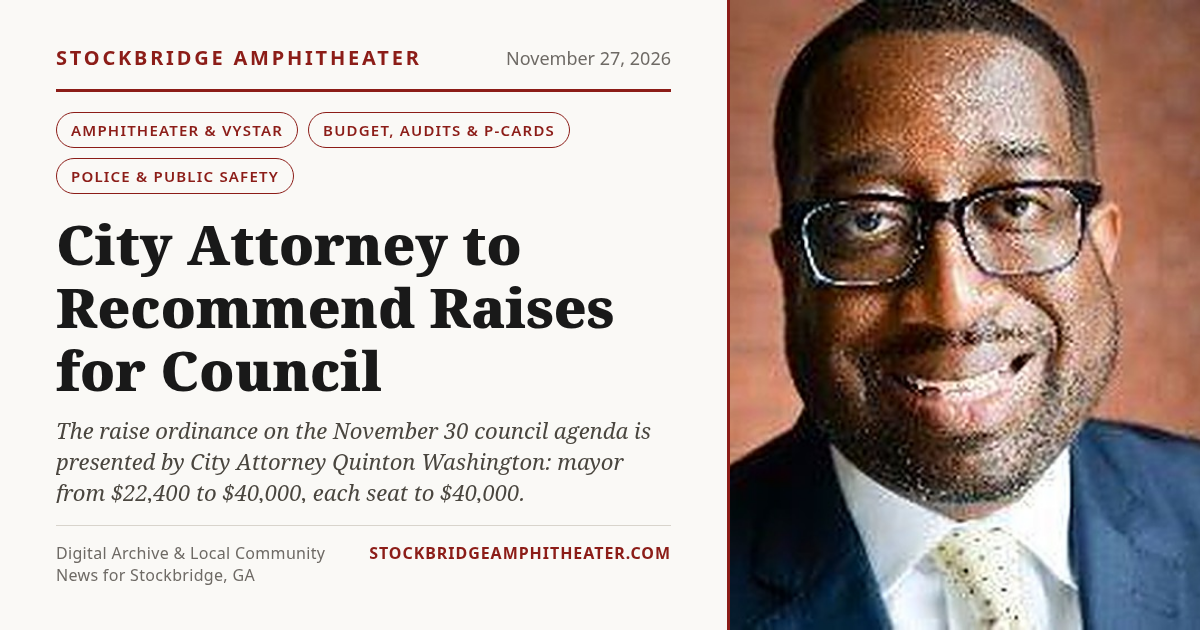
The same packet raises the mayor’s salary from $22,400 to $40,000 and each council seat from $20,000 to $40,000. That is a $117,600 increase for the six seats, adopted December 14, effective January 2028. The timing does the work. The mayor’s seat is vacant and up for special election in March 2027. The sitting council votes itself and the next mayor a raise before anyone qualifies, and the raise lands on whoever wins. The winner campaigns for a $22,400 office and collects $40,000.
The cameras come up for a vote in March, and everyone hates them
The school zone speed cameras go to a voter referendum in March 2027. Under the new state law the city cannot renew the camera contract without one. The council signs the ten year deal in December, and the same voters get their say on the cameras a few months later. Everyone already hates RedSpeed and the tickets. They are the most unpopular thing the city does. A driver gets a ticket in the mail, a processing fee on top of the fine, and no officer to argue with. Nobody likes the cameras. That is the political reality, not a prediction. The city is counting on that money anyway. The camera fund is budgeted at $1.15 million for FY2027, up 23%, with $762,960 already collected this year. The ten year extension is approved on a one page memo. The amendment text is not in the packet. No termination clause is shown, no exit ramp. That income is likely to fail at the ballot. If the referendum rejects the cameras, the $1.15 million fund and the police program built on it have to be unwound from a ten year contract the city signed right before the vote. The budget counts revenue the voters are about to take away.
The revenue is built on air
The budget counts on $2,000,000 of electric franchise fees next year. Through November 10 this year, the city has collected nine cents. Local option sales tax is projected at $8.5 million, about 14% above this year’s collection pace, in a city that is not growing.
The city is not growing
Stockbridge has grown 1.5% in four years. Henry County grew 9.5% over the same span. The residents are going to the county, where the same dollar buys a house without a city millage, a camera program, and a $3 million amphitheater line. This is a growth budget for a city that is not growing.
What to do
First public hearing was November 30. Final adoption is December 14. If you think roads come before shows, and that a council voting itself a raise should have to explain a 17% Public Works cut, the time to say it is now. Sources: City of Stockbridge FY2027 proposed budget packet, November 30, 2026 (240 pages); FY2025 audit; FY2026 budget and Q1 financial report. Figures recovered from the packet’s damaged text layer were verified by rendering and OCR and by arithmetic cross-checks, line items summing to the printed totals.