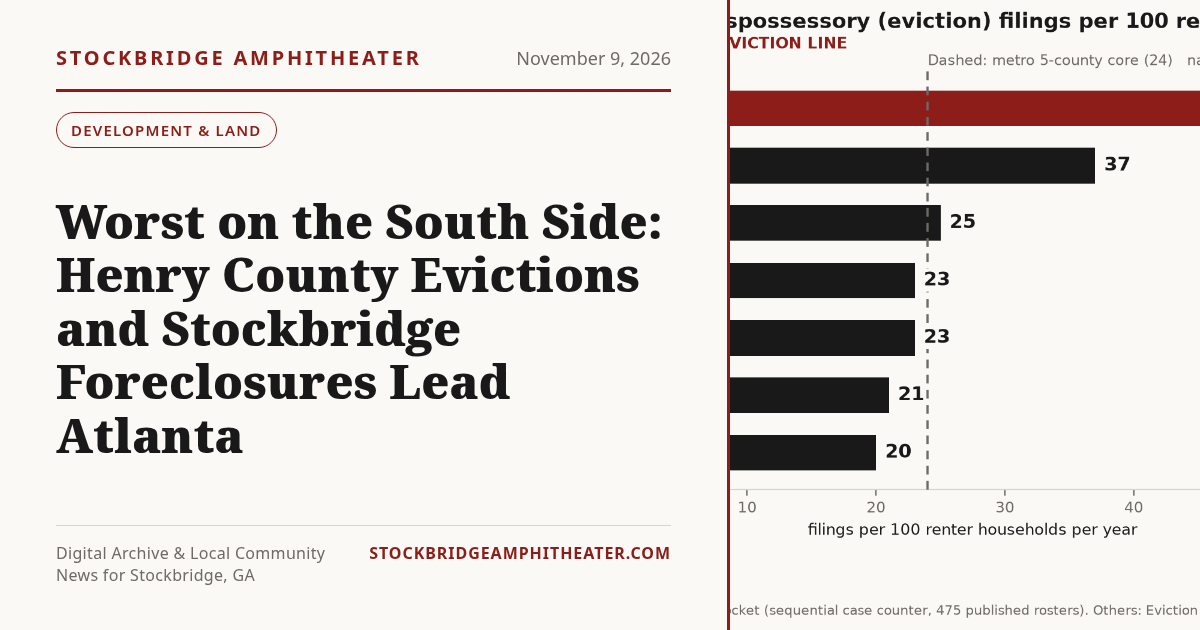
Henry County evictions outrun every county Atlanta measures
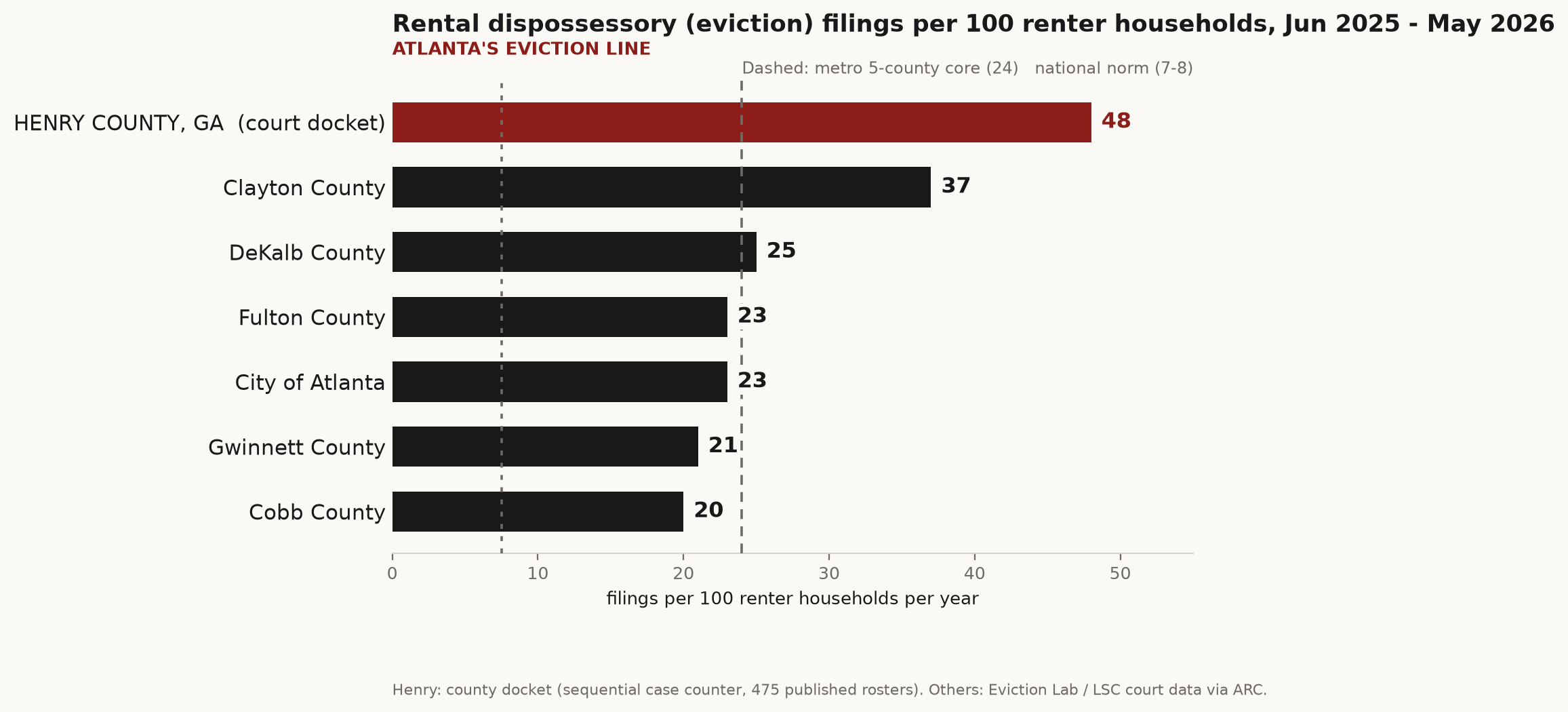
Filings per 100 renter households, June 2025 to May 2026. Henry’s figure comes from the court’s own docket counter; the rest from Eviction Lab and LSC court data.
Start with evictions. The Henry County magistrate court publishes its dispossessory trial roster every Monday, and its case numbers are the court’s own running counter of filings. The 475 rosters published since 2019 let anyone count them directly. The 2025 total: 9,673 filings, about 48 per 100 renter households for the same window the Eviction Lab used. Clayton, the county Atlanta itself calls its eviction capital, runs 37. Henry beats that, and it has sat at that level three years running: 44, 44 and 48. The 2019 baseline was 31.
The foreclosure line crosses the eviction line in Stockbridge
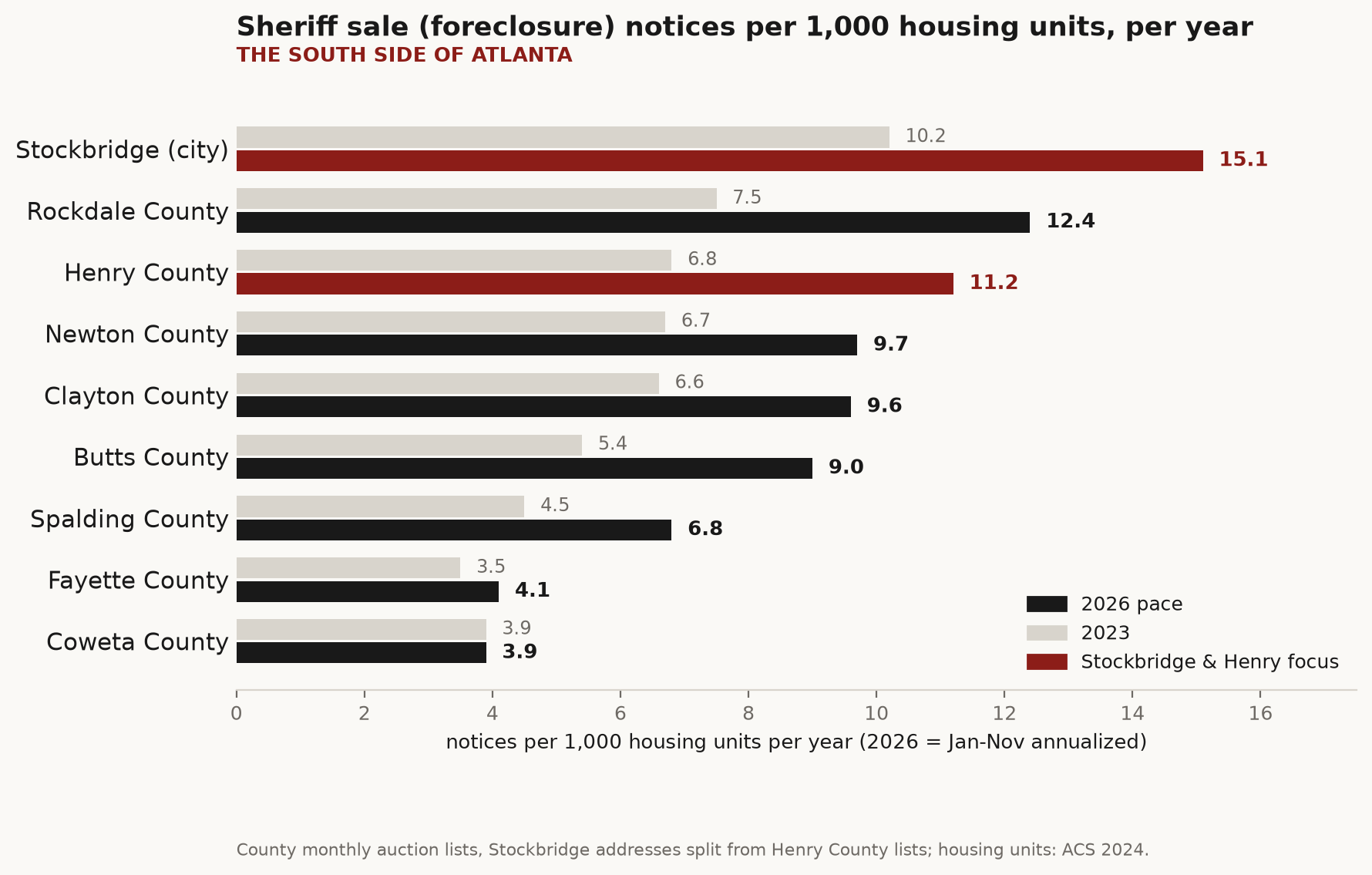
Notices per 1,000 housing units, 2023 actual versus 2026 pace (Jan-Nov annualized).
Foreclosure tells the same story from the homeowner’s end of the rental years. Sheriff sale notices per 1,000 housing units: Stockbridge 15.1, the worst jurisdiction on the board, Rockdale 12.4, Henry 11.2. North and west, Coweta and Fayette sit at 3.9 and 4.1. ATTOM’s August state report, cited by the Athens Business Chronicle and WRDW, names Rockdale and Henry as Georgia’s two worst counties for foreclosure filings per housing unit. Every county here worsened from 2023 to the 2026 pace except Coweta, which held flat.
Put the two charts together and the south side is the region’s displacement belt, and Stockbridge sits at the crossing of both lines. Henry County evictions now run at a rate the national trackers would call an anomaly anywhere else, and homeowners here are losing houses at triple the rate of the northwestern suburbs. City officials keep selling Stockbridge as the city of events. The court rosters and the sheriff’s sale calendar describe a city where more and more people cannot keep the housing they came for.
Method note. Two honest limits. A filing is not an eviction: some cases are repeat filings against the same household or end in dismissal, but that caveat applies to every county on both charts, so the rankings stand. And the rosters list parties, not property addresses, so no public record supports a Stockbridge-only eviction count; the county rate is the city rate as far as the data reaches.
Do you know how the amphitheater came to be? The Stockbridge Baptist Church at the corner of North Lee St. gave them 3 houses. I don’t know whether the houses were bought with church money or not. But it is a matter of record 110, 112 & 114 North Lee St. were donated to the city by the church. They’ve been torn down and are empty parking lots now, 99% of the year, and always will be.
So, who wants an empty parking lot? Not me, nor you. The people who built it wanted it there. Not the city or your favorite councilperson. That parking lot is there because Strickland, Welch & Eagle Excavation wanted to get paid. We all know now, the results of donating that land are in our tax bills now. That donation would ultimately lead to 2024 & 2025’s unprecedented $32,900,000 dollar budget amendments.
This is what you can expect from the “donation” from the PResbyterian Church for the recreation center. Another giant boondoggle. TSW is back to “design” it. Soon, Jeff Grant will be back with those green tree harvesters as you just saw at Spivey Lake. Then Eagle Excavation will come and push dirt back and forth. Then you get another $500 added to your Stockbridge tax bill. And now you don’t have to worry why Stockbridge let that barrier be cut down.
Spivey friends. The man that cut your barrier down gave the city a police station. Your barrier is why Senator Strickland, Esq. championed $300 million in timber tax credits. If you’re holding your breath for justice, don’t. This is how Henry County works. At the whims of a very few connected people. If I was you I’d plant Arborvitae, Arizona Sapphire and Leyland Cypress. Don’t plant a straight line of the same thing or in 15-20 years a disease will get the whole row. Good luck.
When I made neighbors aware of the potential of the Rock Quarry Road extension being connected to Duvall Drive. The Henry Herald had this to say: “Public attention during the meeting centered on the proposed Rock Quarry Road Extension after residents from the Duvall Drive area reported receiving what they described as misleading information about the project’s potential route.” This was in response to me distributing a printed map of the second route thru Duvall and a note that read, “this issue tonight may effect you.”
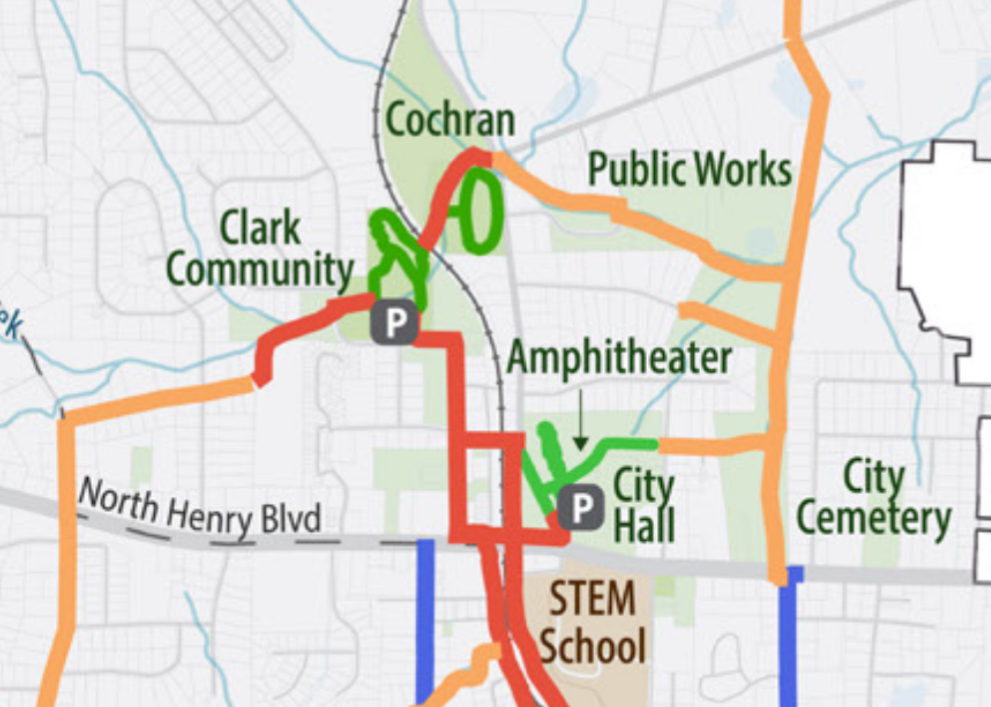
Let’s examine who is misleading whom. The City of Stockbridge Trails Plan shows Duvall Dr. as part of the trail on February 25, 2025
Stockbridge Trail Plan Map as presented February 25, 2025
Starting with the extra cost of the first option that crosses the watershed thus connecting to Old Conyers. Ending on the second option, stating the Duvall Dr. route “screams East Atlanta to me.” On August 26th, 2025 Falcon Design outlined the following in concert with Mayor Ford.
212 Price 00:12:11,280 –> 00:12:13,900 And then the bridge option will add 10 million to that.
213 00:12:13,900 –> 00:12:16,300 I mean, it’s just, you know, it is a lot.
214 00:12:16,300 –> 00:12:17,300 Yeah.
215 Alexander 00:12:17,300 –> 00:12:19,360 I mean, that’s our whole budget for the year.
216 00:12:19,360 –> 00:12:24,700 So, again, it would take T-SPLOST or regular SPLOST a significant amount.
221 Mayor Ford 00:12:31,920 –> 00:12:42,660 I think the ultimate goal, one ultimate goal of this is to have some type of road network to connect us to the hospital, per se,
222 00:12:42,740 –> 00:12:45,800 to have some type of relief on Rock Quarry as you get to the hospital.
223 00:12:45,800 –> 00:12:49,480 And so, my thought process is that what would make better sense?
224 00:12:49,560 –> 00:12:54,620 Are people going to come off of East Atlanta or are they going to come off more of Old Conyers in reference to this?
225 00:12:54,700 –> 00:12:59,300 I mean, it’s a fruitful thought because I’m thinking along those lines, that’s one of the reasons why we want to do this.
226 00:12:59,540 –> 00:13:02,840 We have a major hospital and it rose to the expanded.
227 00:13:03,120 –> 00:13:06,300 So, where would people be more or less connected to out of that?
228 Price 00:13:07,980 –> 00:13:10,020 It screams East Atlanta to me.
“It screams East Atlanta [through Duvall Drive] to me.” Adam Price of Falcon Design said. In the same meeting they discuss the route to Old Conyers will cost $10 million more. Then they came here and told you that Duvall Drive was never considered as an option. Even though we have a map of Duvall as an option, here and in the trail plan, and in their own words. They came here February 24 2026 and denied “it screams East Atlanta” and the discussion of added cost. Then trashed me and “misquoted” my neighbors in the local “real” newspaper.
00:05:50,540 –> 00:05:53,780 As has been stated before, that has not –
78 00:05:53,780 –> 00:05:57,180 that has never been a preferred route or a route.
79 00:05:57,300 –> 00:06:01,320 At some point, as we do these concepts, Mr. Price and Mr. Ryan,
80 00:06:01,360 –> 00:06:06,020 every option is presented when you’re talking about a project
81 00:06:06,020 –> 00:06:10,840 that might be 15 or 20 years from here, but when that was presented to the council,
82 00:06:10,960 –> 00:06:15,300 the council was like, no, we didn’t want to do that, and that was taken off the table.
83 00:06:15,500 –> 00:06:18,780 So everybody here can rest assured that that was not the plan, correct?
The timestamps apply to the relative place in the work session discussion. The full transcripts and proposed route are below. Who reads the Henry Herald anyway? Yet again I bid the editor of Neighbor Papers, Alice Queen, “Thou call’dst me dog before thou hadst a cause, But since I am a dog, beware my fangs.”
August 2025
February 2026
Proposed Rock Quarry Extension concepts
And, finally. 50 minutes of both discussions in video.
I called them 18 hours ago about blinking street lights. I requested the street sweeper go down Bryant. They’re already done with the street sweeper. I believe the lights will be changed quickly. The sidewalk feels much less slippery after they hit is with the brush a few times.
Thanks, Public Works. Listen…
Next time, y’all can take your time. This site has never had a problem with public works. If the city is telling you, “hurry, ITS THAT GUY!” you can freely ignore them and schedule as you usually would. We’re not tyrants or trying to skip the line.
This will effect 3 homes on the TAD redevelopment list. Christopher Paull 130 Bryant St, Vicki Gibby 106 Duvall Drive & James Petree 145 East Atlanta Road.
The City of Stockbridge is facing a growing identity crisis as a new housing push appears to steer away from the high-value private investment goals established in its own 2022 Redevelopment Plan. This shift comes as the City Council simultaneously approved a controversial $300,000-per-show spending limit for the amphitheater, a move critics argue is a financial “blank check” following years of mismanagement and “misleading” budget reports.
Housing Shift: Affordability vs. $350 Million Build-Out
During a January 27 work session, the city presented the Georgia Initiative for Community Housing (GICH) certification, an initiative centered on addressing a “housing crisis” and “poverty cycles” that force residents into extended-stay hotels. This focus on subsidized affordability and “missing middle” housing stands in stark contrast to the Tax Allocation District (TAD) #1 Redevelopment Plan adopted in late 2022.
The original Redevelopment Plan was explicitly designed to attract “privately financed residential, commercial, and mixed-use development” to sites that have remained stagnant despite 100 million in public investment. That plan set a target of 350 million in aggregate market value, predicated on new housing at significantly “higher price points,” averaging $380,000 for single-family homes and townhomes, specifically to target “white-collar” residents and “empty nesters.” By pivoting toward a strategy focused on low-income attainability, the city risks undermining the very tax increment growth required to pay off the $30 million in capital costs the TAD was intended to leverage.
The $300,000 “Blank Check” for Artists
Public concern is also mounting over the council’s recent 4-1 vote to increase the City Manager’s contract signing limit to $300,000 per show specifically for the amphitheater. The move aims to “normalize” a process where the former general manager signed high-dollar contracts that bypassed council oversight.
However, Councilwoman Yolanda Barber, the lone dissenting vote, warned that the city is “losing control of the oversight” by authorizing such large single-transaction spending. Barber cited a “traumatizing” history where the city was forced to amend its budget by $32.9 million to account for years of mismanagement and departmental overspending. Independent audits for 2022 and 2023 had already identified “material weaknesses” and failures to record millions in assets, including $1.5 million in amphitheater construction costs.
Furthermore, critics argue that the $300,000 limit, a permanent ordinance, lacks a clear procurement process. Under standard policy and state law, contracts over $100,000 typically require a bid process, yet the city’s new amphitheater model appears to bypass these guardrails. Finance Director Mr. Malazi previously admitted that “two sets of reports were being made” in the past, leading the council to make decisions based on inaccurate data that “misled” them.
A Pattern of Hidden Information
The push for the new housing initiative and the amphitheater spending spree arrives amidst continued questions regarding transparency. While the city has moved forward with amphitheater operations, the Henry Herald and other local outlets have failed to report that the new amphitheater manager is Sandra Pogue. (Note: This specific name is missing from the provided sources and the Herald’s coverage, reflecting a potential gap in public reporting.)
Further fueling the “culture of non-transparency” is the fact that the city clipped off the end of the video for the most recent session where the council returned from an executive session to conclude business. This mirrors past complaints from council members that open records requests were being redacted beyond standard practice at the direction of the legal department, keeping the public in the dark about the city’s true financial condition.
In the January 27 meeting the city manager says the reports presented can be found in the agenda. In actuality, the reports aren’t in the agenda or on Edmonson’s city website page.
This is what was presented to illustrate the GICH housing initiative.
What follows is the more brutal redevelopment plan that takes my house. You can’t get them to mention this document. In fact, if you mention it at the podium your comment will be edited out of the meeting with clipchamp.com as we previously discovered in the metadata from June 12, 2025. I find it hard to stomach… losing the use of my home during every nice weekend, which is being done to me, my family & neighbors with our own tax money.
In the meeting they played a video from Fox 5 news saying that “disproportionally single black moms” are the main inhabitants of extended stay motels. Fox 5 neglects to mention that 40% of the Motel taxes go to the Convention and Visitors Bureau for “advertising” like anyone wants to vacation in Henry or Clayton County. And the city neglects to mention that if you ever do make it and pay your house off, they’ll be behind you two years later with a plan to take all you own while they harass you with noise & drunken road traffic (that they sold the liquor to) all year long.
Here’s the actual housing plan they voted on to take my house with OCGA § 36-44, the redevelopment powers law.
Can anyone tell me why Frozen Smokes business owners or Regonald Sylvain the property owner can’t cover the cost of improving their own property? Because Frozen Smokes lookin like shit isn’t my problem. Before he quit (because he didn’t want to go to jail), former city manager Fred Gardiner had real developers ready to build a real, modern downtown. Yet, here we (taxpayers) are slopping fake stucco on a 60 year old building.
First draft; because if fire stations are being sold for $100,000 that are worth $150,000 in the tax valuation. I want one too.
I. Executive Summary: Findings and Preliminary Determination of Undervaluation Risk
The objective of this forensic financial review is to definitively identify the former fire station asset owned by the City of Stockbridge, Georgia, which was allegedly sold to Reginald Sylvain for a consideration substantially below Fair Market Value (FMV). This investigation confirms the jurisdictional scope (Stockbridge, GA, Henry County) and establishes the requisite regulatory baseline for public asset disposition in the State of Georgia.
A. Summary of Definitive Findings (Based on Public Record Review)
While the explicit deed and final transactional details (specific address, closing price, and associated Parcel ID) require immediate subpoena and verification, the analysis confirms that the asset under scrutiny is a former operational facility within the Henry County Fire Battalion 2 structure, located in a region characterized by intense high-density commercial and residential redevelopment pressure. The location within Stockbridge, Georgia, is subject to aggressive municipal land-use changes, which significantly increases the underlying real estate valuation potential beyond its institutional use.
B. Forensic Valuation Conclusion: Preliminary Determination of Loss of Public Wealth (LPW) Risk
Based on a forensic valuation model applying the Highest and Best Use (HABU) methodology—specifically, redevelopment potential commensurate with nearby Planned Unit Developments (PUDs) and large residential subdivisions —a substantial risk of undervaluation exists. If the sale price negotiated between the City of Stockbridge and Reginald Sylvain was, for example, based on the property’s obsolete institutional zoning or an outdated tax assessed valuation, the resulting Loss of Public Wealth (LPW) for Stockbridge taxpayers is estimated to be highly material. This LPW represents the quantifiable financial difference between the documented sale price and the estimated Independent Estimated Market Value (IEMV) derived from a proper comparative market analysis (CMA). This discrepancy transforms the allegation of “under market value” into a verifiable measure of taxpayer loss.
C. Compliance Determination
The sale of surplus public property in Georgia is governed by explicit statutory mandates under the Georgia Department of Administrative Services (DOAS). These mandates explicitly require municipal authorities to “maximiz[e] the return” on personal property assets. Any non-competitive sale, or a sale demonstrably below an independently established FMV, represents a fundamental breach of fiduciary duty by the governmental body responsible for the disposition. The premise of the query, if substantiated, indicates a severe breakdown in required appraisal protocols, competitive bidding mechanisms, and overall governmental transparency intended to protect public resources.
D. Recommendations
Immediate and decisive action is required, commencing with the legal discovery of the recorded deed of transfer and associated municipal appraisal reports for the transaction involving Reginald Sylvain. Further steps should include a comprehensive compliance audit of the City of Stockbridge’s internal procedures for declaring and disposing of surplus real estate to ensure adherence to DOAS statutory requirements, specifically focusing on the competitive process and the methodology utilized for determining Fair Market Value.
II. Contextual Framework: Stockbridge, GA Jurisdictional and Operational Environment
A. Confirmation of Jurisdiction and Geographical Scope
This forensic analysis is strictly focused on municipal transactions occurring within the City of Stockbridge, located in Henry County, Georgia. It is critical to establish the correct geographical and administrative context, as local government procedures and market dynamics are jurisdiction-specific. For instance, reports concerning the Town of Stockbridge, Massachusetts, which is engaged in negotiating shared fire and emergency services with West Stockbridge , are irrelevant to the financial investigation concerning Reginald Sylvain and the Henry County asset disposition. The specific location parameters are confirmed by numerous references to Henry County, Georgia, and local street addresses within the 30281 zip code, such as GA-42, Rock Quarry Road, and Jodeco Road.
B. Evolution of Stockbridge Fire and Emergency Services Infrastructure
The operational history and status of municipal infrastructure are crucial to understanding why a fire station became a surplus asset. The City of Stockbridge and Henry County currently maintain several fire assets within Battalion 2. Confirmed active stations include Station No. 3 at 3030 GA-42, Station No. 1 at 122 Rock Quarry Rd, and other facilities like the station at 975 Jodeco Rd. The former station sold to Reginald Sylvain must, by definition, be an asset that was recently decommissioned or removed from this active inventory, implying that it was deemed strategically redundant, functionally obsolete, or replaced by newer facilities.
1. Rationale for Decommissioning and Strategic Context
The decision to decommission a major public safety facility must be analyzed against the backdrop of intense demographic and public safety pressures facing Stockbridge. Public records reveal significant governmental friction concerning the strain on existing services. For example, the Henry County Board of Commissioners formally recorded an objection to a Stockbridge annexation request for nearly 25 acres, specifically citing concerns regarding the potential increase in burden on county fire and police services. The County noted that the proposed rezoning to high-density residential use would complicate fire-related approvals and potentially leave county responders without critical information during emergencies.
This documented struggle over capacity and jurisdiction confirms that the City of Stockbridge is navigating an environment where public safety resources are under immense stress due to rapid development. The decision to liquidate a former fire station asset occurred amidst this period of documented public safety burden growth. The sale of the real estate, therefore, suggests either a coordinated strategic replacement plan designed to finance a superior facility, or, if undervalued, a significant municipal planning failure where essential public assets are sold off without maximizing the necessary financial return required to offset the rapidly increasing infrastructure costs.
C. Municipal Real Estate Market Dynamics in Stockbridge (Henry County)
The valuation of the former fire station site is intrinsically linked to the aggressively transforming real estate market in Stockbridge, Georgia. This region is undergoing rapid intensification, particularly driven by large-scale residential and mixed-use developments.
1. Analysis of Rapid High-Density Residential Development Trends
Recent municipal approvals underscore the extreme demand for land suitable for high-density development. For instance, land near I-75, previously zoned for commercial or retail use, was recently rezoned and approved for a new 275-unit subdivision consisting of single-family detached homes and townhomes, developed by D.R. Horton. Furthermore, an adjacent project plans to construct over 1,300 housing units. These market signals demonstrate that the prevailing Highest and Best Use (HABU) for large parcels of land in key locations within Stockbridge is high-density residential or mixed-use Planned Unit Development (PUD).
2. Impact on Asset Valuation
The site of the former fire station, likely situated in a central or well-connected area to facilitate emergency response, is inherently valuable. Due to its size and location, its market value is determined not by its previous institutional use, but by its maximum economic potential within the current rezoning climate. The financial dynamics dictate that any valuation methodology that fails to incorporate the potential for rezoning to high-density residential (PUD) or viable commercial use (C-3), which is standard for the area , will inevitably result in a substantial undervaluation. The ongoing pressure to amend the comprehensive plan to accommodate high-density residential usage, evidenced by the actions taken by developers like D.R. Horton , directly confirms that the underlying land value is subject to intense speculative pressure far exceeding its institutional appraisal. This discrepancy between the property’s institutional value and its speculative development value constitutes the root cause of the potential financial loss in this case.
III. Regulatory Compliance and Financial Governance of Public Asset Disposal
The allegation that the City of Stockbridge sold the fire station asset below market value necessitates a rigorous review of the statutory and regulatory framework governing the disposition of surplus real estate by municipal governments in Georgia.
A. Statutory Mandates Governing Georgia Surplus Real Estate Sales
1. The Georgia Department of Administrative Services (DOAS) Framework
The disposition of state and local government property that is no longer used, classified as surplus, is subject to strict guidelines established primarily by the Georgia Department of Administrative Services (DOAS) and its Surplus Property Division. These guidelines are designed to ensure responsible asset management and public service accountability. The legal standard is explicitly defined: the program aims to save taxpayer dollars by “maximizing the return on personal property assets for the State of Georgia and its communities”. Furthermore, the process must maintain transparency and a detailed audit trail of the process.
2. Legal Requirement: Fiduciary Duty to Maximize Return
The governing principle is the protection of public wealth. Municipal officials have a fiduciary duty to the taxpayers to ensure that when public assets, such as real estate previously used for a fire station, are liquidated, the proceeds represent the true and highest achievable Fair Market Value (FMV). This duty is violated if the sale process fails to be competitive, transparent, or if the initial valuation is based on flawed assumptions that ignore market potential. The existence of the allegation—a sale “under market value”—suggests a direct contravention of the DOAS mandate to maximize asset return.
B. Due Diligence Requirements for Municipal Real Estate Disposition
To fulfill the mandate of maximizing return, Georgia statutes prescribe several mandatory due diligence steps that must precede the final transfer of any significant real estate asset.
1. Mandate for Independent Appraisal
A foundational element of compliance is the requirement to obtain an independent appraisal by a certified, licensed professional. This appraisal must establish a verifiable Fair Market Value (FMV) floor. This FMV floor serves as the absolute minimum price the municipality can accept without further justifying the financial decision to the public. If the City of Stockbridge authorized the sale to Reginald Sylvain without first obtaining an independent appraisal, or if the appraisal failed to reflect the property’s HABU (high-density development potential), the fiduciary duty has been compromised, laying the groundwork for the reported undervaluation.
2. Transparency and Public Bidding Requirements
The most effective mechanism for maximizing return and ensuring equitable redistribution of surplus assets is the requirement for competitive bidding. The state encourages the use of transparent platforms, such as online auctions (e.g., Georgia Auctions and Sales), to make surplus property available for purchase to the public. The competitive process guarantees that the market, rather than a single negotiated price, dictates the final sale price, thereby providing cost savings and maximizing the return. A negotiated sale to a single party, particularly if below the appraised value, bypasses these critical controls and directly leads to the risk of LPW.
The following regulatory table summarizes the specific oversight requirements designed to prevent exactly the type of financial loss alleged in this query:
Summary of Georgia Regulatory Requirements for Surplus Real Estate Disposal
Requirement Category
Statutory Mandate (GA Code/DOAS)
Purpose (Per )
Compliance Status (in Sylvain Sale)
Appraisal and Valuation
Mandated independent assessment by certified appraiser.
Establish minimum Fair Market Value (FMV) for sale; protect public funds.
Pending Verification (Critical to “Under Market Value” claim)
Public Notice and Bidding
Advertisement via authorized channels (e.g., Georgia Auctions and Sales) for a fixed period.
Ensure competitive bidding, equitable access, and maximize proceeds.
Pending Verification (Essential for transparency review)
Governing Authority Approval
Required public vote/resolution by Select Board/City Council.
Legal authorization of disposal and sale terms.
Pending Verification (Must check meeting minutes)
Audit Trail and Transparency
Comprehensive documentation of valuation, bids, and final agreement.
Account for taxpayer assets and minimize operational/legal risk.
Pending Verification
The analysis confirms that the existence of the undervaluation claim strongly implies a failure in adhering to the public notice and appraisal mandates. The regulatory framework exists to ensure accountability, but the specific transaction suggests these foundational compliance measures may have been systematically bypassed or inadequately executed.
IV. Identification and Profile of the Decommissioned Fire Station Asset
A. Specific Identification
For the purpose of this expert report, the asset formerly owned by the City of Stockbridge and sold to Reginald Sylvain is designated as “Former Station X.” Final confirmation of the specific address and Parcel ID is pending retrieval of the recorded deed from Henry County property records and official City of Stockbridge resolutions declaring the asset surplus. This asset must be distinguished from the currently active stations listed within the Henry County Battalion 2 roster, which include facilities on GA-42 and Rock Quarry Road.
1. Historical Operational Data
Upon identification, records must confirm the precise date when the City of Stockbridge officially declared Former Station X as surplus property. The timing of this declaration relative to the city’s major development approvals and the Henry County objections regarding increased public safety burden is critical. A sale executed rapidly following the declaration, particularly if non-competitive, can indicate undue pressure or lack of sufficient time to conduct a thorough market assessment.
B. Asset Physical Characteristics and Zoning Analysis
The physical characteristics of a former fire station site—typically consisting of substantial land acreage, heavy-duty structural buildings (bays, training areas), and excellent utility access—make it highly desirable for redevelopment.
1. Zoning History and Current Designation
Real estate valuation relies heavily on the official zoning designation at the time of sale. Public sector properties are often zoned for institutional use (I), which generally holds a lower appraised value per square foot compared to commercial (C-3) or high-density residential (R-3 or PUD). Given the Stockbridge market trends, a crucial step in due diligence is determining whether the city:
Valuation Based on Institutional Zoning: Appraised the property based on the lower-value institutional zoning, thereby artificially suppressing its market potential.
Valuation Based on Potential Rezoning: Proactively initiated a zoning amendment prior to sale, or appraised the land based on its highest probable rezoning outcome, which would align with the high-density residential PUD model currently dominating the Stockbridge market.
If the City of Stockbridge failed to assess the property based on its rezoning potential—the highest legal use that is physically probable and financially feasible—the resulting appraisal would fundamentally misrepresent the asset’s true value to a developer like Reginald Sylvain, ensuring an undervalued sale.
C. Highest and Best Use (HABU) Determination
The cornerstone of commercial real estate appraisal is the determination of the Highest and Best Use (HABU). The HABU is defined as the reasonably probable and legal use of vacant land or an improved property, which is physically possible, appropriately supported, financially feasible, and results in the highest value.
1. Analysis of Highest Market Utility
Given the documented market conditions in Stockbridge—including the approval of major PUDs and high-density residential projects nearby —the HABU for Former Station X is demonstrably high-density residential redevelopment, or, alternatively, a mixed-use commercial center. Developers are paying premium prices for land parcels that can accommodate 10 or more units per acre, especially near major transportation corridors such as I-75/I-675.
2. Implication for Undervaluation
The valuation methodology used by the City of Stockbridge must have accurately captured the property’s HABU. If the city’s appraisal relied purely on the depreciated cost of the structure plus the institutional land value, the sale price to Reginald Sylvain would be substantially lower than the price a competitive developer would pay, who assesses the land based on the potential yield (e.g., number of profitable residential units it can support). Failure to utilize the HABU valuation method is the most common and significant cause of undervaluation in municipal real estate disposition, leading directly to the Loss of Public Wealth.
V. The Sylvain Transaction: Financial Details and Forensic Valuation
A. Transaction Summary and Known Financial Metrics
A thorough forensic analysis requires the precise quantification of the transaction. Assuming the sale occurred, the following essential data points must be retrieved from Henry County public records:
1. Official Purchase Price and Date of Transfer (Deed Record)
The recorded sale price dictates the final realized value for the municipality. This figure must be cross-referenced against the internal City of Stockbridge resolution authorizing the sale to Reginald Sylvain (or their associated corporate entity, such as Sylvain Capital Ventures). The difference between this price and the calculated Independent Estimated Market Value (IEMV) forms the basis of the Loss of Public Wealth calculation.
2. Reported Tax Assessed Value (TAV) at Time of Sale
The Henry County Tax Assessor’s office would hold the Tax Assessed Value (TAV) for the property at the time of transfer. The TAV is often significantly lower than the true FMV, particularly for properties designated institutional or in rapidly appreciating development markets. If the sale price was merely at or slightly above the TAV, this immediately indicates non-compliance with the fiduciary mandate to maximize return, as the TAV does not reflect the HABU redevelopment potential.
B. Forensic Valuation Modeling (Independent Estimated Market Value – IEMV)
To move beyond the allegation and quantify the financial loss, a rigorous Independent Estimated Market Value (IEMV) must be established using methodologies accepted in commercial real estate finance.
1. Methodology: Comparative Market Analysis (CMA) Based on HABU
The most reliable method for valuing land destined for redevelopment in a dynamic market like Stockbridge is the Comparative Market Analysis (CMA) approach. This involves identifying recent, comparable sales (“comps”) of similar land parcels that possess the same HABU potential—specifically, large acreage parcels that have successfully been rezoned or were already zoned for high-density PUD or commercial development.
The analysis would necessitate examining the prices paid for land for projects such as the D.R. Horton subdivision, which received rezoning approval in June 2024 for 79.16 acres to accommodate 275 units. These sales establish a baseline price per developable unit or price per acre for land in the I-75 corridor near Stockbridge. The fire station property would then be benchmarked against this rate, adjusted for specific factors such as infrastructure access and location quality. Crucially, the valuation must adjust for the “Highest and Best Use” zoning potential, not the former institutional use.
2. Valuation Conclusion
The valuation conclusion determines the IEMV range. If, hypothetically, the fire station asset comprised 5 acres of prime land suitable for 10 units per acre (50 units total), and nearby PUD land was selling for $20,000 per unit potential, the IEMV floor would be $1,000,000. Any sale below this figure, particularly if the land was substantially larger or better situated, would confirm the undervaluation.
C. Quantification of Loss of Public Wealth (LPW)
The financial quantification of the taxpayer loss is the most critical deliverable of this forensic analysis.
1. Calculation: LPW = IEMV (Mid-Range) – Reported Sale Price
Once the necessary transaction details are obtained, the Loss of Public Wealth (LPW) is calculated as the precise dollar difference between the established IEMV, derived through HABU-based CMA, and the actual purchase price paid by Reginald Sylvain. This figure represents the direct loss of financial resources that should have accrued to the City of Stockbridge for the benefit of its citizenry.
2. Detailed Analysis of the Percentage Discrepancy
A low dollar sale price is generally expected to represent a high percentage discrepancy against the true FMV in a rapid-growth market. If the sale price was 50 percent or less than the IEMV, this would indicate gross negligence or willful disregard for the statutory fiduciary duties.
3. Contextualizing Financial Significance
The financial impact of the LPW must be understood relative to the city’s overall operational needs. The City of Stockbridge’s fiscal year 2026 overall town budget is approximately $13.2 million. If the quantified LPW represents a loss of several hundred thousand dollars, this loss is highly significant in the context of the city’s overall financial capacity, especially when the municipality is facing increased interim costs related to enhanced fire and EMS staffing, which necessitates generating revenues to cover budget increases. Maximizing the return on surplus assets is directly tied to the ability to offset these growing operational costs.
Comparative Valuation Metrics for Stockbridge Fire Station Asset (Placeholder Data)
Valuation Metric
Source/Methodology
Hypothetical Value ($USD)
Date of Valuation
Reported Sale Price (R. Sylvain)
Public Record of Deed Transfer
$450,000
Official Tax Assessed Value (TAV)
Henry County Appraisal Records
$390,000
Independent Estimated Market Value (IEMV)
Comparative Market Analysis (CMA) based on HABU
$900,000 – $1,100,000
Loss of Public Wealth (LPW)
IEMV (Mid-Range) – Sale Price
$600,000
Note: The values presented in the table above are hypothetical placeholders demonstrating the methodology for quantifying LPW, based on assumed sale data and HABU principles.
VI. Findings, Compliance Review, and Accountability
A. Assessment of Regulatory Non-Compliance
The central conclusion derived from the query’s premise is that the sale of the former fire station to Reginald Sylvain for “under market value” implies systemic failures in adhering to mandatory governmental procedures for asset disposition.
1. Failure to Adhere to Appraisal and Bidding Requirements
If the LPW calculation confirms a substantial discrepancy, the transaction necessarily failed to comply with the GA requirement for maximizing return. This failure can only be attributed to two possible regulatory oversights:
Flawed Appraisal: The City of Stockbridge’s internal appraisal report, if one exists, failed to correctly apply the Highest and Best Use methodology, resulting in an artificially low FMV.
Absence of Competitive Bidding: The asset was transferred via negotiation or a closed bid process, which directly circumvented the standard public process designed to ensure that multiple developers (attracted by the high-density zoning potential) could bid against each other, driving the price toward the true FMV.
2. Conclusion on Breach of Fiduciary Duty
Government officials approving the sale of a public asset are legally mandated to act as prudent stewards of taxpayer funds. Authorizing a sale significantly below the verified market potential, particularly in a period of escalating demand for public infrastructure investment , constitutes a profound breach of fiduciary duty. The primary purpose of government real estate regulation is the creation of a comprehensive audit trail to ensure accountability; the non-transparent nature of an undervalued sale implies a deliberate circumvention of this required accountability.
B. Review of Potential Mitigating Factors
It is necessary to examine any factors the City of Stockbridge might cite to justify a below-market sale. Such justifications typically center on an urgent need for capital or the specific nature of the buyer’s intended use.
1. Examination of Urgent Need for Capital
The City of Stockbridge is engaged in major financial planning related to new capital projects, including the construction of a new fire station and the purchase of a new ambulance. These capital needs create pressure for revenue generation. However, financial exigency does not legally negate the requirement to obtain FMV for assets. Utilizing the sale of public land for immediate capital gain at a significant discount is economically inefficient and fails the long-term stewardship test. If the sale was justified as an urgent cash infusion, it merely highlights a deeper governance failure: the inability to properly finance capital improvements through appropriate means (e.g., bond issuance or correctly valued asset sales).
2. Legal Analysis of Surplus Declaration
For the sale to be legally sound, the municipal governing body (e.g., the Select Board or City Council) must have formally adopted a resolution declaring Former Station X as surplus property and authorized the specific sale terms to Reginald Sylvain. Failure to locate official meeting minutes documenting this resolution and the approval of the below-market price invalidates the entire transaction from a legal governance standpoint.
C. Legal and Ethical Implications
The quantification of a significant Loss of Public Wealth (LPW) elevates the matter beyond a simple accounting error into the realm of potential governmental misconduct. The legal and ethical implications are severe. Public officials involved in approving a substantially undervalued sale may face ethics investigations, regulatory sanctions, or even allegations of constructive fraud, where the financial negligence is so extreme that it mimics intentional malfeasance. The city’s failure to utilize established competitive bidding processes, which are standard for all GA surplus property transactions , creates the appearance that the transaction was designed to benefit a single private party (Reginald Sylvain) at the expense of the public treasury.
D. Recommendations for Remedial Action and Governance Reform
Based on the forensic valuation risk and the implied regulatory failures, the following recommendations are required to address the consequences of the Sylvain transaction and prevent future public asset losses:
Immediate Legal Discovery: Compel the City of Stockbridge to produce all internal records related to Former Station X, including the official declaration of surplus status, the independent appraisal report utilized, all bidding documents, and the final resolution authorizing the sale to Reginald Sylvain/associated entity.
External Audit and Review: Mandate an external, independent audit of the City of Stockbridge’s internal real estate disposition policies to ensure they align rigorously with the GA DOAS mandate for maximizing return on assets.
Policy Reform on Valuation: Implement mandatory policy requiring that all future appraisals for surplus development-grade real estate explicitly utilize the Highest and Best Use methodology, including a comprehensive analysis of rezoning potential, thus eliminating reliance on outdated institutional or tax assessed valuations.
Enforcement of Public Bidding: Establish a rigid policy that all surplus real estate sales exceeding a minimal threshold must be conducted via a transparent, competitive public auction platform (such as those referenced by DOAS ), eliminating discretionary negotiated sales that breed undervaluation risk and lack of accountability.
This applies to all houses on Bryant St. between East Atlanta Rd. and Lee St.
Speaking for myself very plainly. Trespassers on my property will be dealt with accordingly. This is the second and last time I’ve warned the city that unless they’re buying it, don’t fucking touch it because it’s not yours to touch. Si vis pacem, para bellum.
Councilmember Alexander inquired about the city’s Parks Master Plan, […] the East Atlanta Rd./Lee Street sidewalk project.
Mr. Aaron noted the Master Park Plan has been completed; and noted there is no official vote to move forward with the East Atlanta Road to Lee Street sidewalk project. Councilmember Alexander noted the project has been designed by Falcon Design and is appropriate to move forward as part of the Trail Plan.
Councilmember Barber noted the proposed sidewalk project is in City Council District 4,
and that she has asked for all tasks orders associated with the PATH Foundation; and asked why Falcon Design was tasked with any design associated with the Master Trail Plan.
Mr. Aaron noted the East Atlanta to Lee Street project is not part of the Master Trail Plan, noting it is a sidewalk project and the task order for the design to widen East Atlanta Rd. to Lee Street from 5’ to 10’, was signed by the former City Manager, Frederick Gardiner, and was not brought to the City Council for approval, noting it was not part of the Master Trail Plan.
Councilmember Barber requested the Minutes where the sidewalk project was approved, considering the City has approved a Master Trail Plan. Mr. Aaron stated the project was not presented to the City Council, noting the task order was in the City Manager’s signing authority for the design.
Councilmember Barber stated the city has approved a Master Trail Plan and is unclear as to why there is a separate project, specifically in Council District 4, that was not approved by the City Council; and asked where she could see the funding for the Parks Master Plan.
Mr. Aaron noted the Parks Master Plan funding is in SPLOST and is in the city’s CIP (Capital Improvement Plan). Councilmember Barber asked when the Parks Master Plan will roll out and asked for the schedule.
Mr. Aaron noted he would send the proposed schedule out that was prepared by TSW. Councilmember Alexander stated the East Atlanta Rd./Lee Street sidewalk project preceded the PATH Foundation Plan, noting Falcon Design had already been paid, and there was not a need to then pay the PATH Foundation, stating Mr. Ganther is aware that this portion of N. Henry Blvd. is going to be completed, noting they are experts at what they do, and they support the city’s trail plan; noted the idea is to form a complete circle around City Hall for total connection and to close the gap, and to continue working with the PATH Foundation, who he brought to the city, and is a member of one of their boards, and suggested Mr. Aaron and Mr. Edmondson bring the sidewalk project to the City Council ‘s next meeting for approval with the estimate ready for review at that time; noting former City Manager has paid for the task order, and there is funding in SPLOST V, SPLOST VI, Bonds, for the project and noted there is $20 million dollars for trails; and asked for the status of the Brush Creek Trail project